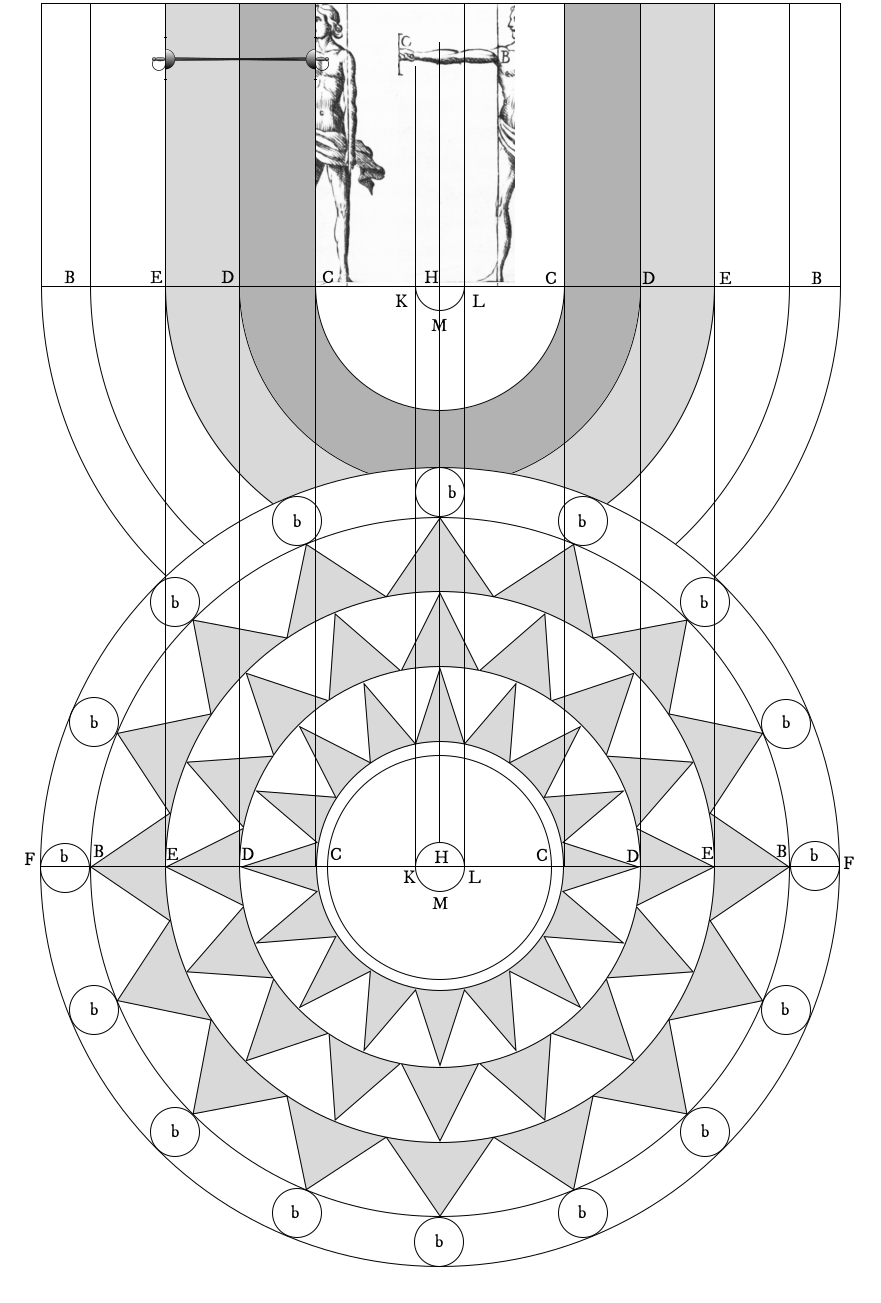
Let's imagine that the fencer is firmly positioned on the right angle at K.L., and at a right angle with his arm and sword P.G.K. Let's assume his line of direction is A.H. and that the six geometric feet, which is the combined length of his arm and sword G.P., is divided into three parts at the points N.O.P. The first section G.N. from the center of his arm to the center of the hilt of the sword is a length of two feet and a quarter. The second N.O. is one and three-quarters feet, which is from the center of the hilt to the midpoint of the sword, considering from the pommel to the tip. The third section O.P. is two feet, which is half of the sword's length to the very tip.
From each of these points G.N.O.P., we imagine perpendicular lines dropping to the lower plane K.C.D.E. On the line H.E., the common intersection of the primary vertical plane A.B. and the lower plane B.H., being all parallel to each other and to the line of direction A.H., four parallelograms are formed: the first A.K., the second A.C., the third A.D., and the fourth A.E., all four being encompassed by the parallelogram A.E.
The first is G.K.M.L., whose base is K.M.L., formed from the parallelogram A.K., which encompasses the swordsman. The second is N.CC.Q., with its base as CC.Q., formed from the parallelogram A.C. The third is O.DDD., with its base as DDD., formed from the parallelogram A.D. The fourth is P.EEEE., with its base as EEEE., formed from the parallelogram A.E.
Just as these four parallelograms are contiguous and contained within the parallelogram A.E., the four cylinders they create are also contiguous and encompassed by the largest one, P.EEEE. All of these cylinders have two surfaces, one interior and another exterior, except for the swordsman's cylinder G.K.M.L., which only has an exterior surface.
Since in this construction we couldn't depict the bases of these cylinders in their entirety, due to the elevation, we deemed it clearer to show them fully in the figure that is placed on the plane beneath this one, with the perpendiculars extended to intersect with their diameter F.F. From the divisions they cause on it, the necessary understanding for their comprehension and explanation arises.
To these bases and circles, another circle of four, BBBB., follows. It's located eight and a half feet from the center of the figure and is concentric with the aforementioned circles. Its diameter is 17 feet, and the space between this circle and the adjacent one, EEEE., is two feet. Following this last circle is another, FFFF., concentric to the others, with a radius of nine and a half feet and a diameter of 19 feet. The distance from this circle to the adjacent one, BBBB., is one foot. In this space, at intervals, there are smaller circles marked with the letter b.
Regarding the people, not only is attention given to those who will defend the Plaza, but also to those with whom it can be attacked. It is commonly believed that one fortified individual is worth six of the besiegers. There are authors who claim that one of the fortified is worth ten of the besiegers. Based on this consideration, the capacity of the Plaza is determined, not only in terms of housing but also to ensure there is sufficient space for the handling of weapons, both near its circumference on the inside and in the center of the Plaza. The designated space is often called the "Plaza de Armas" or "Weapons Square."
The weapons used to defend the Plazas are either purely defensive, like walls and bastions, or offensive. The latter is subdivided into smaller arms, like arquebuses, muskets, etc., and larger ones, which are different types of artillery: cannons, half-cannons, culverins, half-culverins, sacres, etc.
With the primary weapons, the walls, the inner polygon is defended. The so-called outer polygon is defended with the second set of weapons, whose jurisdiction extends to the range of the musket. With the third set of weapons, the territory within their range is defended, and these compel the besiegers to set up their circumvallation line far enough from the Plaza so as not to be harmed.
The shape of the Plazas can be circular, as they were traditionally made, or polygonal, as experience has shown is necessary for them to be defended from the weapons now in use. These can be triangular, quadrilateral, pentagonal, etc. These variations are seen in fortified cities, citadels, or castles, and field forts, shaped like stars, pincers, and redoubts, half-moons, etc. Others are used by the besiegers to fortify their quarters and circumvallation lines.
Firstly, the location is considered, and the fencer cannot choose it, as he must fight wherever his opponent confronts him. However, to elucidate our idea, it has been convenient to select a flat terrain, as depicted in the previously explained figure. This serves to better clarify our point, much in the same way that, to teach irregular fortification, one must first understand regular fortification, the principles of which one should strive to maintain as much as possible, even when presented with irregular situations.
Although it's observed in fortified places, as mentioned, that one fortified individual might stand against six besiegers, this shouldn't be applied to our fencer. It's not that he can overpower six opponents. What he can do, however, is with a slight movement, whether whole or partial, counteract the complete or partial moves of his opponent, granting him a significant advantage, perhaps even greater than a ratio of one to six, as demonstrated in some of the scenarios we addressed.
La Plaza de Armas de eſte Fuerte ſe proporciona por la cantidad de la longitud del brazo, deſde el axis de ſu cilindro, y parte dèl, correſpondiente al centro del brazo, haſta el centro de los gavilanes, como ſe vè en el eſpacio que comprehende el circulo dos CCCC. en el qual no ſolo ſe puede mover el Dieſtro ſobre ſu centro; pero tambien dar ſus compaſes con mucha facilidad à todas partes, para las operaciones à que le obligare el contrario.
The weapons used to defend this Fortress are the sword and its guard. Within them, two types of defenses are identified: one is solely defensive, consisting of the guard and the strong part of the sword up to its midpoint. With this stronger part, the defense of the space from C to D in circumference is formed. We aptly compare this to the inner polygon of fortresses, as both focus primarily on defense. The other half of the sword, from the midpoint to the tip, defends the outer space in circumference from D to E, enclosed between the two circles DDDD and EEEE. We aptly liken this to the outer polygon of fortresses. Just as this outer space or polygon in fortresses is defended by smaller weapons like arquebuses and muskets, our Fortress is defended with the cut and thrust of the sword. And just as besiegers can't approach fortresses without danger due to the range of these weapons, so an opponent can't break the range the fencer maintains with his arm and sword without danger.
The space from circle E. to B. is what we compare to the area defended by the Artillery with its range from the Fortresses, because within this jurisdiction and space, the fencer can reach and wound his opponent easily using a compass, without leaving the Fortress or changing its position. And for this reason, just as the Artillery forces the besiegers, to avoid danger, to establish their encircling line at a distance, and with such proportion, that it's not just the Artillery that can harm them for having come too close, but also considering that if they are too distant, they will waste more time than necessary approaching the Fortresses through their trenches: with these same considerations, we have determined in our Fort this distance, so that the one intending to attack it neither risks too much by being too close, nor wastes excessive time if too distant, waiting for opportunities presented by the carelessness of the Diestro not maintaining his Fort with defense. And for these mutual conveniences, and the possibility of going on the offensive without changing the position of his Fort, we say that this distance between the two opponents is (and we appropriately call it) the true mean of proportion, as it is where both have security and an equal disposition to approach each other, given the length of their swords, and the ease with which each can take their steps.
The outermost circle FFFF is imagined to be outlined by the left foot of the opponent, and with the center of his right foot, he describes the inner circle BBBB. He stands perfectly on a right angle at F.B. in this middle proportion relative to the fencer (Dieſtro), each establishing their fortress without any difference.
The substance of our Fortress is partly physical and partly mathematical: the physical part is the sword and its guard, and the imaginary part is everything considered in the figure presented in perspective and in plan. Yet, for the fencer, it functions as if the whole fortress were actually made of steel and iron, just as the guard and sword are, given the possibility he has to position it anywhere for his defense. To clarify this, it's noted that in fortresses there are essential and incidental parts, and these same elements are found in our Fortress.
The essentials of fortresses are walls, embankments, bastions, moats, etc., and these are constructed before any enemy lays siege. The incidental elements include tenailles, half-moons, traverses, redoubts, counter-batteries, counter-mines, counter-approaches, etc., and these are often constructed when an enemy sets up camp, opposing their plans.
The essential part of our Fortress is the sword with its guard, which are ready before the occasion to fight arises. The incidental part involves the fencer positioning it in areas as needed to counteract his opponent's intentions. From this capability emerges the idea of our Fortress as if it were entirely made of steel and iron. And because we've demonstrated some of this in explained cases, it follows that with these essential and incidental parts, this concept has enough substance that we can appropriately say it bears a great resemblance to real fortresses and strongholds.
Regarding the shape of our Fortress, it is exceedingly perfect, as can be seen in the perspective figure, and even clearer in the one laid out flatly. This design encompasses the ancient style of fortifications that were circular, as well as the modern method of fortification, which uses angles similar to bastions, both in the inner polygon and the outer. Immediately next to them is the appropriate space with its surrounding area, suitable for the weapons of both combatants.
However, since we have already explained these spaces and the Parade Ground at the beginning of the previous chapter, and the entire figure, both in perspective and flatly, and successively what each part is and serves for, and the concept of this Fortress, we now only have left to explain the angles of the inner and outer polygons that we imagine in the figure and how vital it is to understand their purpose, which we explain in the following manner:
Firstly, when the fencer stands balanced with his opponent in the middle of proportion, as depicted in the figure, he can, through a Atajo either from the inside or the outside, and also from both sides at a sharp angle with greater strength, manage to place his opponent's sword on the sides of his angles using any of these four universal methods to interact with the opponent's sword.
And the last method is when the Diestro takes a step to one side or the other, blocking the path corresponding to his opponent's sword to launch an attack. This action causes the opponent's sword to end up on one of the sides of these angles. Most of the time, the Diestro is in a position to strike, or at the very least, forces the opponent to make movements out of necessity. Taking advantage of these, he can immediately attack.
The first method assumes that the Diestro waits for his opponent to attack him, ready to execute any of the five types of wounds that are possible. If the attacks were thrusts and were aimed above the guard, with a slight upward movement, he will ensure they don't target his torso, face, or head. If the opponent's thrust is aimed at any side of the guard, with just a minor movement of it, he can place his opponent's sword on any side of these angles, achieving the same defensive effect. If the thrust is aimed at the lower part, under the jurisdiction of the acute angle, the opponent's sword, if intending to strike, will have to pass through the weaker part of the Diestro's sword, be it from the inside or the outside. Also, with minimal movements, he can defend and position the opponent's sword on any side of the angles of this polygon. If the opponent forms circular or semi-circular feints from the upper plane, aiming to strike the Diestro, he can also, with very short movements of his guard, defend against them, regardless of their type. If the opponent attempts these types of attacks in the lower plane, under the jurisdiction of the acute angle, the Diestro can also defend against them with greater strength in his sword and very short movements.
The space between the outer Polygon (end of the Orb of the Diestro's Sword) and the mean of proportion B, although primarily designed for the opponent to move in order to approach the proportional means of the tricks, doing so transversally, resembles the trenches made by the besiegers of the Fortresses obliquely, so that the bullets from the Artillery cannot directly target them. The opponent, to avoid the risk of equality and the danger of attacking along the Diameter line, moves on the sides of the Angles, which we also imagine in this space. The sides of these Angles can also be used and are advantageous, just like those of the previous Polygons, because many times it happens that the opponent, with the sword in hand, voluntarily places his arm on its sides on both parts, especially for a trick, whose name is to Call. It also happens that he places his arm on its sides due to the attacks of the Diestro. At other times, the same occurs when the Diestro uses one of the four universal methods from the mean of proportion to position the opponent's sword on one of the sides of the outer Polygon's Angles, and the opponent voluntarily, at the same time, places his arm on one of the sides of the Angles that are in this third space, making it easier for the Diestro than he might have otherwise managed. Thus, it's not a stretch to say that the Angles in this space form a third Polygon, because from what we've mentioned about them, it's evident that the same effects can be achieved as if they truly were one.
Note that this idea of our stronghold, which we've conceived for the Fencer, is also imagined for his opponent without any differences. This implies that if both are right-handed and each knows how to defend in their stronghold, one cannot offend the other. Because no matter how they move, whether around the center of their particular circle or from place to place, they will bring these positions with them, and only through negligence can an offense occur.
Someone might argue that this treatise is not essential for Fencing, thinking all this elaborate construction of our Fort to be superfluous. But to clarify for those who question, we reply that it is the fundamental basis of all Fencing, upon which its mighty mechanism relies, as will be demonstrated later. We position it here after having explained in the preceding chapters what is necessary for understanding and practicing the Art, its Method, Definitions, specific terms of this science, the Requests, Maxims, and general Precepts to be observed, and the Geometric Definitions that the enthusiast should bear in mind, along with their adaptation to Fencing, and the practice and use of the Compass. Without this knowledge, one would proceed blindly, and many terms, such as Cylinder (in which we envision the fencer), how to contemplate it, how many and what kinds can be formed by his arm and sword with its rotation, according to the divisions in which we partition its quantity, etc., would remain unclear.
So that the curious might better visualize what we want them to conceptualize, we've prioritized their benefit over our efforts, offering them this Fort with its adaptation to our science, and providing them with a thorough understanding of the potential it offers for both defense and offense. This is for those who are protected by its bulwarks, angles, and lines of fortification, both internal and external, to achieve the desired goal, which is where the aspirations of our well-founded doctrine lie.
Just as in Mathematics, its practitioners are allowed to conceive of Spheres, Circles, and other lines to regulate movements, whether of the stars in the sky or ships in the water, I believe I too have been permitted to shape ideas to adjust the movements of the arm and sword in the air, aligning them simultaneously with the feet on the ground. If the former serves for contemplation and utility, the latter serves, no less profitably and notably, for the preservation of the minor rational world, or Microcosm, as the Greeks called it, which is the well-organized fabric of the human body. And if those are suited to their purpose, such as imagining routes or paths for navigation, so too are the ideas we conceive for weaponry, as there's nothing more appropriate for man's defense and offense than considering the siege and conquest of a fortress. Here, it should be noted that just as Astronomy contemplates those different spheres in which the bodies of planets move, seeing them as complete without anything material in them other than the bodies of the planets forming them through their movement, so too should Fencing consider its fort completely, even though there's nothing material in it other than the Sword, which describes and shapes it through its movements. Moreover, in this, we have conformed to the rules most accurately observed by the Military in its wise operations.