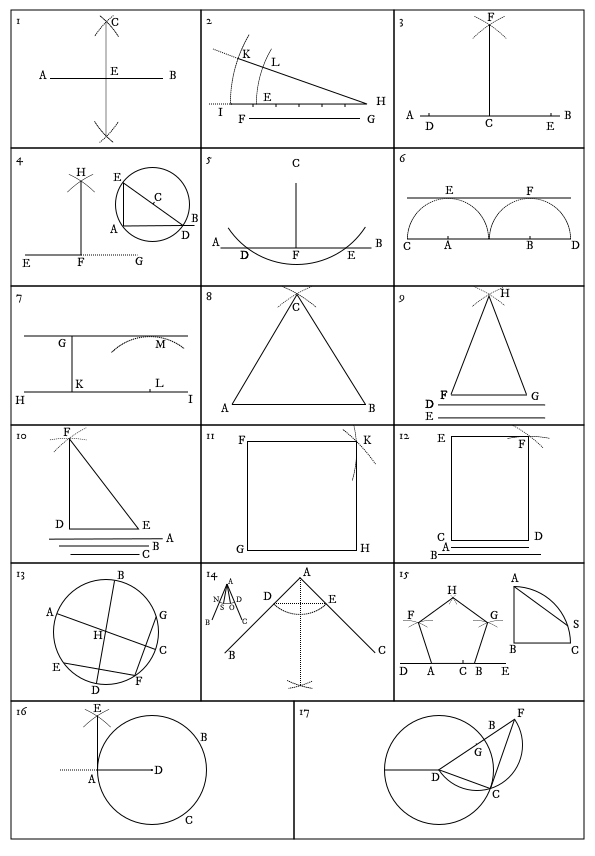
Having understood the definitions, or geometric principles that have been referred to, we will now discuss the use of the compass, or the practice of some problems necessary for our intent: so that the expert does not lack knowledge of the appropriate rules in the construction of the figures of the true Skill; as it is so precise, both for its own use and just in case, as it usually happens, he gives a lesson to a King, Prince, or Lord; and this one, being fond of Mathematical disciplines, asks him, before or after handling, or exercising, geometric reason for what he has been taught, or will be taught: and so that the Master can satisfy his desire, giving him full satisfaction, demonstrating the Propositions of true Skill, without the Compass, and the Rule being an obstacle, it is convenient to keep in mind the following rules.
Let the given line be A.B. figure 1. Center the points A. and B. and with any interval, as long as it's greater than half of the line, describe four portions of Circles, and let two of them intersect at point C. and the other two at point D. and from point C. to point D. draw a line, let it be D.C. which will divide the line A.B. into two equal parts, at point E. as demonstrated in the Proposition 10 of book 1. of Geometry by Euclid.
In the Art of Fencing, this construction is used when it is necessary to divide the common Diameter Line in half; and if it is needed to execute it on the ground, the fencer will do it by taking a string, and having one of its ends fixed at the ends of the line: with the other end, and a pencil he will describe the crossings, as was done with the Compass; and having made the intersections on both sides, he will draw a line, which will divide the common Diameter in half.
If he doesn't find a string at hand, he should position himself at an angle, and above a right angle, in the mean proportion, and placing the other Sword by the shoe as a plumb line, letting the pommel reach the ground, and making a revolution on the heel of the right foot, until he returns to the place where he started, the pommel will have passed dividing the circle into two equal parts: and drawing a straight line from one division to another, the Diameter will be divided in half; and if he does not want to make the revolution, he should move his arm and Sword, both to the right side and to the left; until the pommel of the hanging Sword is perpendicularly over the circumference, and he will find it has fallen on the fourth part of the Circle on both sides: and if he draws a line from one to another, it will divide the Diameter in half, creating four right angles at its center.
Shoe here refers to the leather cover added to the tip of the blunted sword for practice
Let the line F.G. figure 2. be given to divide into five equal parts: draw another undetermined straight line H.I. and with any opening from the end H. five equal distances will be taken on it, and where they end, which we will suppose is I. an arc will be made with the same opening of one of the five parts, towards K. this point of intersection will be made K. and through this intersection, and the point H. the line H.K. will be drawn undetermined: now take the opening of the given side G.H. and with it from H. the arc E.L. will be described. I say, that the chord E.L. will be the fifth part of the proposed line G.F. as is clear from the 2nd Proposition of book 6. of Euclid.
This proposition of dividing a line into as many parts as desired is found to be restricted in the practice of our Fencing, regarding having precise quantities, by which to govern all the demonstrations: which are regulated by the divisions that we have made of the body, arm, and instruments, in this way: The length of the man in six parts, or Geometric feet, from the sole of the foot to the zenith of his head; the arm in two feet, from its origin, to the wrist line; the Sword in four feet, from the pommel to the tip; the whole Cross in one Geometric foot, from the end of one quillon to another; the hilt, or guard of a quarter of a foot, or four fingers of Semidiameter, whose measures, and instruments serve as a base, or flat scale, to construct, or fabricate on the lower plane, or ground all the figures of Fencing, without needing any other divisions: so the fencer will use these instruments, and a string for whatever he needs to construct on the flat surface, or ground.
Let the line A.B. be figure 3, and the point be C. Then from the side C.A. take the line C.D. and equal to it the line C.E. Let the point E.D. be the centers, and with any interval, as long as it is greater than half of the line D.E., describe two portions of circles, that intersect, and let it be at point E. From which, and point C. draw the line C.E. which is perpendicular to the line A.B. as demonstrated in Proposition 11, book 1, of the Geometry of Euclid.
This construction is applied in Fencing when on any point of the eight in which the line of the Diameter of the common circle is divided, or in any intermediate of its divisions, it is desired to raise a perpendicular, to ascertain the quantity of some of the means, or distances, or even if it is desired to raise them on the tangents that pass through the heels of the right feet, the perpendiculars of the Isosceles triangles, which are in the proportionate means, both by the posture of the Sword, as well as by the profile of the body, this operation can be done on the ground, drawing with a string its crossers, in the same conformity as it has been done on paper with the compass, and the rule.
Let it be at the end F. of the straight E.F. figure 4, where the perpendicular is desired to be raised. For this purpose, it will be discretionarily extended towards G. and making with any opening from point F. the equal distances F.G.F.E. and with any larger opening from points G.e. the intersection H. will be made. Draw the H.F. which will be perpendicular to E.F.
Let the line A.B. and the proposed point on it be A. Take any point outside the line, with the condition that, when extended, it does not coincide with it; and let it be, for example, the point C. Center the same point C. and with the interval C.A., which is the distance from the point taken outside to the end of the line where the perpendicular is to be raised, describe the circle arc E.A. D. which cuts the line A.B. and if it does not cut it, extend it until it cuts: and in this example, let it be at point D. From which, through point C. draw a line, which cuts the portion of the circle at point E. From which to the proposed point A. draw a line, which is perpendicular to the line A.B. because the angle E.A.D. is right, as demonstrated in Proposition 31, book 3, of Euclid.
This construction serves in Fencing for when at the ends of the line of the common Diameter it is necessary to raise perpendicular lines, which extended on one side and the other serve as infinites, passing through the heels of the right feet of both combatants, to give through them the trepidant compasses.
Let the proposed line be A.B. figure 5, and the point outside of it be C. From which, with any interval, describe a portion of a circle that cuts the proposed line in two parts, or points, and let them be D. and E. Divide the line D.E. into two equal parts, at the point F. Draw the line F.C., which is perpendicular to the line A.B. as demonstrated in Prop. 12 of book 1 of Euclid.
This construction is applied in Fencing for when, from any of the proportional means, touching the wounds of first intention, it is desired to determine the amount by which each one deviates from the line of the common Diameter. This operation will be done on the ground, by fixing the end of a cord at the center of the heel of the foot that took the step, which is the point that is found outside the line; from which, and with any interval, or amount of cord, a portion will be described; and by dividing the divided portion in half, a perpendicular will be drawn from the point of division to the given point outside, whose length indicates the amount by which that proportional mean is separated from the line of the common Diameter.
In Fencing, this construction is observed when, after drawing the infinite line that touches the heel of the right foot, to use it as a guide for the trembling steps that correspond to it; it becomes necessary to draw another line parallel to it, extending from one side to the other of the heel and tip of the left foot, so that this one can be used as a guide for the steps that belong to it.
If the line H.I. figure 7 is given, and it's requested to draw a parallel line to it passing through point G, a perpendicular G.K. will be drawn from this point (as previously taught). Using its interval, from any point on the line, let it be L, the arc M will be described, and the tangent M.G. will be drawn, which will be the parallel line that is being sought.
This construction follows the same course as the preceding one, considering that the given point outside the line is the heel of the left foot, and the perpendicular that drops represents the distance between the two heels. Using this interval and describing the portion of the circle, or arc, in the same way that was observed on paper, the tangent touching the left foot will be drawn, which will be parallel to the one touching the heel of the right foot.
Let's consider the line segment A.B. in figure 8. Using the distance between its endpoints, intersections will be made at point C. From there, lines C.A and C.B will be drawn, resulting in the formation of an equilateral triangle, which is also equiangular or has equal angles, as demonstrated in Proposition 1 of Euclid's Book 1.
In fencing, the construction of an equilateral triangle is not commonly practiced on the lower plane. While on the upper plane it is considered for certain attacks, and to allow the body, supported by its constituting lines, to pass beneath the angles created by the swords' contact at their near end and the concluding movement, it is never rigorously an equilateral triangle. However, stating that it is equilateral helps differentiate it from the isosceles and scalene triangles and also distinguishes the action of each.
In fencing, these isosceles triangles are described both by the posture of the sword and by the body's profile, as demonstrated in my universal explanation. The vertices of these triangles are the proportional middles used to transition from them to the proportional endpoints of all injuries. The smallest of its three sides has a length of six geometric feet, which are found in the tangent of the opposing right foot, from its right heel and the proportional middle, to the first orb of its sword. From these points, straight lines are drawn to the proportional middle of the right-hand posture of the sword, which is on the tangent of its right foot, three feet away from the proportional middle.
If the three lines A.B.C. figure 10 are given, and wanting to form a triangle with them, take one, let's say C, and set it as the base from D to E. With the length of B, from the endpoint D as the center, draw an arc towards F. And with the length A and center E, intersect at F. Afterwards, draw the lines F.D and E.F, and you'll have the desired triangle.
If the intention is to form a right triangle, given the two lines that form the right angle and terminated, let's say C and B, set one like C from D which will be the base, and raising a perpendicular at one of its ends D.F equal to B, draw the line F.E, called the diagonal, and the triangle will be formed.
But, if one of the lines forming the right angle is given, like C, and the diagonal A, all you have to do is set C as the base D.E, and raising an indeterminate perpendicular at D, take the length of the diagonal A and from the point E make the intersection F. From there, draw the line F.E and the triangle will be formed.
This construction (as also revealed in the universal demonstration) is found in the same preceding isosceles triangle; since dividing the smaller line in half, which is the tangent of the opponent's right foot, and from its division raising a perpendicular, which when extended divides the angle formed by the two larger lines at the proportional midpoint of the fencer, it will be seen that with this line or perpendicular, the isosceles triangle has been divided into two right-angled scalene triangles; all their lines are unequal. For example, the smallest, which is the base, is three feet long, from the heel of the opponent's right foot to his proportional profile midpoint. The other, which is the perpendicular, is eight feet, from the fencer's proportional midpoint to that of his opponent. And the largest line, opposite the right angle, serves as the hypotenuse; it starts from the proportional midpoint and the opponent's right foot and touches the fencer's proportional point, where it meets the perpendicular, as seen in the universal demonstration.
Given the line G.H. in figure 11 to form a square on it, raise the perpendicular G.I. from the endpoint G, which should be of the same length as G.H. Using this same length from the endpoints I.H., create the intersection at K. From this, draw the lines K.I and K.H. which form the desired square, as demonstrated in the Proposition 46, Book 1 of Euclid.
In fencing, the construction of the square is made in the same manner as was practiced in the first application, dividing both the common diameter and the circumference in half. From these points, drawing from the proportional midpoint and centers of the right feet of the combatants, the four straight lines, which we call transversals, until one meets the other in the fourth part of the circle, both due to the position of the sword and the profile of the body, we will find the desired square inscribed within the common circle.
Let the lines A.B. be given in figure 12. Take one of the two lines, let it be A, and place it from C to D. Raise a perpendicular from one of its endpoints, C.E., equal to B. Using this length, create an arc from point D toward F. Then, with the distance of C.D. and from endpoint E, intersect at F. Draw the lines F.D and F.E, which will complete the desired figure.
In fencing, this right-angle parallelogram is described using two terminated and unequal straight lines in the following manner. Let the first line be the common diameter, with a length of eight geometric feet. Let the second, unequal to the first, be the portion of the tangent, which goes from the proportional midpoint, and the center of the right foot, to the proportional position of the sword of the fencer, with a length of three geometric feet. Now, raising a line at this endpoint, or proportional midpoint, which is perpendicular and equal to the common diameter, it will meet at the proportional midpoint of the profile of the opponent with the portion of their tangent, completing the desired figure. And another right-angle parallelogram, equal to this one, is found in the profile of the fencer.
To determine the center of the circle A.B.C.D. in figure 13, choose three arbitrary points on its circumference, let's say E.F.G. Draw lines from one point to another, such as E.F and F.G. Divide these lines in half, as previously demonstrated, with lines D.B-C.A. extended until they meet at a single point, let's say H. This point H will be the sought-after center.
If, in the practical application of fencing, one wishes to find the center of the common circle, it is quickly and easily done, both because the sword acts as a semidiameter of it and because, assuming the two fencers are firmly positioned at the midpoint at a right angle, if from that plane, through the primary vertical, they naturally lower their arms and swords to the acute angle until the tips touch the lower plane or ground, it will be found that they precisely occupy the center of the common circle.
Let the straight angle be A.B.C. in figure 14. This angle is to be divided into two equal parts, which can be achieved by taking two points on sides A.B. and A.C. equally distant from point A, let's say they are D. and E. Using a compass with the distance between these two points, or another larger or smaller distance, describe two arc portions which intersect at point F. Draw a line from point F to point A, which divides angle A.D. into two equal parts, as demonstrated in Proposition 9, Book 1 of Euclid.
If there's a need to divide an angle into three equal parts or another proportion that isn't doubled, it can be done by dividing the arc of the circle enclosed between the two lines forming the angle as required. For example, if we need to divide angle A.B.C. into three equal parts, we'll take points on the lines A.B. and A.C. that are equidistant from point A, let's say N.D. Divide them mechanically (this is sufficient) into three equal parts at points S. and O. Drawing lines from these points to point A will divide the angle into three equal parts. The same can be done for any other non-doubled proportion.
In fencing, we see right and straight angles divided into two equal parts, both on the plane below and at the proportional midpoint. The right angles that meet at the centers of the right feet of each fencer, formed by the common diameter line and the internal tangent, are divided into two equal parts or angles of 45 degrees by the transversal lines that form the square inscribed within the common circle.
In fencing, we also use divisions of 3, 5, or more equal parts, or another proportion that isn't doubled, as seen in the same straight angles of 45 degrees. These are formed at the center of the right foot by the common diameter and transversal lines that divided the right angle into two half-right angles.
For the fencer to move from his midpoint to the proportional positions of the thrusts, for some, it is necessary to deviate from the common diameter by half a foot, for others one foot, and for others one and a half or two feet. In this respect, we divide the angle into the necessary parts, whether even or odd.
Given the proposed line A.B. in figure 15, divide it at the point C such that A.C is the larger segment and C.B is the smaller. Extend line A.B on both sides until lines B.E and A.D are equal to the larger part A.C. Using A. and D. as centers and with the distance of the proposed line A.B, describe two arcs that intersect at point F. Do the same from points B. and E. and they intersect at point G. With the same distance, describe two other arcs from points G. and F. and they will intersect at point H. Draw lines to these points, and you'll have constructed the equilateral and equiangular pentagon A.B.G.H.F, as demonstrated in Proposition 10 of Book 4 of Euclid.
Alternatively, one can describe a pentagon, or any regular polygon, inside a circle. Suppose we want to describe a pentagon. First, describe a quarter-circle, let's call it A.B.C. Divide this quarter-circle into five equal parts. Take four of these five parts, and draw a chord, or straight line, A.S. from their endpoints. This line will be the side of the equilateral and equiangular pentagon inscribed, or constructed within, a circle whose radius is A.B. The reason behind this method is as follows: By dividing a quarter of the circle into five equal parts to make the pentagon, the entire circumference will consist of twenty of these parts. The line A.S. is the chord of four of these parts. Therefore, the combined length of the four equal parts A.S. will have the same proportion to the entire circumference as one part has to the five parts into which the quadrant A.B.C. was divided. Thus, A.S. is the side of the pentagon. Using this method, one can inscribe any shape in a circle. For instance, if you wanted to inscribe a seven-sided figure, you'd divide the quadrant into seven equal parts and take the chord of four of these parts as one of the sides of the seven-sided figure. This reasoning applies to the pentagon and all other figures similarly.
The pentagon is seldom or never described in the lower plane. If ever used in fencing, it's when the body is evenly balanced on both feet, distanced proportionally from heel to heel. One side of the pentagon is determined by the distance from one heel to the other, and the body provides the other four sides—legs and thighs—when the body is evenly leaning on both legs, bending the knees until it's in a stance position, as described in the geometric definitions and the application of the pentagon in fencing.
This construction is also very straightforward in the practice of fencing. Given any point on the circumference, whether of the common circle, specific circle, or the maximum one, the lines (both the diameter and others that divide it) serve as a guide for drawing tangents. In fencing, the tangents always pass through the centers of the feet of both combatants when they are in the mean proportion, or in the proportional points if one steps into the sphere of the sword of their opponent.
Let's consider figure 17, where a point F is given outside the circle. Draw a line from F to the center of the circle, which we'll call F.D. Bisect this line at point G. Draw a semicircle D.C.F., which intersects the given circle at point C. Draw a line from this point to F, which will be the desired tangent, and it will be perpendicular to the radius D.C., even though it is not necessary to draw this radius.
This application is the same as the previous one, and even more straightforward. Any given point outside the circle to draw a tangent will end up pointing to the center of the foot that touches the circumference. Given the two corresponding and clear points, the one outside and the one on the circumference, in this operation, all you have to do is draw a tangent from one point to another. If the given point outside is in a place where a tangent cannot be drawn that touches the center of the foot on the circumference, it will not be necessary for the use and practice of fencing.
To truly understand and universally apply the art of fencing, it's essential to have knowledge and practice in the foundational principles of geometry, as already explained. Alongside this, one must also practice and be familiar with the exercise of weapons, as will be evident throughout this treatise. This stands in contrast to the opinion of many who are presumptuous in this art and claim that there's no need for geometry when engaging in combat. Such individuals disdain geometry simply because they lack understanding of it. It's evident that someone who possesses both theoretical and practical knowledge in a science will use it more effectively than someone who only has practical experience. The latter is not in control of what they practice; instead, the practice controls them. Since geometry provides the theoretical foundation for the art of fencing, someone who fully understands it will master the art. Conversely, without this understanding, the art will dominate the practitioner. For this reason, and to avoid an extensive focus on geometry, I have only provided the basic rudiments, as these are the aspects most commonly addressed in fencing. Subsequently, I've included the practice of certain geometric problems that are essential for our purpose. If enthusiasts wish to delve deeper into advanced geometric concepts, they should study it more extensively.
For a better understanding of everything discussed and the benefits that can be derived from it, I will present the proportions of both the body and the sword based on measurements by Albrecht Dürer. Then, I'll present the idea of our Stronghold and its structure. Once familiarized with its marvelous concept, we'll start discussing all the lines, surfaces, and shapes we need to consider, caused by the movement of the sword. Afterward, we'll explore the utility of all these concepts in the practice of fencing.