In the clarification of the proper and necessary terms for understanding the regimen of this Art and its teaching, we have defined that the science of the Sword, commonly referred to as the Skill of Arms, teaches how to deliver a blow and defend against one from the opponent, whether with the Sword alone or with the other Weapons that usually accompany it.
To grasp the understanding of this action in Weapons, we need to first know the agent or mover, which is the Swordsman or his opponent, and the moved thing, which is the Sword, and in how many ways he can move it, along with the other parts of the body, in order to form some treta. Then, immediately, we must see the harmony and discord that may exist between these movements, both of the body and its parts.
Aristotle in the third book of Physics, speaking of movement, says that it seems to belong to the category of the continuous; and the continuous properly pertains to continuous quantity, whose species are Lines, Surfaces, and Bodies. Thus, it seems that Aristotle with these words wanted to suggest that the speculation of movement pertains to Geometry, the key to the mathematical sciences, whose role is to discuss continuous quantity and speculate its properties. This is clearly implied, since movement and quantity are so intertwined that we find nothing that belongs to quantity that can be moved without its movement causing a physical or imaginary quantity; for if it is a point that moves, its movement will cause a straight, circular, or mixed line, depending on the nature of its movement.
The first three considerations, of the point, the line, and the surface, are very necessary in Fencing, as shown in its place; the last, which pertains to the body, is not used in this science because although the bodies of the two combatants must necessarily move to form their tactics, we do not consider the bodies that cause the movements, but that they move along certain straight or curved lines, according to the form of the movement. In this, they imitate the astronomers, who, although they consider those celestial bodies moving within their orbits, to regulate their movements they rely on lines, not on bodies. The same is done by those who deal with navigation; to regulate the movement of the ship on the surface of the waters, they rely solely on lines, which they call bearings (rumbos).
And given that all who have dealt with movements, both violent and natural, have done so under the speculation of continuous quantity, it will be good for us to imitate them in this. For if, through these imaginations, they have been able to regulate the movements of the stars in the heavens and the movement of ships in the water, it won't be much to hope that, using the same means, we can regulate the movement of the sword in the air and the movement of the body on the ground.
This being so clear that it does not admit controversy, we will put all our effort into finding the way to facilitate the Art of Fencing through Mathematics, showing the use of some lines, surfaces, and bodies, which will serve us as a guide and north star for its perfect understanding. But before we can do so, we define some definitions related to Geometry, even though in the proper terms we have already specified a great part of them; but without figures, because of the complications that ensued. And in these definitions we now declare, it's necessary to include them, so that later we can show the fencer their application in the Art of Fencing.
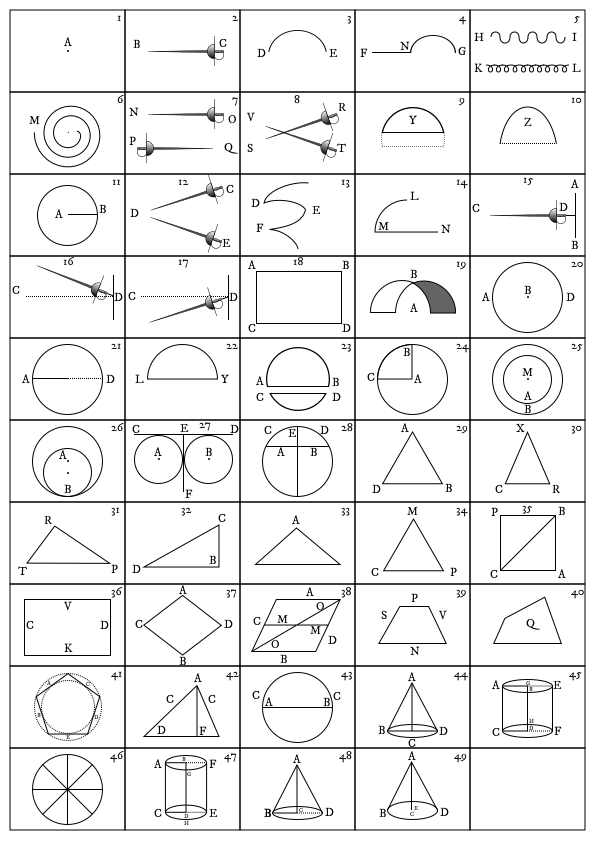
Among mathematicians, two types of Points are recognized: one is Mathematical or imaginary, an essence without quantity, abstracted from matter, and solely objectified by the understanding; the other is Physical, Real, or material, which, however small, can always be divided into divisible parts. This is marked with the letter A in figure number 1.
In the Art of Fencing, we also consider two types of Points: Physical ones, which are considered at the tips of Swords; and imaginary or Mathematical ones, considered at the intersection of certain imaginary lines, both on the ground plane (understood as the Floor) and on the bodies of the two combatants, or in the Air, with the lines we consider passing through the arms and Swords of the two combatants.
2. A Line (according to Euclid) is a length without breadth. Just as the Point is considered in two ways, one Physical and the other Mathematical, the Line will also be either Physical or Mathematical. For if the Line, according to Plato, is the flow or movement of the Point, if the Point is Physical, the resulting Line will be Physical; and if the Point is Mathematical, abstract from matter, the Line will also be Mathematical.
Definition of the Line.
A straight Line is the shortest extension from one Point to another, the smallest of all lines that have the same endpoints, or that which lies evenly between its Points. For example, the Line B.C., which resulted from the straight movement from Point B to Point C. The limits or ends of the Line are Points, like B and C, and are seen in figure number 2.
Of the Straight Line.
In the Art of Fencing, we consider the Sword, Dagger, and Montante, or their edges, as a Physical line. Whenever the tip of the Sword moves to a place where it can leave a mark or trace of its movement, such as on the ground, or against a wall, or on the body of its opponent, the line it causes with its movement will be Physical. And whenever it moves in the Air, even though strictly speaking it seems to be Physical, we will call it imaginary because it falls not under the sense of sight but under imagination; and such a line will be straight, circular, or mixed, according to the nature of the movement.
In the Art of Fencing, we consider it when the arm bends without making an Angle at the cut, and when the body is positioned in an arch-like manner, leaning forward or to the sides, making the Arch in depth; it is also considered on the ground plane, and particularly in the compasses, which derive their name from it.
In the Art of Fencing, H.I. is considered when the tip of the Sword, with an accidental or strange movement mixed with slackening movements, describes portions of curved lines underneath the other Sword, to one side and the other; and K.L. is considered when also with an accidental or strange movement mixed with others, it forms curved lines without interruption in its course, or even when using the Sword to encompass the opponent's Sword to restrict its freedom.
En la Deſtreza ſe conſidera en muchas partes, y propoſiciones, como quando ſe forman las dos generales, flaqueza encima, y debaxo de la fuerza; y quando la Eſpada del Dieſtro figue à la de ſu contrario por la parte de adentro vnitivamente, haſta haer movimiento de concluſion, quedando hiriendo, formando el Angulo mixto: y tambien quando eſtando pueſto el atajo por de fuera en el extremo propinquo en la Eſpada del contrario, ſi eſte levantare el brazo, y guarnicion, incluirà, y rodearà el Dieſtro las Eſpadas por aquella parte, haſta dexar la contraria debaxo de ſu brazo derecho, y la fuya hiriendo por encima de la juriſdiccion del brazo, haziendo al miſmo tiempo movimiento de concluſion; y aſsi eſta linea eſpiral ſe puede formar tomando la Eſpada por la parte de adentro, y la de afuera.
In fencing, they are formed when choosing the middle proportion, according to the Art, to immediately set a block on the inside; they are also considered in many other propositions and cases, both on the lower plane and on the upper one. In the bodies of the combatants, the Vertical, Collateral, and Diametrical lines are parallel.
11. A circular line is one that results from the movement of a point when it always moves at an equal distance from another point that is immobile: for example, if point A is fixed and point B moves always at an equal distance from point A, the line that results from its movement will be called circular, number 11.
Of the circular line
In fencing, we use the most generalized kind of Angle, as will be explained in each species: and we consider the rectilinear one anywhere the two Swords intersect or touch the Horizon plane; and also in the lower one it is caused, both in the lines we consider in it that serve us as directions, and when the transversal steps are given, mixed with trepidation, and strange; and in the imagined lines from one shoulder to the other of the fighters. A planar rectilinear angle is also formed for some propositions.
16. A right angle occurs when a straight line, falling upon another straight line, makes the angles on either side equal to each other: each of the angles is called right, and the line is said to be perpendicular to the other: for example, the line C.D. is said to be perpendicular to the base A.B. and makes the right angles, number 15.
Right
In fencing, it is considered when the right arm is not affirmed, as it arises in the body, without participating in any of the extremes from top to bottom, to one side or the other, the body being the line A.B. and the arm, and sword C.D. and these right angles are also considered and formed, both in the lower plane and in the touching of the swords.
19. Surface is that which has only length and breadth, and in the same way that we consider the line caused by the movement of the point; we also consider the Surface caused by the movement of the line: and as the line is divided into three differences, straight, circular, and mixed, according to the nature of the movement of the point; the Surface will also be divided into three, according to the difference in the movement of the line, which is called flat, spherical, or mixed, and the ends of the Surface are lines.
Definition of the Surface
20. A flat surface is one that is equally between its lines and is caused by the lateral movement of the straight line when it moves equally: for example, let’s suppose that the line A.B. moved entirely from where it is, to D.C. equally, and directly by the shortest path, it will have caused a flat surface, bounded by four straight lines A.B.-A.C.-C.D. and D.B. and we call this type of Surfaces flat, for brevity.
Of the Flat Surface
In Fencing, this Surface is demonstrated in the lower plane, and also in the upper one, imagining a contact line from one combatant's shoulders to another's, for when they face each other, the bodies are squared, and the Swords in parallel lines, pointing the tips to the left shoulders, and considering in them a point of contact, will have formed a flat Surface.
21. A circle is a figure contained by a single line, which is called circumference, indicated by the letters A.D. to which, from a point within it, all the lines that go to the circumference, being straight, are equal to each other; and this point is called the center, as indicated by the letter B. in number 20.
Definition of the Circle
In Fencing, it is useful when, by taking the opponent's Sword from the inside, one strikes with a thrust in the right vertical: and when taking it from the outside, one strikes above the Sword in the Diametral of the chest: this quarter of a circle is also considered in the formation of other strikes and in the lower plane, as the common circle is divided into four, as is the one considered in the man's chest.
In Fencing, these circles are evident, as the maximums include those that are caused by the revolution, which is caused by the divisions of the arms, and Swords, and all are concentric; which serve as a guide or compass, both to regulate the measures of the means of proportion, as proportioned, giving them a fixed quantity to the compasses, as will be explained in its place.
In Fencing, they are considered when the Swords, and bodies are unequal, as the circle described by the larger one, and with the larger one, will include the one described by the smaller one: and it is also considered in the lower plane, as the circle, to whom we give the name of Maximum, will include the common one, which is imagined between the right feet of the combatants, and they have different centers.
En la Deſtreza ſe manifieſtan eſtos circulos en los Orbes, que de las diviſiones de los brazos, y Eſpadas de los combatientes, conſideramos en el plano inferior; pues el Orbe, ò ciruclo que deſcribe el Dieſtro con ſu punta de Eſpada, es contingente al que deſcribe el brazo del contrario; y à eſte reſpecto en las demàs diviſiones de la Eſpada, como ſe verà en ſu proprio lugar.
27. A Triangle is a closed surface with three lines and three angles, it takes its name according to the lines and angles; thus, when it consists of straight lines, it is called a Rectilinear Triangle, if of curved lines, Curvilinear, and if of two straight and one curved line, Mixed, as was said of the angles.
Definition of Triangle
In Fencing, we use it for many things, both for self-defense and for offending the opponent; particularly for the perfect attack on the inside, considering one of its sides as the arm, another one as the line of contingency of the chest, and the other imagined from the hilt of the Sword, to converge on the left shoulder.
In Fencing, it is important in many cases, applying it more or less, as in the previous figure: and in the lower Plane, its consideration is crucial for the true understanding of the steps, for if one is to strike, one must walk by one of its sides, or Perpendicular, that is considered in it, as will be seen in our universal demonstration of the Circle.
In Fencing, we use it, both in the lower Plane and in the upper one, for when we make the rigorous assault from inside, through a block, we consider the longest line to be the one we imagine coming from the tip of the right foot, converging with the opponent's tangent; and the shorter one, the one that comes from the right heel, converging on the shortest path with the same tangent, and this tangent is the third side.
30. A Right Triangle is the one that has a right angle, as manifested in number 32. with the letter B. and the line that is opposite C.D. where its extremes converge, causing acute angles: is called Hypotenuse, being opposed to the right angle B. for whose discovery Pythagoras offered the sacrifice of a hundred cows to the Goddess Minerva.
Right Triangle
En la Deſtreza ſe forma eſte Triuangulo en muchos propoſiciones de la Eſpada, y Daga, quando ſe combate deſde el extremo propinquo, y con la Eſpada ſola ſe vè quando el contrario encoge, y baxa el brazo al Angulo agudo, y la punta de la Eſpada ſube al obtuſo, y el Dieſtro aplicando ſu eſpada con la graduiacion neceſſaria, ſea por de dentro, ò por de fuera, encamina herida de eſtocada, ſirviendo ſu eſpada de linea Ipotenuſa.
35. A Rhombus is an equilateral figure but not a right-angled one, composed of four equal sides, like the square: they differ in that their angles are unequal, and if two Diagonal lines are drawn from one angle to another, they will not be equal, and its sides are equidistant and of opposite contradiction, because the angles A.B. are obtuse, and C.D. are acute, as verified in number 37.
Definition of Rhombus
36. A Rhomboid is a figure that has its sides, and angles, equal to the opposite ones, but it is neither equilateral nor rectangular; it is similar to the Rhombus, except that the opposite sides are longer, like A.B. is longer than C.D. and to the line designated by the O.O. dividing it from one angle to another, we call it Diagonal; and to the line that divides it into two Rhomboids, as indicated by the letters M. and M. we call it Diametrical, number 38.
Of the Rhomboid
37. The remaining four-sided figures, which are not the aforementioned, are called Trapeziums; of this species, some are more irregular than others, the most regular one has two equal sides, like S.V. and the other two opposite sides parallel, like P. and N. in the figure of number 39.
Definition of Trapezium
And in Fencing, it is useful in the doctrine of Beautiful Spanish; for when we affirm ourselves in it, the body slightly collapses, bending the knee in such a way that the thigh forms one side, and the leg forms another; the third side will be the distance that should exist from the left foot, which sustains the body, to the right one; and the fourth side will be the right leg and thigh, which will be without forming an Angle: this figure is also considered in other cases, which will be referred to when we discuss this doctrine in the third Book, which deals with all the strategies.
For the regular Pentagon, when affirming ourselves with the body in the French posture, equally on both feet, one heel will be distant from the other the same amount as the length of the thigh or leg; because from the birth that the thigh makes in the fork to the knee or bend, we consider one side; it is indicated by the letter A. the second side, equal to this, we consider from the knee, down to the ground; it is indicated by the B. the third is the other thigh, indicated by C. and the fourth the other leg D. the fifth, and last side, is the imagined one from one heel to the other; it is indicated by the E. figure, number 41. And for the irregular Pentagon, when the interval from one heel to another, is of greater, or lesser length, than the sizes referred to.
40. When dealing with any angle in a triangle, the lines that comprehend it are called sides, as demonstrated by the two C’s. And the line that is opposite to the angle A. is called the base, like the letter D.F. And the line that is drawn from the angle A. perpendicular to the base, is called the Perpendicular; and the parts of the base are segments, the greater D. and the lesser F. num. 42.
Of the Sides in the Triangle
Following the understanding of straight, circular, and mixed lines, and of right, obtuse, and acute angles, and of the flat Surface, which we have divided into different figures, both of three, four, five, six, and more sides; we now move on to the understanding of the curved Surface, which is divided into spherical, and mixed.
A sphere is a solid figure, contained by a single surface, to which, from a point that is inside, all lines drawn to the circumference are equal to each other; and the description, or formation of the sphere, is made with the revolution of a semicircle, over its fixed diameter, until it returns to the place where it began.
He does not specifically declare that the surface is caused by the movement of the circular line; but as said it is inferred, because the line with its movement causes surface; and he says, that the sphere, as a body, is contained by a surface, which cannot be other than the one described by the line of the semicircle C. and C. that moves over its diameter A.B. num. 43.
The Cone is a solid figure, formed by the revolution of one side of a triangle, around another that remains still, like the triangle A.B.C. where the side A.B. moves around A.C. and causes the conical surface, and the whole triangle, being a surface, causes the body contained in the conical surface, figure number 44.
The same is seen in the following figure, which is called Cylindrical, which is caused by the revolution of the side A.C. in the parallelogram A.B.C.D. around B.D. this side causing the Cylindrical surface, in which the body of the Cylinder is contained; where it is seen, that this surface is called Mixed, as it is composed of two movements, or two different types of lines, one is circular, and the other straight, being formed by the revolution that the straight line makes around the other side.
In the same way that the line is divided into straight, circular, and mixed, and the surface into flat, spherical, and mixed; also, the bodies are divided into three differences: namely, those that are comprised of flat surfaces, such as the five bodies called Regular, and other infinite ones found in nature, those that are understood under mixed surfaces, of which there are many; but among all, in Fencing, we need to consider three of them, which are the Sphere, the Cylinder, and the round Pyramid, which although demonstrated, we will declare again, in this manner.
45. A cylinder is a solid figure, formed by the revolution of a parallelogram around one of its sides, which remains still, until it returns to the place where it started: its axis, or axle, will be the side that was immobile, or the base of the parallelograms, as in this figure number 47.
Definition of the Cylinder
46. The cone is a solid figure, contained by two surfaces, one flat and the other mixed; it is formed by the revolution of triangle A.B.C. around or along the side A.C., which remains immobile, until it returns to the same place where it began. The side that remains immobile is called the axis, and the base is the circle that describes the base of the triangle, number 48.
Definition of the Cylinder
Apollonius of Perga provides another description of this Pyramid, saying: If from a point a straight line is drawn to the circumference of a circle, which is not in the same plane as the point, and the point remains fixed, the line moves along the circumference of the circle, until it returns to the same place where it started, or began to move: the surface described by the straight line is called a conical surface; the vertex, the point that does not move; the axis, the line drawn from the vertex to the center of the circle; and the Cone, what we call Pyramid, is what is contained by the conical surface, and the circle, and the circle serves as its base.
Another Description of the same Pyramid
For example, let point A. be in a different plane than circle B.C.D., draw a straight line from A. to B., a point on the circumference of the circle, and with point A. fixed, move the line A.B., or the extremity B., along the circumference of the circle B.C.D, it will describe a conical surface, its vertex will be A., its axis A.E., its base the circle B.C.D., and everything contained between the circle and the surface will be the Cone, or conical Pyramid, as shown in figure number 49.
These three bodies are of great consideration in Fencing, as will be mentioned in their place: the first, which is spherical, is not only used to consider the movements made within the jurisdiction of a sphere, which is formed, or considered formed with the movement of the Sword; but it also serves to consider some horizontal, vertical, and oblique planes, along which the Sword must move, for the formation of strategies that resemble the circles considered in the celestial sphere.