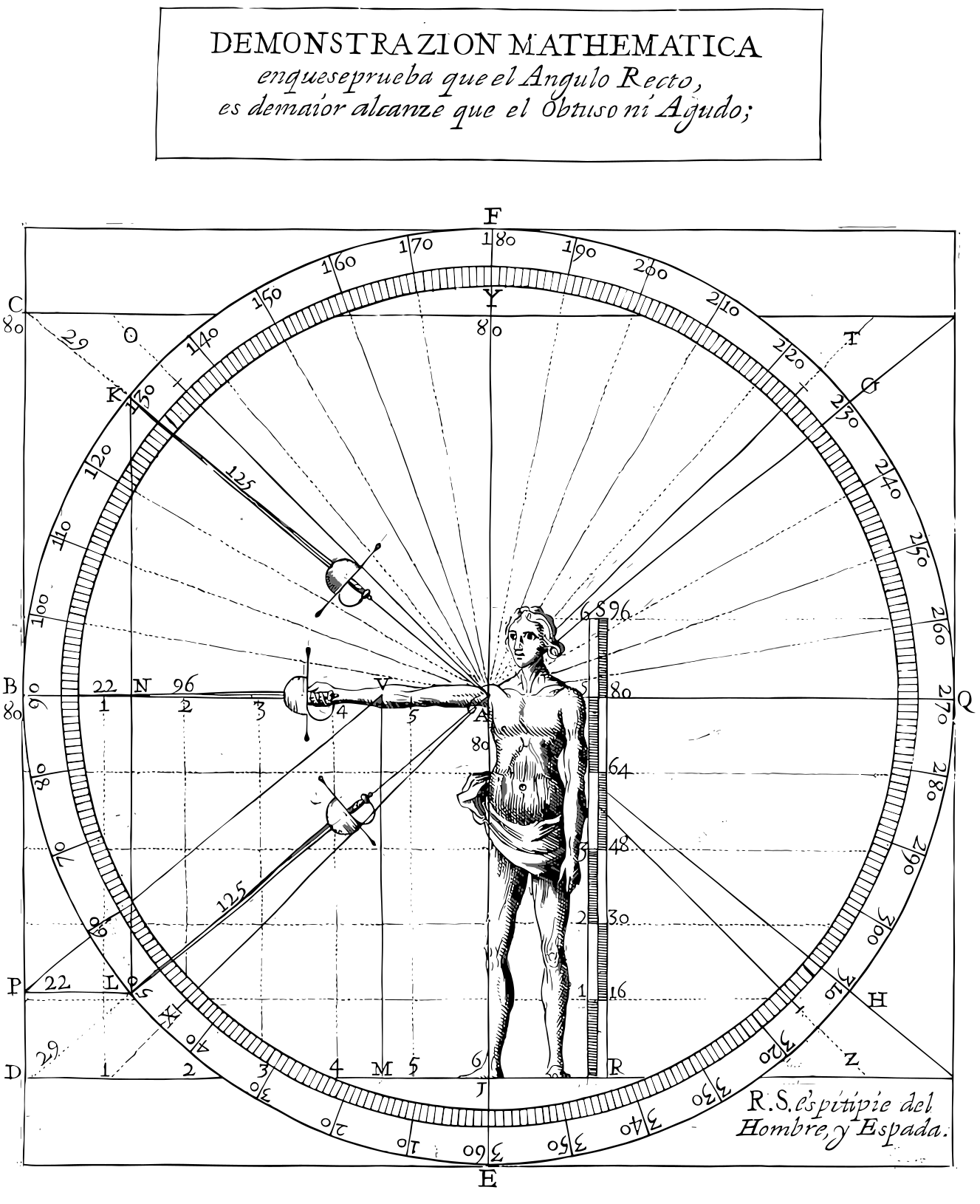
For a true understanding of the explanation of this demonstration, I must first base it on Mathematical Philosophy, which deals with things that have a countable or measurable quantity; given this, I (following the example of Euclid, the principal of geometers, who asked for the grace to be allowed to describe a circle with any center, and to draw a straight line from one point to another) asked enthusiasts at the beginning of this second book, in the Petitions of the sword's regimen, to grant me that the most perfect height of a man would be two yards since Vitruvius in book three says: That a man's foot is the sixth part of his body; and Claudius Vegetius, in book 1 of De Re Militari, discussing what stature men should be chosen for war, says: That Consul Marius chose new Soldiers of six feet in height; and for this, in accordance with Vegetius, Vitruvius should be understood in the cited place, saying that the foot of a man, is the sixth part of his body, or stature; but it should be understood that the foot he mentions is geometric, which is composed of four palm widths, and each palm has four fingers, making 16 fingers, which is a third of a yard: with the height being six of these feet, one will find that a man, according to the cited authors, will be two yards tall; following these same authors and many others, both ancient and modern, who discuss this and affirm it, according to the rule of the most wise Marco Vitruvius, who also states that six geometric feet is the proper proportion, or height of a man; although strictly speaking, a handsome man should have a smaller foot than what these authors suppose, I do not set out to contradict them, as their doctrines are so accepted, and affirmed by Alberti Durero and Juan De Arfe, in their Symmetries, as very diligent statuaries, and they consider the said six geometric feet to be the most perfect, which are the two yards.
Vitruvius's "De Architectura", Book 3
Vegetius' "De Re Militari", Book 1
I also asked that the sword, with which distances and measurements are to be regulated, must be according to the standard of these kingdoms of Castile, since by law and pragmatic sanction, it is prohibited to carry any but of five quarters, measuring from the guard to the tip, because with the hilt and pommel, which is its entire magnitude, it has four thirds, which make four geometric feet. Given and granted this (as it should be), I base the regularity of the demonstrations under these measures, as they are the most accepted by all scientific men, both Statuaries and Painters, who deal with the Symmetry of man; because if I had to follow the measures brought by Albert Durer, they would cause confusion, due to the aliquot parts being so minimal and lengthy for this science; thus, I make use of measuring or gauging the body of a man by feet, and by fingers, and the same with the sword, since it is the instrument with which the defense and offense (if convenient) are to be made, measuring, regulating, and proportioning with them the distances, movements, angles, actions, strategies, profiles, and aspects, etc., with such direction, that the knowledgeable Fencer may enjoy the admirable and favorable effects of this science.
Given and granted that the well-proportioned human body is two yards tall, which is its total length, making six geometric feet, and that each one is sixteen fingers in length, if the sixteen are multiplied by six, they will make ninety-six fingers for the total height of the figure.
Body 96 fingers in length
As mentioned above, the arm from the wrist line to the shoulder is two geometric feet, and the sword is four feet; when held in hand, the pommel reaches the wrist line. Thus, adding the 64 fingers, which is the length of the sword, to the 32 fingers of the arm, it is found that the combined length of the arm and sword is 96 fingers, which matches the height of the man's figure (as I have assumed), clearly recognizing the proportion between the man and the sword. By making the shoulder the principal center of the arm, one can describe a spherical surface with the arm and sword, with the arm and sword acting as the semi-diameter of said sphere.
Given all these measurements and proportions under this affinity, I present the following demonstrations to prove, both philosophically and with the mathematical evidence from Arithmetic, Geometry, and Astronomy, which angle has the greatest reach. Through the degrees of the sphere, their value will be known, adjusted by Arithmetic with clear evidence; and by Symmetry, the measurements of a man for the use and perfection of this science, as mentioned.
Proceeding to the demonstrations, I say that with the man positioned with his arm and sword, as indicated by A.B., with A being the center and interval up to B, if the arm and sword were to describe a circle over the center A, and moving the tip of the sword indicated by B, passing through F.Q.E. until returning to B, a spherical surface indicated by B.F.Q.E. would be formed. The sphere, according to philosophers and astronomers, is divided into four quadrants, each assumed to be 90 degrees, which, multiplied by four, make 360 degrees, the graduation and value given by philosophers, as indicated by the demonstration with the letters B.F.Q.E.
Demonstration
Angles of the sphere
The same will be found if the sphere is divided with two obtuse angles and two acute angles, which equal the same 360 degrees as the four right angles or the eight semi-right angles, as shown by the letters B.G., G.Q., Q.L., and each of these obtuse angles I suppose to be 130 degrees, and each acute angle to be 50 degrees, both equalling 100 degrees; and the two obtuse angles 260 degrees, which with the 100 degrees of the acute angles, make the same 360 degrees; with which it is seen that the two obtuse angles and the two acute angles equal the same as the four right angles or the eight semi-right angles. Thus, by virtue of the sphere's gradation, the value of the angles, their quantity, and how they inherit degrees of their value from one another, as will be seen in the following form, is understood.
The angle E.A.B. is 90 degrees. For example: the arm and sword decline to the letter L, losing 40 degrees, and the same for its opposite, since each of them becomes 50 degrees, and in angle E.A.B. it rose from B. to K. so that having 90 degrees in B, it is found, by having moved to the letter K, it acquired 40 degrees, and the same for its opposite; thus, each will be found to be 130 degrees; and this is the value that each of the obtuse angles acquired, since being right angles of 90 degrees, they became right angles of 90 and are found to be 50 degrees; with which the two obtuse and two acute angles come to have the same 360 degrees as the 4 referred right angles.
The ruler that marks R.S. represents the man's body, is divided into six equal parts, making six geometric feet, and each one of 16 fingers in length; by this ruler, the body, the arm, and the sword are to be measured, serving as a yardstick; the arm and sword are also divided into six parts, as shown by the numbers that are at the perpendiculars, falling on the flat surface, gridding the divisions of the man's body, which is seen in the propositions so accurately adjusted to its Symmetry and composition.
The line F.A.E. is the perpendicular that divides the sphere into two equal parts, serves as the man's right vertical side. The letter A is the center of the sphere, and of the arm and sword. F represents the Zenith. And the letter E, the Nadir. B.Q. is the horizon line, which also passes through center A, causing with its section four right angles in it, as indicated by the letters B.A.F., F.Q.A., Q.A.E., and E.A.B., all of which are right angles: with which it is demonstrated the plane at the height at which the Diestro must carry his arm and sword to be affirmed in a right angle, as he places the body and feet in the form demonstrated by the figure.
Having already provided knowledge of the most proportional measurements of the human body, according to the best Symmetry, and the length of the sword (according to the standard of these kingdoms), along with the understanding of the degrees of the sphere and the value of the angles; it is good to examine their reaches, according to Geometry, in the following manner.
Let the line C.D. be one of the verticals, or collaterals, considered on the opponent, and at the center of the Diestro's arm A. up to B. the distance he has with his arm and sword, affirmed at a right angle; draw from point A. a straight line perpendicular to C.D. by the 12th of the first book of Elements, the point A., the Y.A.J. parallel to C.D., and A.J. will be the Diestro's vertical, affirmed, as supposed, at a right angle, and upon a right angle; with which by proposition 29 of the same book by Euclid, the angle B.A.J. made by the Diestro's arm and sword line with his right vertical will also be right: being alternate to the angle J.A.B. equal to two rights, center A. interval A.B. it is seen described by the vertical plane the portion of circle K.L. I say, that rising or lowering from the right angle A.B. his arm and sword, the Diestro, in any part of the sphere, causing with the vertical line Y.J. an obtuse or acute angle, will have in each of these angles less reach than in the right angle A.B. Suppose that the sword and arm lower from the right angle A.B. to the acute angle of 50 degrees at point L., so that the line A.L. represents the arm and sword; it is extended to meet C.B.D. at point D., I say it will reach less in this position than in the right angle, by the quantity D.L. and although the proposition is evident and clear, by the figure it is geometrically demonstrated in two ways.
I say that the arm and sword have six geometric feet, as previously mentioned, which make 96 fingers, and the line B.D. equal to J.A. parallel between them, of five feet, which are 80 fingers, and squaring the side A.B. makes 9216, and squaring B.D. 6400, and the sum of both 15616, whose nearest square root is 125 fingers, which is the value of the hypotenuse A.D., of which subtracting 96 fingers, there remain 29 fingers for the line L.D which are one foot and thirteen fingers; and this quantity is what the Diestro's sword would need to be longer to reach his opponent in D. as it reaches in B., and this same calculation matches completely with the previous one.
If the Diestro raises his arm and sword from the posture of the right angle A.B. to the obtuse angle of 130 degrees at C., through the triangle A.B.C. caused in this posture being equal, and its sides to the triangle A.B.D. that causes the acute angle, because the same quantity that B.D. has is had by B.C. and the angles that the Diestro causes at the center A. are equal among themselves in both postures, A.C. will be equal to A.D. and A.K. equal to A.L. and C.K. equal to D.L. In this order, any other postures, both of the acute and the obtuse angle, can be examined; and in any, it always verifies that the Diestro will have less reach in them than in the posture of the right angle A.B.
The second demonstration in the preceding supposed that the two combatants did not move, and examined the quantity that had to extend (more than the ordinary) the Diestro's sword, to reach in the posture of the acute angle to his opponent in D. and now will be determined the quantity that the Diestro has to approach to strike his opponent in the same posture of the acute angle with his arm and sword, and it is demonstrated in this way.
Draw through point L. the line K.L. perpendicular to A.B. and parallel to D.C. cutting A.B. at point N. with which we will have two triangles A.B.D. and A.C.B. right-angled, and similar, by proposition two of Euclides, and it will be as A.L. to L.D. so A.B. to B.N. and when of four proportional quantities, the three are known, as in this case A.D. and D.L. and A.B. the fourth will be found by line, by proposition 12 of book 6 of Euclides, and by numbers will be formed a rule of three, saying: If 125 fingers which have the A.D. by the preceding proposition, give us the D.L. of 29 fingers, what will A.B. of 96 fingers give us? and following the operation, will be found the fourth proportional B.N. of 22 fingers, which is the quantity that the Diestro diminishes from his reach, being in said posture of the acute angle at A.L. than he has affirmed in right angle A.B. and this quantity of 22 fingers, is with which he has to approach his opponent so that he can reach him, giving compass of the same quantity from point J. to point M. with the center of the arm A. will pass to point V. and his vertical in V.M. and the line of the Sword from point L. to point P. and this quantity (which as said is of 22 fingers) is the advantage that the right angle A.B. has in reach to the posture in acute angle A.L. which is what was demonstrated.
The same result would occur if the Diestro were affirmed in obtuse angle A.K. if there was any part of his opponent's body he could reach; because the triangle A.N.K. are equal in everything to the triangles A.B.D. and A.N.L. as seen in the figure, which is not demonstrated to avoid repeating the same: and it is noted, that if the Diestro varied the postures in obtuse and acute angle, that are of more or less degrees of the sphere, each one of them can be examined by the order that I have had here in the two preceding ones, adjusting the angles, and proportions and the rest, according to the postures, or rectitudes in which the Diestro can be found affirmed.