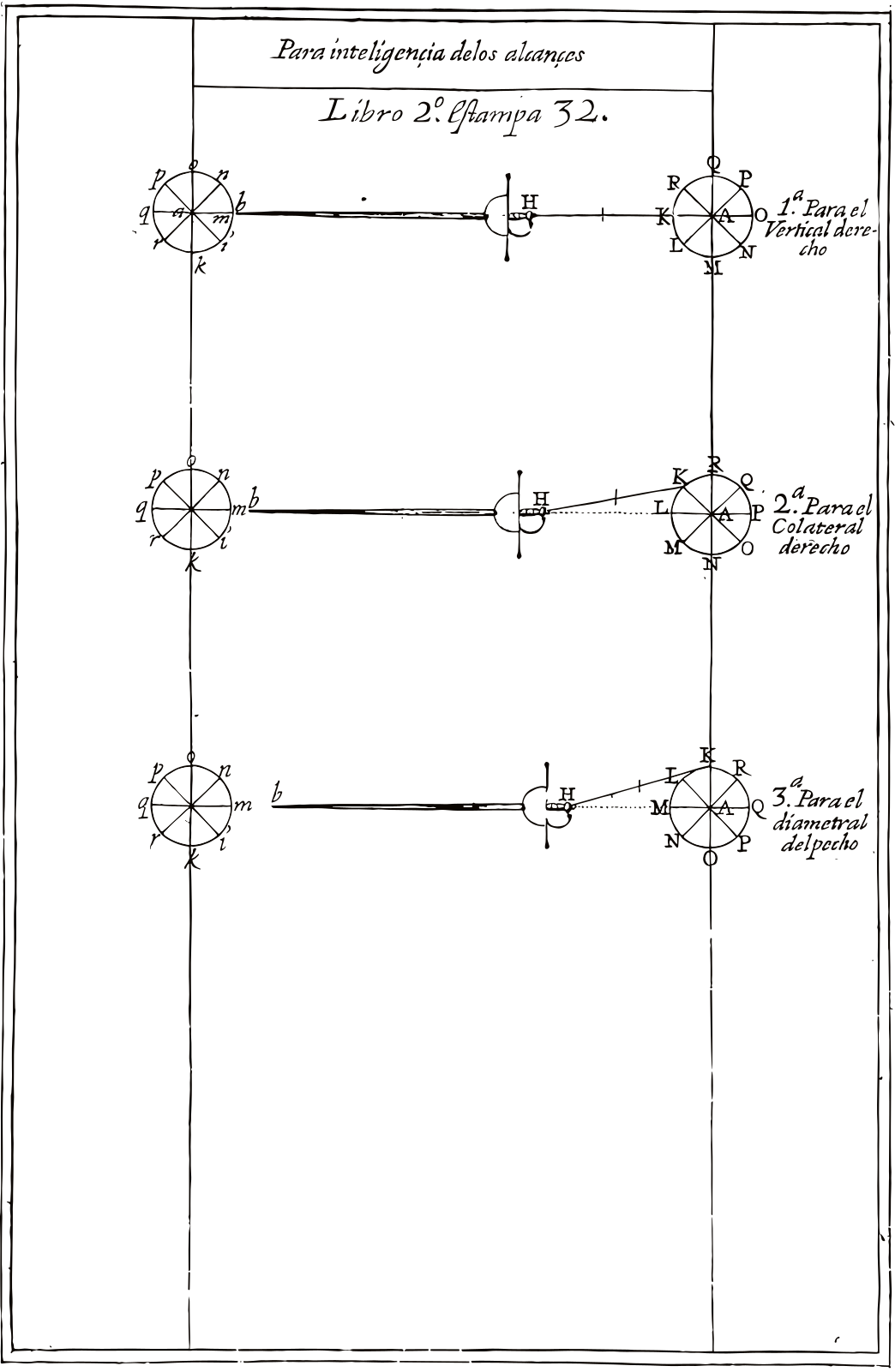
Although in the demonstrations before this one, the reaches of the right angle in the three planes, right vertical, same side collateral, and chest vertical, which are reduced to the three postures of profile, half-profile, and square, have been sufficiently proven, and sufficient notice given to be able to regulate the reaches of the intermediate planes of these three; yet, desiring to provide all possible clarity to those who would not wish to tire themselves in examining these demonstrations, it seemed appropriate to us, for greater understanding, to put in figures the cylinders in which we imagine the two opponents, and the arm and Sword of the Fencer, so that immediately one can judge the amounts of reach lost, regarding the right angle, which is caused in the right vertical plane in the other two planes, collateral of the same side, and chest vertical; and with these so visible demonstrations, not only can they be perceived without effort, but it can be recognized that they conform in everything to the other two previous demonstrations, so that there can be no doubt in their reality and evidence the Fencer is affirmed with his arm and Sword in his right vertical plane.
Given, then, that the Fencer affirmed in the first figure in his cylinder Q.O.M.K. divided into its eight principal planes so that A.K. is his right vertical plane, in which we imagine him affirmed with his arm and Sword A.O. his chest vertical plane A.Q. his vertical plane corresponding to the back A.L. his right collateral plane A.P. his collateral plane corresponding to his left side of the back A.N. his left collateral plane, and A.R. his right collateral plane corresponding to the back.
K.H. is the length of the arm from its center K. to H. hilt of the Sword, and the straight line of the same arm, of a length of two geometric feet. H.B. is the length of the Sword from the hilt, or straight line, to the tip, of a length of four geometric feet. And point M. is the one where the tip of the Sword has the point of contact in the opponent's cylinder in the chest vertical plane, whose cylinder is divided with the same eight planes, as those of the Fencer, with which it will have caused in its right vertical plane of the primary vertical plane, and applied it in the chest vertical plane of his opponent.
In the previous demonstration, it is clear that with the length of the arm and Sword, the Fencer affirmed in the right vertical plane in the common section of the primary vertical plane and the upper plane, will reach his opponent in the cylinder in which we imagine him affirmed in his chest vertical plane at point M.
Now, we consider the Fencer affirmed in this second figure in his cylinder (divided into the same planes as the first) in his right collateral plane A.L. having preceded the motion around the direction line, which represents in the cylinder the point A. so that the point K. is the center of his arm, and K.H. is the length of it, and H.B. the length of the Sword, which occupies the common section of the primary vertical plane with the upper plane, corresponding to his right collateral plane A.L. It is recognized that the motion the Fencer made in moving his right vertical K.O. away from the primary vertical plane A.H. lost reach, regarding his opponent, by the amount of B.M. which is just over three fingers, and it is the same that we have demonstrated in the other two demonstrations; and in this figure, the Fencer has caused his primary plane in his right collateral plane A.L. and the tip of the Sword corresponds to the chest vertical plane of his opponent; although it is not circumstantial because any other point corresponding to the tip of the Sword will verify the same loss of reach.
Assuming in this third figure the Fencer in his cylinder, divided into the same planes as the two preceding ones, affirmed in square, which is when the right vertical plane A.K. causes a right angle with the primary vertical plane A.H. in such a way that the center of his arm corresponds to point K. and the length of his arm K.H. and H.B. the length of the Sword, which is at a right angle, occupying the common section of the primary vertical plane with the upper plane; and in this posture, as seen in it, loses a half foot of reach, a little more, which is the amount of B.M. that is the point where the tip of the Sword would have reached to make contact in the cylinder of the opponent, and this same amount is what was demonstrated in the two previous demonstrations as lost in reach in this posture, and in it, the Fencer causes the primary plane in his chest vertical plane, and the Sword applies it in the same plane of his opponent, although it does not reach his cylinder, it does not have a point of contact on it.
From these three demonstrations, it follows that to examine the reaches in each of the three principal planes and their intermediates, it is the same to move the Sword and arm, applying it to the planes while the body remains fixed, as in the first demonstration, as it is to keep the arm and Sword fixed and apply the planes to them through the motion of the body, over the center of the right foot, as in the second demonstration, or around the line of direction, as in this third one.