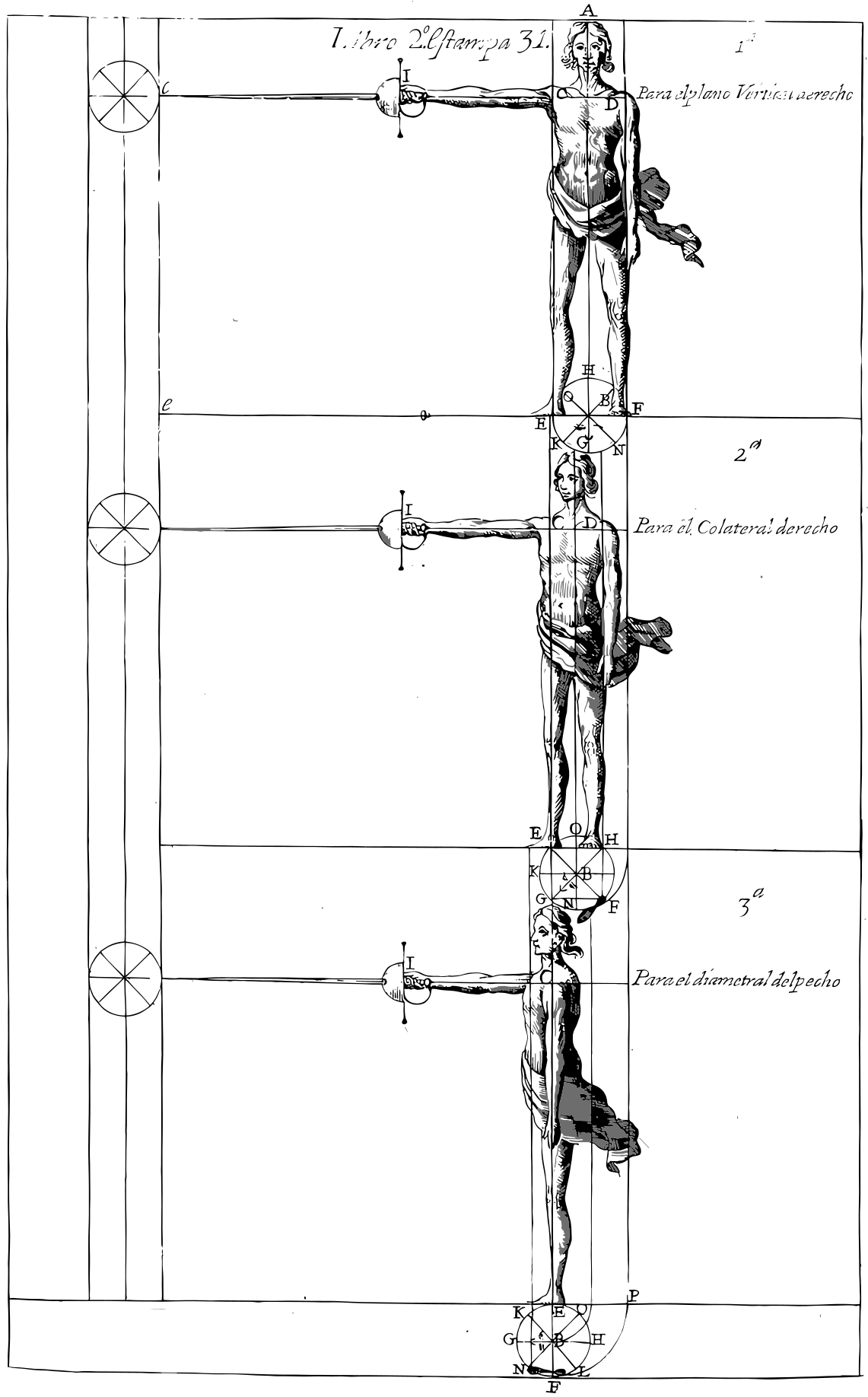
Although the demonstrations we have made of the greater and lesser reach of the right angles that can be caused in their jurisdiction are evident and clear; still, for one and the other to be seen with more distinction and to be more perceptible to the sense of sight, we have thought it appropriate to include here the three principal figures on which said demonstrations are based; in the first, the Fencer is affirmed in profile in his right vertical plane, in the second affirmed in his same side collateral plane, and the third affirmed in his chest vertical plane, so that in the difference of these positions one can judge the greater and lesser reach in each of them, whose knowledge can serve those who do not want to tire in the Mathematical demonstrations. And it is noted, that in the Mathematical demonstration, which has been made, where it is supposed that the cylinder in which we imagine the Fencer stays still, and only the arm moves from the right vertical plane to the chest vertical plane, and from this plane the arm returns to the right vertical plane, because so it was convenient to what was demonstrated; but in these three figures, which we have placed in elevation, with the considerations that must be had in the lower plane for the knowledge of them, it is necessary to suppose, for more clarity, that the arm and Sword do not move, and that the cylinder, or body is the one that moves, by means of the left foot, around the line that passes through the center of the right arm and ends also in the center of the right foot, as seen in the second and third figure, and the amount that in each one the Fencer brings the body closer to his opponent, which is what he loses in reach with him; and first we place the first figure, in which the Fencer is affirmed in profile in right angle, and on right angle, as the foundation by which the knowledge of the other two is to be regulated.
Given that the Fencer is affirmed in his right vertical plane in right angle I.C.E. corresponding to the primary vertical plane, and on the base of his cylinder E.G.F.H. in the lower plane, where E.F. represents the same right vertical plane, and the line K.B. represents his right collateral plane, and G.H. his chest vertical plane, and that he has opposition to his opponent, in equal body and arms, affirmed in the same opposition without difference. In this case, approaching one another, they will be able to reach each other in their vertical lines C.E. passing through the centers of their arms, and their right feet at the points of contact corresponding to them.
In this second figure for its understanding, we say, that as in the previous one he was affirmed with the arm and Sword in the right vertical plane, and in the same plane on right angle with the feet in the lower plane; in this second, by having moved the left foot to point F. and having made the necessary motion over the center E. of the right foot, he remains affirmed in the right vertical plane F.E. with the feet on the side, as seen in the figure, with which he opposes his opponent his right collateral plane B.K. caused in the primary plane, in which plane his Sword will also be due to the movement of the left foot to F. and he brings the body closer to his opponent a little more than three fingers, which is the amount of body that comes out of the line C.E. end of his cylinder; and the same is recognized in that the face comes closer the same amount to the same line C.E. regarding the position it has in the first figure, and it is the same amount we found in the said Mathematical demonstration.
In this third figure, as seen in it, to place the Fencer in square, he passes his left foot to point F. completing the fourth part of the circle P.F. required for it, and his vertical plane F.E. on the part that is seen in the figure, with which he opposes his opponent his chest vertical plane B.G. causing in it the primary plane; and in this position, he brings the body closer to his opponent by half a foot, more or less, by the part of him that is outside the cylinder, where we imagine him in the first figure, and to the line C.E. that passes through the centers of the arm, and of his right foot, and it is the same amount we found he lost in reach in the said Mathematical demonstration, and the same that in this figure is found to bring the face closer; and both we have adjusted by their footprints with all possible rigor.