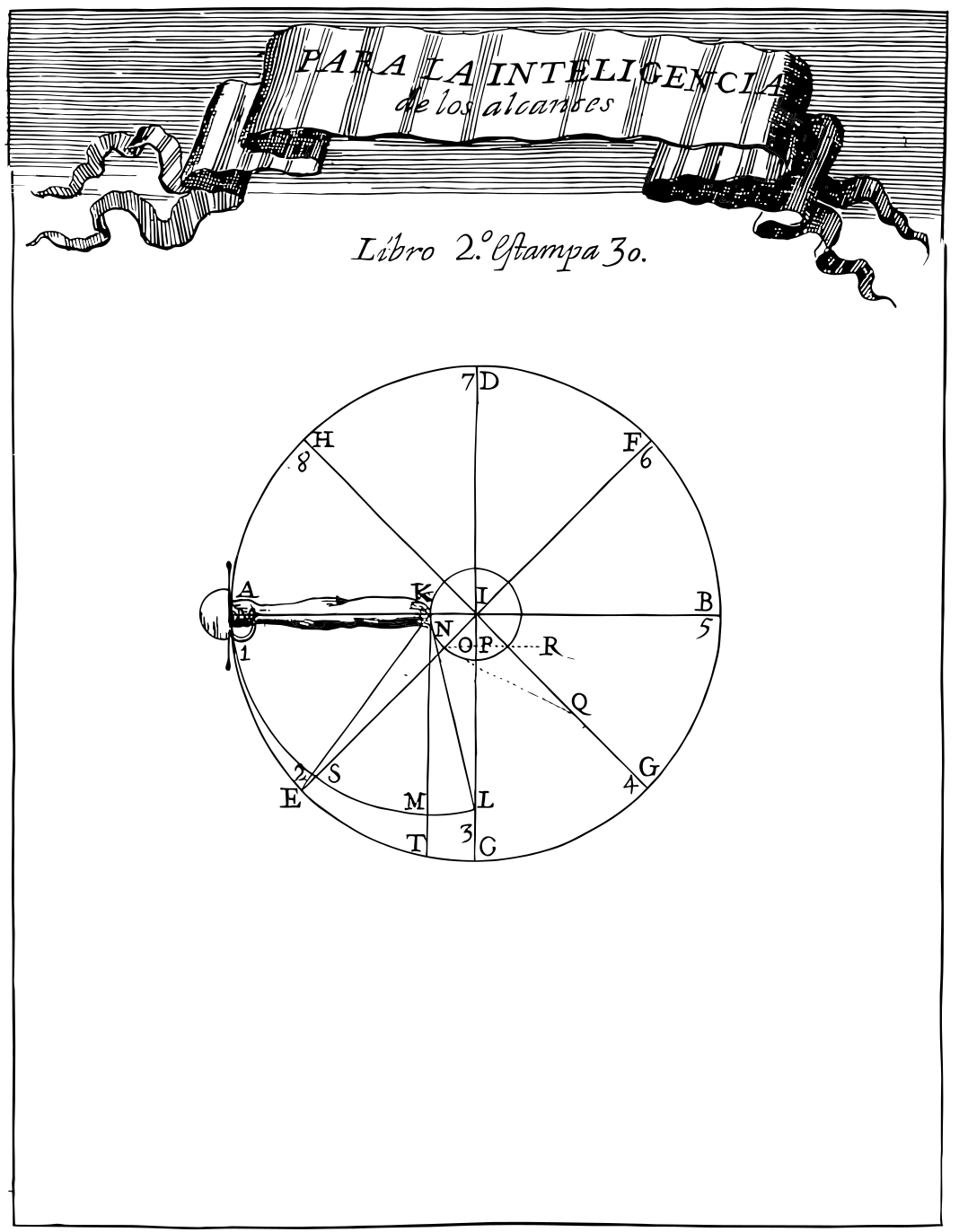
The Fencer will be affirmed at a right angle in any part of their jurisdiction, with respect to themselves, and to their opponent, whenever with the straight line, which is imagined to pass from the direction line through the center of the arm, and through the center of the sword's guard, to its tip, or with the line that is imagined to pass through the center of the guard (kept in these three cases as far away from their body as possible), will occupy the common section of the primary vertical plane with the upper plane parallel to the Horizon.
Because the primary vertical plane can be caused in all the particular vertical planes of the body, and the right angle, according to our speculations, only has jurisdiction from the Fencers's right vertical plane to their chest vertical plane, in which it can form its right angles of greater and lesser reach, as we will demonstrate through the figure that will follow after the explanation.
Let the circle A.C.B.D. represent the upper plane divided into eight equal parts, with the eight semidiameters. I.A. representing the right vertical plane. I.E. representing the collateral plane on the same right side. I.C. representing the vertical plane that passes through the chest's diameter. I.G. representing the left collateral plane. I.B. representing the left vertical plane. I.F. representing the left collateral plane of the backs. I.D. representing the vertical plane of the backs. I.H. representing also the right vertical plane of the backs.
These planes are common sections of the four vertical planes, represented by the four diameters AB, CD, EF, and GH, which intersect at the direction line, represented by the point I in the center of the figure; and for clarity, we mark the eight planes that they cause, with their numbers from one to eight, as seen in it.
Because in this jurisdiction of the right angle, in respect to the organization and composition of the body, many right angles can be caused that have differences among themselves, it is necessary to examine it, so that the Fencer knows the nature of each one, and where they will have greater and lesser reach; and to demonstrate this, we say:
Let the same figure be given, with the same planes that have been explained, in such a way that the semidiameter I.A. is the length from the direction line, represented by point I, to the center of the guard, which is two geometric feet and three-quarters of another. Take I.K. as half a foot, and from the center I, at the interval I.K., describe the circle K.N.O.P., which will be the common section of the cylinder, in which the Fencer is imagined to be contained, and of the upper plane.
When the same center of the guard occupies its chest vertical plane I.C. at point L., which is the jurisdiction of the right angle where the Fencer can keep their arm straight parallel to the Horizon, without bending it; consequently, it can be examined, if desired, how much more reach will be lost from the chest vertical plane I.C. (where the jurisdiction of the right angle ends) in its left collateral plane I.G., which will only come to have reach at point Q, and on the line N.R. parallel to its left vertical plane I.B., which is as far as their arm and guard can reach at point R, although this, depending on the disposition of the bodies of the combatants, may have some irregularity; but whenever it is examined, there will be very little difference.
Center K, interval K.A. (length of the arm to the center of the guard), describe the arc A.S.M.L., which is the space in which the arm, without moving the body, can move over its center parallel to the Horizon (as we have said), without bending, nor making an angle at L. This arc will cut the line I.E. at point S, and I.C. at point L. We say that the difference between E and S, and C and L, are the amounts of reach the Fencer will lose in the planes I.E. and I.C., and we demonstrate this in the following way.
Draw the line K.S. because from the point S, which is outside the circle K.N.O.P. (representing the Fencer's cylinder), two lines have been drawn to the outer circumference S.K.S.N. According to the eighth proposition of the third book of Euclid, S.N., which produced, passes through the center I, will be shorter than S.K. by the amount of S.E., which we will prove by sines, by proportion, and by geometric demonstration.
By sines, since three things in the triangle K.I.S. are known, which are the side S.K. of 36 digits, the side K.I. of eight digits, and the angle K.I.S. of 45 degrees, by the nature of the planes that are spaced apart by one-eighth of the entire circumference of the circle A.C.B.D., it will be found by this method that the difference between these two lines S.K. and S.N. will be three digits, and almost a fifth.
For the construction with center K and interval K.A., the circumference A.S.M.L. has been described according to definition 13 of the first book of Euclid, meaning the line K.A. will be equal to K.S. However, I.A., by the same definition 13 of the first book, is equal to I.E., and by the same definition of the circle, the line I.K. is equal to I.N. Therefore, the remainder K.A. and N.E. will also be equal to each other, according to axiom 2 of the first book of Euclid. It follows then that K.S. will be equal to N.E. by axiom 1 of the said elements, stating that quantities that are equal to a third quantity are equal to each other: for example, the line K.S. is equal to K.A., and N.E. is equal to the same K.A., thus N.E. will also be equal to K.S. And if from N.E., the greater, is subtracted N.S., the lesser, the remainder will be E.S., which is the amount of reach the Fencer loses by placing the center of his guard in his right collateral plane I.E. at point S.
Thus, imagining the opponent positioned so that the center of his right foot occupies point E., such that it corresponds to the center of his right arm occupying his own right vertical plane, he can reach the Fencer at point N. with the same length of 36 digits, without being reached himself, because the Fencer's reach, although of the same length, does not extend beyond point S. due to having his arm and the center of his guard in his right collateral plane I.E., and his opponent in his right vertical plane has a longer reach.
The same demonstration, using the same three methods, can be made assuming that the Fencer places the center of their guard in their chest's vertical plane I.C. at point L. It will be found that they will lose from their reach in this position the amount of L.C., which turns out to be half a foot; and that being firmly positioned, their opponent, occupying with the heel center of their right foot the point C., will be able to reach them at point P. without being reached, for the same reason of being affirmed in their right vertical plane of greater reach.
These same demonstrations could be made in any of all the intermediate vertical planes between the referred planes, wherever the Fencer places the center of their guard, and knowledge of the reach in each one, and the amount they will lose from it, with respect to their opponent, assuming them affirmed in their right vertical plane, as said.
It follows that the right angles that the Fencer can create in the common sections of the vertical planes with the upper plane, from their right vertical plane I.A. to their chest vertical plane I.C., which is the jurisdiction of the right angles and a quadrant of the circle, will lose reach in each one; however, it is noted that the nature of these right angles is such that as these angles are formed, more strength will be acquired, by joining the part to the whole, until reaching the vertical plane I.C., where it will have greater strength than in any other.
From this same reasoning, it follows that the right angles that are formed from the chest vertical plane I.C. to the right vertical plane I.A. will see the Fencer increasing their reach in each one, and in the same right vertical plane, they will have greater reach than in all the others; and for the same reason of the part deviating from the whole, in each of these right angles, they will lose more of their strength, until their right vertical plane, where they will have the greatest weakness.
From this, it also follows that, given that the perfection of the use of Fencing consists in having inequality with the opponent; the knowledge of these right angles is very necessary because the Fencer will use those of greater reach for the profile of the body, and those of greater strength for the posture of the Sword, to counteract with it the weakness that their opponent's sword will have; and by the profile of the body, they will apply those of their greatest reach, which although the opponent will have in this position those of their greatest strength and lesser reach, not allowing the Fencer with it to counteract the weakness of their Sword, they can succeed in offending without being offended, and not observing these precepts, they will find themselves in difficulty.
In the different natures of these right angles, the difference in each of them is evident because the term Difference, according to our definition, is about something not being another thing, and about more and less, which is what happens with these angles since some have more strength and less reach, and others more reach and less strength.
From this follows the understanding of their properties because, according to the definition, the term property or properties refers to those that are inherently natural to the subject and remain in it, and others by accidents that stem from the use of their potential; this is verified in these right angles, because some acquire degrees of strength and decrease their reach, and others lose degrees of strength and increase in reach.
For more clarity in these matters, it's necessary for the Fencer to form a concept of the three main planes in which they can position themselves within the jurisdiction of the right angle, which are in their right vertical plane, where they have more reach and greater weakness; in their chest vertical plane, where they have their greatest strength and least reach; and in their right collateral plane, which, being between these two extreme planes, will partake of the reach of one and the strength of the other; hence, this posture is the most natural of all to affirm oneself in it, and the posture in the right vertical plane, due to its great weakness, is less secure for waiting for the opponent to act, as the arm is entirely disjointed from its whole, which will give them more disposition to act than in any other.
These same speculations underpin our stance of the square, from which one should not use from the medium of proportion but from the proportional, occupying with the right foot the right collateral plane, and with the left the left collateral plane, causing with the Sword, one should occupy the common section of the primary vertical plane with the upper plane, which passes through the vertical of the chest; and with the arm with the Sword, and the body, are in their greatest strength, and with a natural disposition to make the body's movements from place to place, especially for everything that is worked through the posture of the Sword.
With the same positioning of the feet in their two collateral planes, the Fencer covers with them the depth of their opponent's body, whether the opponent is positioned in their right collateral plane, or in the right vertical plane, or in the intermediate planes between these two. In any of these, the opponent's arm and sword will have more weakness due to being more disjointed from their whole than the Fencer's sword because, having it in the common section of the two referred planes and in front of their chest vertical plane, being more united to the whole as much as possible (having to hold it at a right angle) will be a significant advantage; and by having opposite the opponent's vertical chest plane, which is also naturally stronger for the use of Fencing, for the same reason given, it will also give an advantage.
By having this positioning of the Fencer's sword corresponding to their vertical plane that passes through the chest diameter, which is the midpoint of the two extreme planes, vertical right, and left, just as it is also of the two extreme collateral planes right and left; they can, maintaining the center of their guard in the common section of the two referred planes, move promptly from this midpoint to any of the extremes.
Although in this posture, the Fencer will have less reach with their arm and sword by a quantity of half a foot, as we have demonstrated, this not only can be compensated for to equal the posture of greater reach; but it can have more than it, and with more immediate dispositions, to enter from the proportional medium to the proportionate, and execution of the strikes, and then to exit back to it. Because being the Fencer affirmed in the proportional medium in this posture, they can enter by giving a compass step with the right foot of a quantity of two to three feet, according to the height and organization of each one, keeping it in such a way in the movement, that it always causes a right angle with the line of the left foot produced; and with the line imagined produced from the tip of the right foot, it cuts the diameter line of the circle, which was first common to both combatants; and as anyone can experiment, this compass step will be given without discomposure, in such a way, that the center of the right arm, and this without moving the left foot from the proportional medium; because although when this step is given with the right, the heel of the left will rise somewhat, and to the extent that it does, it will bring the line of direction closer to the heel of the right foot, it will still be found with immediate disposition to retract the body (after having executed the strikes) to the proportional medium, in the same posture it first had in it; and through this compass, it will reach in the quantity given, with more swiftness, and security than in any other posture, and all actions, and strikes will be with much greater violence, and force than in any other; as will be explained more particularly in its place this posture, by means of a figure, for greater clarity, and understanding.
This posture, and the way of giving the compass with the right foot, serves to enter to strike with much more security, and swiftness, both with double weapons and against the postures used in Italy, France, and other Nations, which base their Fencing on not allowing their Sword to communicate, and throwing themselves profiling, seeing some uncovered point, relying on the swiftness they acquire with long exercise; and so it is convenient that our Fencer also has it to be able to offend without being offended; requirements that do not occur in the way that the Nations have of acting, because whenever they strike they can be struck, and they have no more precepts than brevity; and if they encounter someone who also has it, it will result in being struck at the same time, which is what is not allowed in good Fencing, because the offense must always be compounded with defense.
Because it may be noted that the demonstrations we have made in this figure by three different means, in order to find out the reach of the right angle, assuming that the Fencer places the center of the guard in their right collateral plane, so that by them the demonstrations of all the right angles that occur in the vertical planes of their jurisdiction can be regulated.
We say that it has been with particular attention to make it understood that having the arm and guard in the superior plane parallel to the horizon, the Fencer can, without discomposing, with the center of the wrist, raise and lower their Sword to the obtuse and acute angle, and place it to their right and left side with much more security than if the arm and guard accompanied the Sword in these actions, because of how much the body would be left unprotected and exposed; it being so, that by keeping the arm and guard in the superior plane, the place of the right angles, with very short movements made with it to any of the referred parts, they will be able to continue defending their body, sometimes putting their opponent's Sword on the surface of their Pyramid with their own of the arm and guard, and at other times with their Sword; in such a way, that it always contains it, on one side or the other, in the sides of the angle of their bulwark, with which we represent the two vertical planes, as terms in which the total defense consists, so that the opponent's Sword never has direction to their body, nor cylinder, in which we imagine them, as demonstrated in the idea of our Stronghold to which we refer.
Because it is convenient that when using these right angles, it is always through the primary vertical plane, which according to its definition passes through the shortest distance there is between any of the positions in which the two combatants find themselves, by imagining passing through the two particular planes they have opposite, we say; to determine the essence of the right angle with respect to the Fencer and their opponent, in all its universality, that will be caused in the intersection of their line of direction with the line we imagine coming out of it from the center of the arm to the tip of the Sword, occupying with it, or with the center of the guard, or with the Sword together, the common section of this primary vertical plane with the superior plane, for being this plane, as has been explained, the proper place of the right angles, and observing these precepts, the Fencer will achieve to be affirmed in any of them with perfection.
With this, we have given in all that has been referred to a universal knowledge of the nature, differences, and properties of the right angles that can be caused in their jurisdiction; and of the use of them, we will make explanations in their proper places, where their utilities will be made evident.