We cannot but marvel, considering that in the majority of activities performed in the world by humans, especially those subject to Mathematics, such as Geometry, Astronomy, Optics, Perspective, and Architecture, the right angle plays a crucial role. The Geometer, to measure lengths, widths, depths, surfaces, and bodies, does so through right triangles, or by means of lines intersecting at right angles, or by sines, tangents, and secants, which always form right triangles.
The Astronomer does the same with their instruments, such as Quadrants, Radii, and Astrolabes, etc., which cannot be made or used except through the use of the right angle, nor can the movements of the Stars be regulated without considering certain circles: such as the vertical circles with the Horizon (which intersect at right angles) to know the heights; and the meridians or circles of longitude with the Equator, to know the declination; and the circles of latitude with the Zodiac, for the latitudes, which also all intersect with their principal circles at right angles.
The Architect, for their structures to stand, must base and erect them on right angles; and the rooms and interior spaces of buildings, for beauty and convenience, are arranged at right angles, among countless other applications that would require an extensive digression to enumerate fully. From this knowledge, it is concluded that the greatest and most difficult tasks are achieved and performed through the right angle, and it is no less significant for the understanding of Fencing, as will be recognized in the course of this work.
Thus, for the construction of the most essential operations within it, we rely on the right angle, which is the mean between the extremes where the Fencer causes obtuse and acute angles; and because different considerations of the right angle are made, being very necessary for the use of tactics, such as the one caused with the body on the horizontal plane, and with the feet on the same plane, and with the arm, and Sword in the plane we call superior, we will explain them in order.
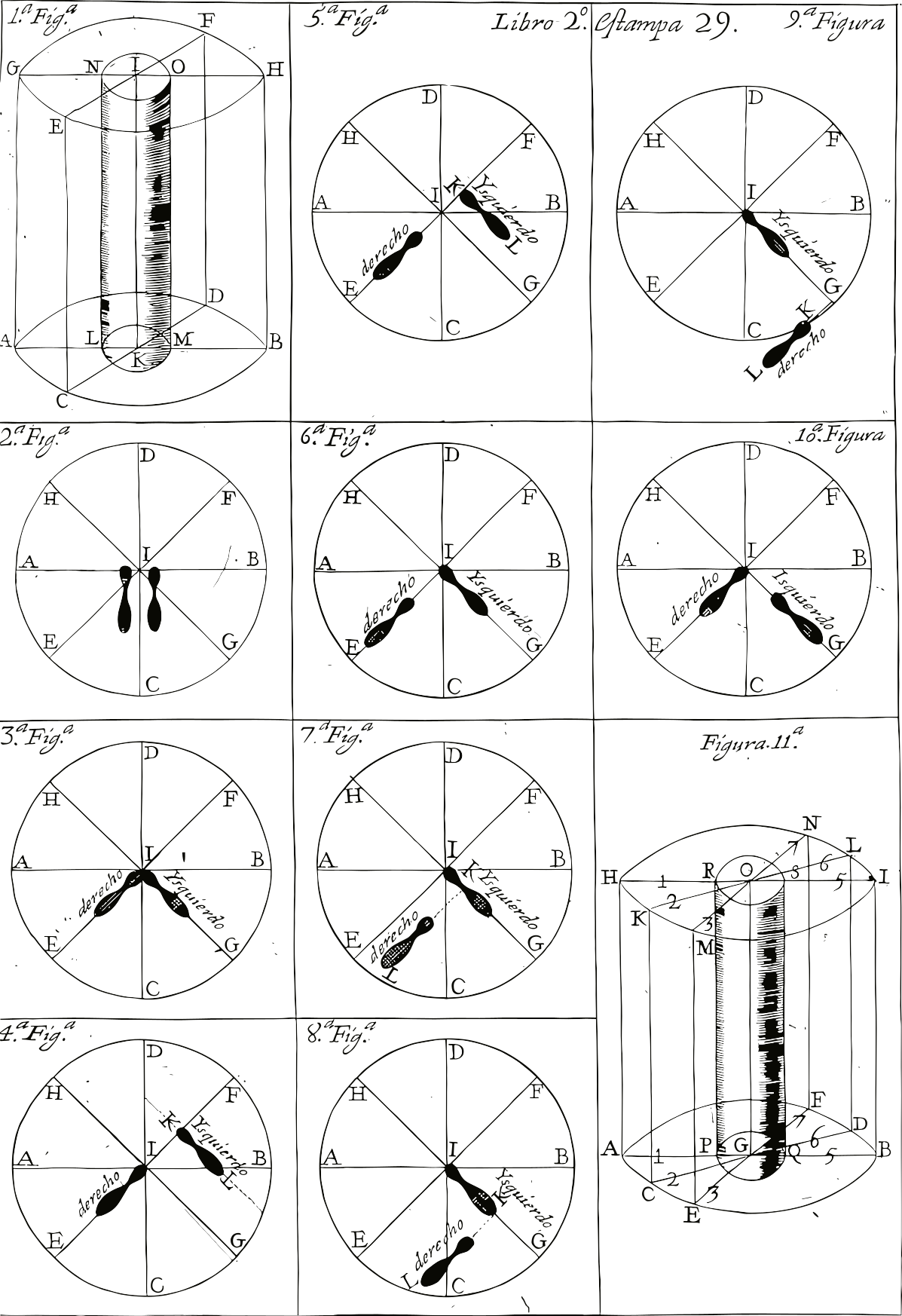
Imagine these cylinders intersected by the vertical plane G.H.B.A. and the vertical plane C.D.F.E. both perpendicular to the horizon, whose common section is the line I.K. axis, as mentioned, of this cylinder, representing the body of the Fencer, which by the cited proposition, will also be perpendicular to the horizontal lower plane, as will the cylinder L.M.O.N itself.
Demonstration of the Right Angle that can and should be made between the feet, and the correspondence they must have with the planes so that they, and the body, are ready to immediately regulate what concerns them in the lower plane, which is the foundation for the success of everything that is done in the upper plane with the arm and sword.
Let there be given one of the cylinders that form the particular Orbs of the Fencer A.B.C.D., divided into eight equal parts with the four diameters A.B., C.D., E.F., G.H., which intersect at the center I. of the figure, whose lines will be the common sections of the four vertical planes with the lower plane.
To examine the correspondence that the right angle, which must be caused between the two feet with these planes, must have, we have thought it appropriate to first suppose that the Fencer is affirmed in the center of the second figure, with the feet on parallel lines; in such a way that the vertical plane, which passes through the chest's diameter, represented by the line I.C., is between both, in which position he had in the body, and that the movements he wanted to make with it from place to place, cannot be as prompt and immediate as required, as experience will tell.
We also present the third figure exactly like the second, and it is supposed that the Fencer is affirmed at the center I. of it, with the centers of the heels of the feet on parallel lines, and moves the right foot until it occupies its collateral plane on the same side I.E., and the left until it occupies its collateral plane on the same side I.G.
In this position, the Fencer will recognize that he is more natural and stronger than in the previous one, and with immediate disposition to make movement with the body to whichever side he wishes; he will also experience that if he continues the motion over the center, bringing the feet closer to the vertical planes I.A. right, and I.B. left, he will find that the body is somewhat forced, and not in a natural posture, which is required for this exercise.
However, as in the position that the feet are in this third figure, they cannot serve but when entering to execute some trick on the opponent, in which there will always be about a foot more of reach, as will be explained in the third Book, in the exercises that the Fencer must have, it is appropriate to give knowledge of the distance that the centers of the heels must be, to be perfectly affirmed on them on a right angle, as it is a much more natural posture, in which the immediate positions will be held, to be able to make the movements that are necessary with the body from place to place.
For this to have more generality, we do not oblige our Fencer to always occupy with his feet their two collateral planes, right and left, but he can also occupy, sometimes with the right and other times with the left, a line parallel to each one of his two collateral planes, without altering the distance that must be made for them to be affirmed on a right angle, as for example.
Given this fourth figure with the same lines representing the same planes as in the two preceding ones, with the same letters, and with the Fencer affirmed with the center of the heel of his right foot, occupying the center I. of the figure, and the foot occupying the right collateral plane I.E., and the center of the heel of the left foot in the collateral plane I.F. of the back, occupying with it the line K.L. parallel to the collateral plane of his left side I.G., spaced the centers of both feet so that there is one foot from center to center, it will be said that the Fencer is affirmed on a right angle, with the same disposition in everything, as if he were affirmed occupying with the feet their two right and left collateral planes I.E., I.G., with the centers spaced at a distance of one foot, as stated.
In imitation of the Pilots, who steer the Ships, whenever they do it by some lines parallel to the courses of their nautical chart, they give them the name of the same courses, and consider them as such, without difference; and there being no difference, in terms of the Fencer being affirmed on a right angle in the referred form, we demonstrate it by proposition 28 of the first of Euclid's Elements, which proves that the external angle is equal to the internal and opposite on the same side.
Because the two parallel lines (in this figure) K.L. and I.G. are cut by E.K. at right angles, the external angle E.I.G is equal to the internal and opposite angle E.K.L.; and being both right angles, we will say that the Fencer is affirmed on right angles, as seen in the figure, which is what needed to be demonstrated.
From all mentioned, it results that not only will the Fencer be affirmed on a right angle with the feet; but he will be perfectly affirmed in a right angle with the body, because the centers of the feet correspond in this posture to the two centers of the arms, between which there is also a distance of one foot, as there is from center to center of the two heels of the feet, and it has been demonstrated by the first demonstration of these figures that whenever the Fencer is firmly upright with the body in the lower plane, he will be at a right angle, and on a right angle, with respect to himself, and he can be so with respect to his opponent with the perfection required.
Since there are different figures that we have to explain, of the various ways in which the Fencer can be affirmed with the body at a right angle, and with the feet on a right angle; having already demonstrated both in the two referred demonstrations, we will excuse the lengthiness of repeating the demonstrations of each one, assuming that they can be demonstrated with the understanding of the demonstration of the first figure, and of this fourth one, and with this note, we will go on explaining them.
In this fifth figure, we suppose the Fencer to be affirmed on a right angle with his feet, as in the previous one, with a difference, that as seen in it, occupies the center I. with the center of the heel of the right foot, and in this figure, the body's line of direction corresponds to the center I. of it, in the middle of the distance of one foot, which we suppose between the centers of the heels of both; and so we will say that he is affirmed on a right angle, caused by the lines E.K. and the parallel K.L. to the left collateral plane I.G.
The posture of this sixth figure is different from the others, because it occupies with the center of the heel of the left foot the center I. of the figure, and the foot its left collateral plane I.G. and with the right its right collateral plane I.E. and in this position, both feet are on their two collateral planes, which by intersecting at right angles at the center I. of the figure, and occupying it with the center of his left foot, we will also say that he is affirmed on a right angle.
In this seventh figure, the posture is also different from the others explained, because although with the center of the heel of the left foot it occupies the center I. of the figure, and with it its left collateral plane I.G. with the right it occupies the parallel line L.K. to its right collateral plane I.E. at point K. with which by the same proposition 28. of the first of the Elements of Euclid, also cited, the feet will remain affirmed on a right angle, caused at K. for being the external angle G.K.L. equal to the internal G.I.E. which both are right angles; and it is of such importance, as will be said in the explanation of the figure, which includes the means of proportion, and proportionate.
In this eighth figure, the right angle is also caused differently from the others, regarding posture, because although the left foot occupies with the center of the heel the center of the figure I. and its left collateral plane I.G., with the right foot it occupies the line L.K. parallel to its right collateral plane I.E. Although this right angle comes to be caused corresponding the heel of the right foot to the tip of the left foot at point K., this does not prevent the same reasoning as in the previous one, since the angle G.K.L. is equal to the internal G.I.E., and thus we will say that he will be affirmed in this posture on a right angle. And this form of right angle is caused when setting aside from the nearest extreme by the posture of the Sword.
In this ninth figure, a right angle is also caused differently because although with the center of the heel of the left foot the Fencer occupies the center of the figure I. and its left collateral plane I.G., with the right it occupies the line K.L. parallel to its right collateral plane I.E. The difference consists in that the right foot and the line L.K. that it occupies do not correspond to the left foot, as in the past, but it meets the line representing the left collateral plane I.G., and by intersecting at right angles, the external angle is equal to the internal angle G.I.E.
The blows that are delivered with this type of compass can be with the Sword alone, or with double weapons, both with the Fencing used in Spain and with that professed by other Nations; and not only will the Fencer attack with great strength and speed, but also will be able to retract the body with the same to the middle of proportion.
These ways of striking should not be understood as being affirmed on a right angle, but this last one, which we have explained, is to form a concept that although compasses that partake of some extreme are to be given, one should always try to conserve the body's position, that at least the feet occupy lines that intersect each other at a right angle, as seen in this figure, and in the preceding ones, and that the feet have a distance between them of one foot, so that their centers correspond to the centers of the arms; and that in any posture, even if somewhat extreme, the rest of the body is upright, because with these precepts the utilities of defense and offense will be achieved with great speed. And in the Treatise on Tactics, special notices, and more individual precepts will be given, so that they can be formed and executed with full perfection.
In this tenth figure, the center of the heel of the right foot occupies the center I. of it, and with it, its right collateral plane I.E., and with the left, its left collateral plane I.G. This position is different from all others because it places the right foot in front, and in this, the left foot is placed in front; with the right angle caused by the intersection of the two transversal lines I.E. I.G. (which represent the two referred collateral planes) at point I. This posture serves to show how the feet should be placed when the Fencer makes a movement of conclusion in the guard of the Sword of their opponent.
Demonstration of the three right angles that are formed in the upper plane at the common sections of this plane with three other vertical planes, which we call principal, that the arm must occupy so that it can be said that the Fencer is affirmed with it at a right angle; and to demonstrate this, the following figure is presented.
Also imagine in the lower plane another base A.E.B.F., entirely equal to the upper base, with three other diameters A.B., C.D., and E.F. that also intersect in the direction line of the interior cylinder at point G., corresponding entirely to the three diameters of the upper base; it is necessary to demonstrate how these diameters cause right angles, both in the upper and lower plane, with the direction line of the Fencer's cylinder, and we prove it in this way.
Since the two bases of the cylinder A.B.I.H. representing the upper and lower planes are parallel to each other, and the direction line O.G., as we have demonstrated in the first of these 11 figures based on proposition 19 of the eleventh of Euclid's Elements, is perpendicular to the base and lower plane; consequently, O.G. will also be perpendicular to the upper base H.K.M.I.L.N. by the corollary to proposition 14 of the same eleventh book; from which it also follows that G.O. will form right angles with the three lines O.H., O.K., and O.M. in the upper plane representing the common sections of the three vertical planes O.H. right, O.K. collateral of the same side; and O.M. the vertical that passes through the chest's diametral with the upper plane in the direction line at point O.
It should be noted, however, that only in the common section made by their right vertical plane with the upper plane, can they be, as mentioned, with their arm at a right angle; but in the other two planes—the right collateral of the same side, and the vertical passing through the chest diametral—they will occupy the common section of each one with their sword, and another mathematical line, imagined from the hilt to the direction line at point O, to be properly said to be affirmed at a right angle with the direction line.
It is also noted, if this right angle were imagined to be caused with the arm line and the right vertical line, it could in these three planes cause a right angle with the arm; however, this consideration would have a very great inconvenience because it would deprive the Art of Fencing of the use of the primary vertical plane, which is always imagined to pass through the two vertices of the two combatants and their direction lines, where it causes the common section with the upper plane, which must always be occupied to be perfectly affirmed at a right angle, and to be, as this primary vertical plane is, the principal north of all the operations of the Art of Fencing, as has been explained with demonstration in the chapter that gives knowledge of the planes, and it will be repeated where necessary, particularly in the Treatise on Tactics, because, as said, it is the guide by which they must be directed and governed for their greatest perfection.