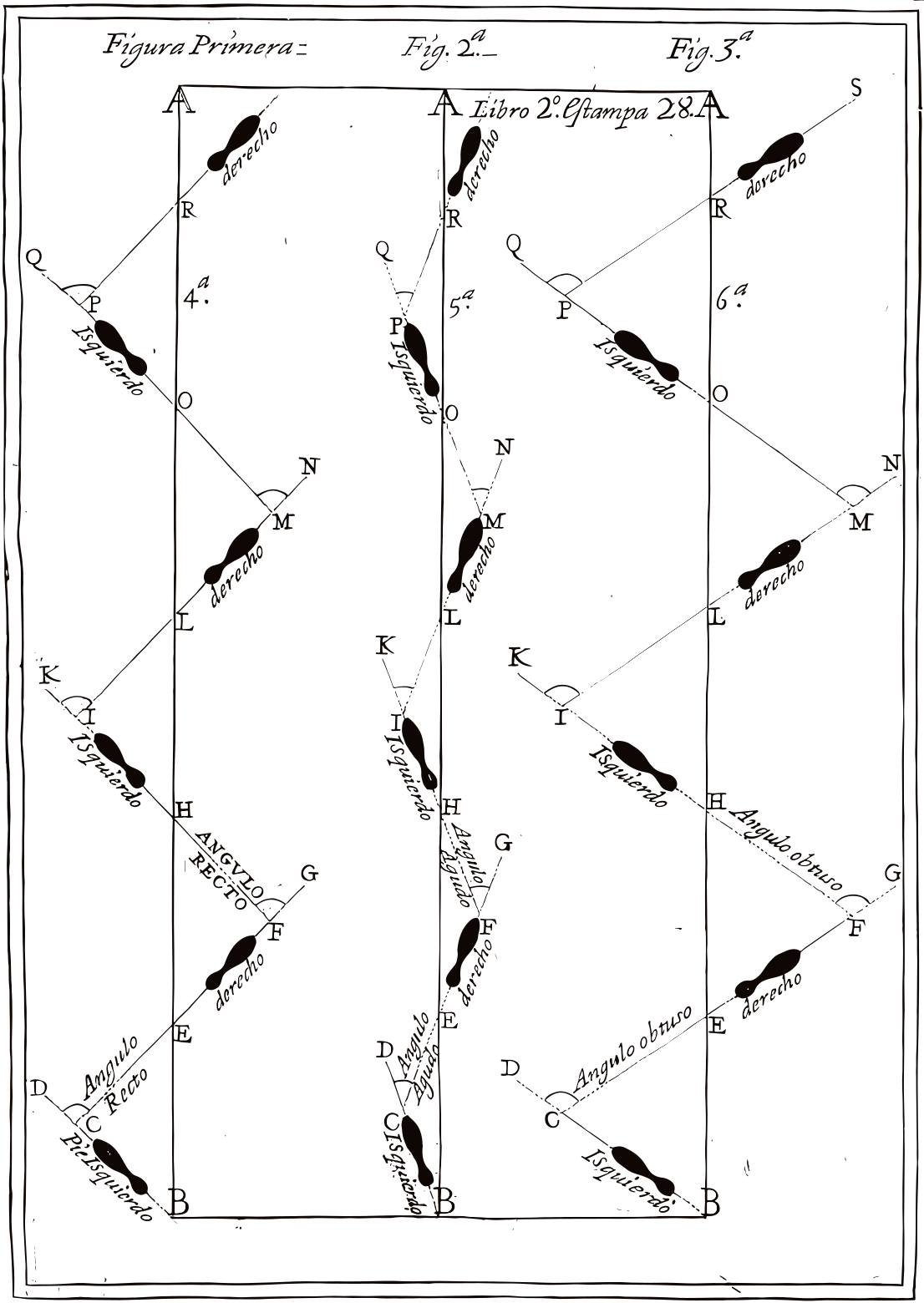
Because in the first triangle B.C.E., the angle C.B.E. is a semirect angle by construction, and the angle C.E.B. is equal to the angle H.E.F. in the triangle E.F.H., which is also a semirect angle by construction, as opposed by the 15th proposition of the first book of Euclid's Elements. Therefore, by the 32nd proposition of the same book, the exterior angle E.C.D. of the triangle B.C.E. is a right angle, formed by the intersection of the lines passing through the tips and lengths of the feet extended, G.E. at C. and B.C. at D., at point C.
Because in the second triangle E.H.F., the angle H.E.F. is a semirect angle by construction, and the angle F.H.E., opposite to the angle L.H.I. in the triangle H.I.L. (also a semirect angle by construction), is equal to it by the 15th proposition of the first book of Euclid's Elements. Therefore, by the 32nd proposition of the same book, the exterior angle H.F.G. of the triangle E.F.H. will be a right angle, formed at the intersection of the lines passing through the tips and lengths of the feet extended, K.F. at E.G., at point F.
Let the line A.B. represent the common section of the vertical plane of the chest with the horizontal lower plane, and let B.C., occupied by the left foot, form an acute angle of 22.5 degrees with A.B. Similarly, let E.F., on the other side of A.B. and occupied by the right foot, make another acute angle of 22.5 degrees with A.B., such that the distance B.E., from the center of one heel to the center of the other, is two feet, one solid and one hollow.
In the second triangle E.F.A. of this second figure, the angle H.E.F. is constructed to be 22.5 degrees, and the angle F.H.E., opposite to the angle L.H.I. (also constructed to be 22.5 degrees), will be equal to it, as per the 15th proposition of the first book of Euclid. Therefore, the exterior angle H.F.G. of the triangle E.F.H. will be a semirect angle, formed at the intersection of the lines extending from the tips and lengths of the feet, I.F. at E.G., at point F.
Let the line A.B. be the common section of the vertical plane of the chest with the horizontal lower plane, and let the line B.C., occupied by the left foot, form an obtuse angle of 67.5 degrees with A.B. Similarly, let E.F., which is occupied by the right foot, form another obtuse angle of 67.5 degrees on the other side of A.B., such that the distance B.E., from the center of one heel to the center of the other, is two feet, one solid and one hollow.
In the triangle B.C.E., the angle E.B.C. is constructed to be 67.5 degrees, and the angle C.E.B., opposite to the angle F.E.H. (also constructed to be 67.5 degrees), is equal to it, as per the 15th proposition of the first book of Euclid. Therefore, the exterior angle E.C.D. of the triangle E.B.C. is an obtuse angle of 135 degrees, formed by the intersection of the lines F.E. extended to C and B.C. extended to D, at point C.
If, with the line of direction on the right foot occupying E.F., one takes a step with the left foot to occupy H.I, then an obtuse angle of 135 degrees will also be formed by the intersection of the lines extending from the tips and lengths of the feet, I.H. extended to F and E.F. extended to G, at point F.
In the second triangle E.F.H. of this third figure, the angle H.E.F., constructed to be 67.5 degrees, and the angle F.H.E., opposite to the angle L.H.I. in the triangle I.H.L. (also constructed to be 67.5 degrees), will be equal to it, as per the 15th proposition of the first book of Euclid. Therefore, by the 32nd proposition of the same book, the exterior angle H.F.G. of the triangle E.F.H. will be an obtuse angle of 135 degrees, formed by the intersection of the lines I.H. extended to F and E.F. extended to G, at point F.
From the explanation and demonstration of all these figures, it is established that for the body to be firmly positioned, and to move forward more naturally, with firmness, good posture, and strength, the best position is that of the right angle. Each foot should be positioned at a right angle with respect to the vertical plane of the chest, so that they are equally distant from it, and this right angle is formed by the intersection of the lines that pass through the tips and lengths of both feet, as seen in the first figure of these last three. When the body is affirmed upon this right angle, it is the most perfect and capable posture among all others. In this position, the line of direction extends further to resist the impulses of the body, both to its sides and to the front, as demonstrated in the fourth figure of the first four. This conclusion is drawn from the explanations made of the different positions in which the body can be affirmed, following them successively, and particularly from what has been demonstrated in the first figure of these last three.
Because if this right angle is compared with the acute angle caused by each foot in the same vertical plane of the chest, with the lines imagined passing through the tips and their extended lengths of twenty-two and a half degrees, and with the concurrence of both lines forming a forty-five-degree semirect angle; it is found that this way of walking is not at all suitable for the Art of Fencing, and that it is best used for walking forward more quickly, because as the feet step closer to this vertical plane of the chest, less time is spent, and steps are taken more easily in this manner; however, it is not as secure, because on the outer side of the feet on either side, the line of direction has less extension than in the posture where a semirect angle with the same plane and a right angle is formed, as referred, with the lines passing through the tips and extended lengths of the feet.
If this same posture of a right angle is compared with the way of walking in an obtuse angle as shown in this third and final figure, it is found to be unnatural and unsuitable for the Art of Fencing, and that the line of direction has very little extension towards the front; this results in a risk of the body's impulses, besides the fact that steps will be taken with difficulty, because the body will be strained as each foot is so far from the vertical plane of the chest. Indeed, each foot, with the line imagined passing through its tips and extended lengths to the same plane, on both sides, forms an acute angle of 67.5 degrees, and with the concurrence of both extended lines, an obtuse angle of 135 degrees.
From what has been explained about the ways in which the body can be positioned, it is understood that although no other species is predicated of the right angle, when wanting to take advantage of it for the Art of Fencing and its use, it is found that it has its differences. For instance, the right angle that has been praised as the most natural and perfect, formed when each foot is equally distanced from the vertical plane of the chest, is different from the right angle on which the body is affirmed. For example: When occupying the right collateral plane with the length of the right foot and the center of the left foot, and if a straight compass step forward is given through the same plane, it is followed by the left foot without moving the center of the heel from this plane. In this posture and way of walking, the vertical plane of the chest is left to its left side, which shows the difference, and that this way of walking is not natural, and will not be so in any direction where this step is given with the right foot, followed by the left; although it will be with other differences in carrying the body more or less strongly, depending on the nature of the planes through which it is given.
The right angle on which the body is affirmed with the left foot in front, for the movement of conclusion, in its left collateral plane, also leaves the vertical plane of the chest on its right side; and this position is also not natural, although for this purpose it is necessary that it can be affirmed in this way.
Even if the Fencer is left-handed, they can also affirm themselves, forming a semirect angle with each foot in their vertical plane of the chest, and a right angle with the concurrence of both lines, imagined passing through the tips and lengths of the feet produced, as has been explained for the right-handed person. Although for the use of Fencing with the sword in hand, it will not be as favorable for the left-handed person, but here we are only discussing the possibility.
The left-handed individual can also affirm themselves in their left collateral plane, with the left foot forward and the center of the right foot in the same plane, on a right angle, as has been explained. In this position, the vertical plane of the chest will be left to their right side, which also recognizes the difference of this position with the others on a right angle; and this position will not be natural either, nor will it be so for any other plane through which this compass step is given with the left foot, followed by the right foot; although it will be with its differences of being more or less weak, depending on the planes through which it is given.
If the left-handed person proceeds to make a concluding movement against a right-handed person, they will be affirmed on a right angle with the right foot forward in their right vertical plane, and the center of the heel of the left foot in it, leaving the vertical plane of the chest to their left side. In this position, the differences it has with the other postures on a right angle are also recognized: and although this is not natural, it cannot be avoided in this movement of conclusion.
The other right-angle positions are observed for the execution of tactics and for the block, due to the posture of the Sword in order to ensure the Fencer's greater safety; nor will any of the other positions that deviate from that of the right angle, participating more or less in the extremes that are usually caused outside of it, be natural, and all are less perfect than the posture of our right angle, which enjoys primacy among them, as deduced from the explanation and demonstration.