Many things are done by people without giving them much thought, as they are seen as natural dispositions inherent in their organization. For example: Although people have the use of their senses, most do not speculate on the causes of their operations, leaving them as matters that belong to philosophers.
It is also very natural for humans to place their feet firmly on the ground and to walk, moving the body from place to place through steps. There will be few who ponder the reason for this, nor the differences observed in walking, as each person walks according to their organization, or by habit usually acquired in childhood. Some walk with their feet in parallel lines, others form an acute angle with the convergence of lines imagined passing through the tips and extended lengths of the feet; others form with these same lines a right angle, and others an obtuse angle. Undoubtedly, the most natural and refined way of walking is when these lines form a right angle between each other, as will be explained later.
Although some authors have said that walking consists of rest and effort, they do not explain the basis of this natural operation, nor anything related to it. Therefore, it is necessary to do so to better understand the positions of the body with the feet in terms of the use of Skill, and its artificial movements from place to place through compass steps. Although I have seen most of what has been written on this subject in Spain, and other parts of Europe and America, I have not found anyone who explains these compass steps, other than that they are accepted as precepts that deviate from natural walking. Considering that the closer they are to being natural, the easier they will be, and the less force will be needed, I have been compelled to this speculation, and others, which are explained later in this book. This is because it is one of the two universal foundations to which the practical part of skill is reduced, as it involves nothing more than movements of the body on the ground and the lower horizontal plane, and of the arm and sword in the air.
Since philosophers and mathematicians have not taken it upon themselves to write expressly on this subject to provide the necessary insights, I have deemed it appropriate, for the common benefit, to try to explain it through simple means that anyone can experience for themselves if they wish. For greater clarity, this will be done using figures.
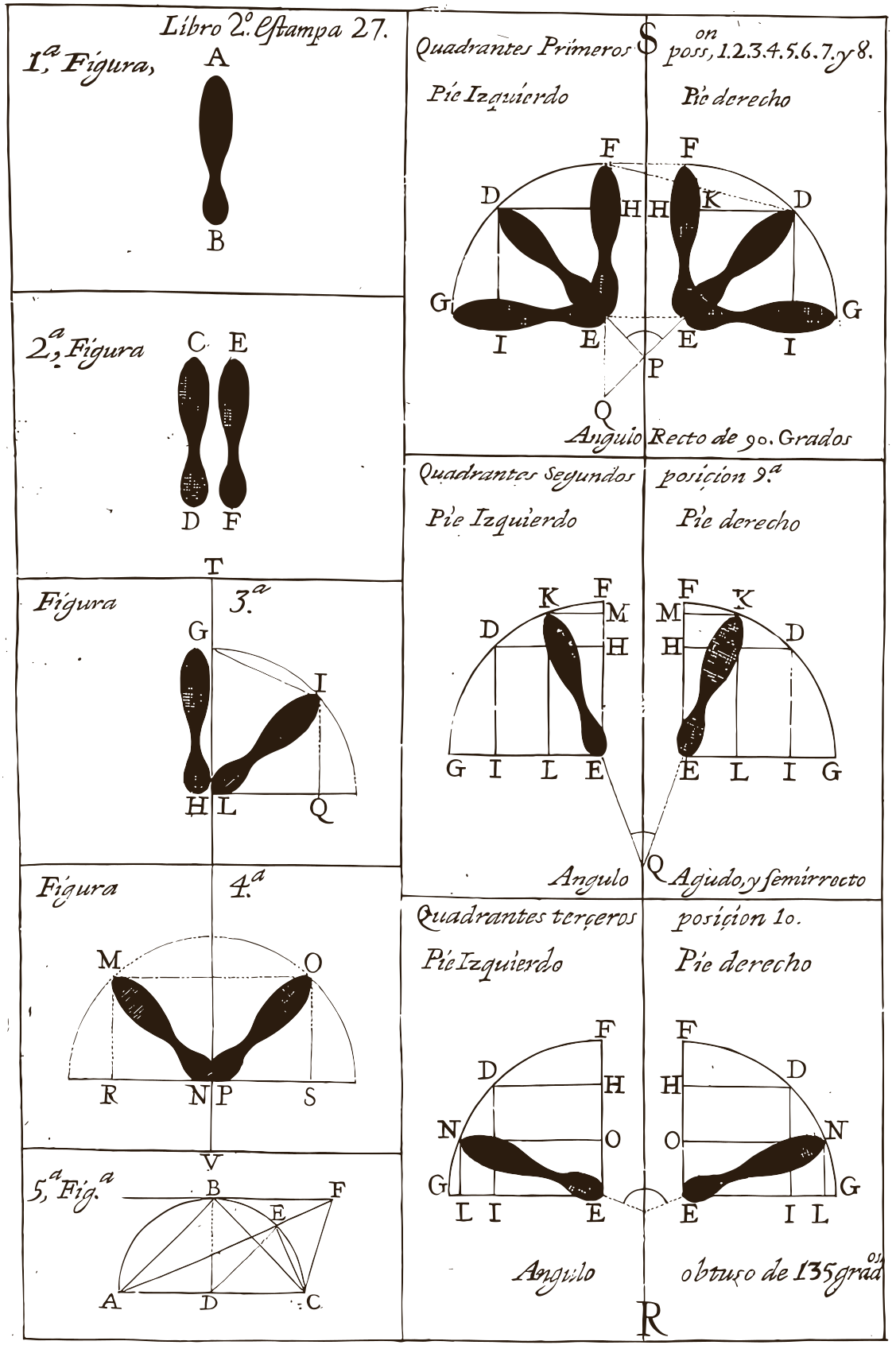
To answer this question, it is necessary to recall what we have said about the nature of the center of gravity and the line of direction, which is imagined in every heavy body. For the human body to be supported, it must not extend beyond the base formed by its feet. The larger this base, according to our definition, the better the human body, which is similar to a column, will be supported. The wider the base, the stronger it will be; and if narrower, weaker. As the width of one foot is not a sufficient base for the body to remain stable on it, due to its limited size relative to the body's weight, it will be very close to moving outside of the line of direction and falling. From this, it follows that the body will be more firmly supported on two feet, as in the second figure, because its width and base will be greater than when supported on just one foot, as in the first.
In the third figure, the left foot is placed near the vertical plane of the chest T.V. at G.H., and the right foot is on the other side of this plane, occupying L.I., which forms an angle with the same plane. Thus, the line of direction extends across the entire area of the triangle G.H.I, the base of the body, which is larger than the area in the second figure.
It also follows from the explanation that the body will be in the third position, or any other, with the right foot at P.O. and the left foot at N.M., with the tips of both equally distanced from the vertical plane of the chest T.V., such that with it, each foot forms a right angle, and together, they form a right angle. In this position, the line of direction will extend over the entire area of the right-angled triangle M.N.O., the base of the body. And because this seems to require evidence to make it clear, I will demonstrate it.
Draw the line B.F. parallel to the base A.C. Extend A.E. until it intersects with B.F. at point F. Because the triangles A.B.C. and A.F.C. have the same base A.C. and are between the same parallels A.C. and B.F., they will be equal to each other according to Proposition 37 of Book One of Euclid's Elements. However, the triangle A.F.C. is larger than the triangle A.E.C. Therefore, the triangle A.B.C. will also be larger than the same triangle A.E.C.
The scalene triangle A.E.C. will be divided into two other isosceles triangles, one obtuse-angled A.D.E. and the other acute-angled D.E.C. And given that the entire isosceles triangle A.B.C. was larger than the other scalene triangle A.E.C., their halves will also be larger than their respective halves.
From this, it follows that of the two triangles having their base on the circumference of the circle and the vertex at the center, as in the triangle A.D.B. with the base A.B., in the triangle A.D.E. with the base A.E., and in the triangle E.D.C. with the base E.C., the largest and most capacious is the right-angled triangle A.D.B. Therefore, the right-angled triangle M.N.O. in our fourth figure will be more capacious than any other acute-angled or obtuse-angled triangle; consequently, the body will be stronger when affirmed in this position with the feet on this right angle, as it has a greater extension of the line of direction in it than in the other two.
The explanation of the four preceding figures aims at the purposes referred to in each of them; and since the positioning of the feet is so important for the use of Skill, and the movements of the body are one of its principal foundations; it is necessary to investigate the differences that can exist in the positioning of the feet, their conveniences or inconveniences, what is not possible in the organization of the human body, and which of all the positions is the most perfect: for better and clearer understanding, we will be explaining them through figures, first describing two quadrants, where the various modes of affirming the body will be placed, to more easily examine their positions.
Describe two quadrants of a circle E.G.D.F. on each side of the line S.R. which we imagine to be the common section of the vertical plane of the chest with the lower horizontal plane, and in both quadrants draw the lines E.G., E.D. and E.F. in such a way that the line E.D. divides the two quadrants into two equal parts, and in them form the squares E.I.D.H. In each of these quadrants, let the right foot occupy the E.F, E.D. and E.G. on the right side of the line S.R., and let the left foot occupy the E.F. and E.D. and E.G. on the left side of the same line S.R., as seen in each of these quadrants.
This position is flawed and unnatural because the line of direction needs to resist the two impulses of the body forward, and the two, to have at the same time extension on both sides in a way that can comfortably stand; and in this case, although the line of direction has the space between the two feet and their widths, it does not have it for the sides more than in the width of each foot, and it is not a sufficient amount for the body to subsist much, and to walk in this position with the necessary security to not fall, as explained in the first and second figures of the first four: moreover, this way of walking is not very natural, nor of good air, and for Fencing it only serves to dispose in this position in such a way that the points of contact are removed from the opponent, and to have more reach on him.
If the left foot remains affirmed in the same line E.F. in its quadrant parallel to the vertical plane of the chest S.R., and moves over the center of the right heel, passing it to occupy the E.D., the body will be affirmed at a right angle, which is formed by the line imagined to pass through the tip and length of the right foot, produced with the line imagined to pass through the tip and length of the left foot, also produced at point Q, parallel to S.R. This increases the base and the extension of the line of direction more than what was in the preceding position by the space of the triangle D.E.K. in the quadrant on its right side.
If the left foot is in its quadrant, occupying the same line E.F., and moves over the center of the right heel from the line E.D. to occupy E.G., the body will be affirmed at a right angle. This is formed by the line imagined to pass through the tip G. of the right foot, and its length, produced in the line imagined to pass through the tip F. of the left foot, and its length parallel to the vertical plane of the chest S.R. at point E. This increases the base of the body more than what it had in the position before this, and the extension of the line of direction by the quantity I.G. in its right collateral plane; in such a way that the line of direction, in this position, extends in the length and width of the entire left foot E.F. and the distance from the center of this foot E. to point G., where the tip of the right foot ends.
If the left foot occupies the line E.D. in its quadrant and the right foot the line E.F. in its own, the body will be affirmed only at a semirect angle. This angle is formed by the line imagined to pass through the tip D. of the left foot, and its length, produced in conjunction with the line imagined to pass through the tip F. of the right foot, and its length, also produced parallel to the vertical plane of the chest S.R.
This position is similar to the second one, with the only difference being that in this one, the semirect angle is caused on the left side of the same vertical plane, while in the second position, it is on the right side; therefore, what was explained about the second position should also be understood for this fourth position.
If the right foot remains in its quadrant occupying E.F. as in the previous position, and if the left foot moves over its heel in its quadrant to occupy E.G., the body will be affirmed at a right angle with the left foot forward. This is caused by the line imagined to pass through the tip F. of the right foot, and its length parallel to the vertical plane of the chest S.R., and the line imagined to pass through the tip G. of the left foot, and its length, converging at point E. on the right side.
If the body is affirmed with the feet in parallel lines in each of its quadrants, occupying E.F. and E.F., and then moves over the center of the heel of each one to occupy E.D. and E.D., it will be affirmed at a right angle. This is caused by the line imagined to pass through the tip D. of the left foot, and its length, converging with the line imagined to pass through the tip D. of the right foot, and its length, with both converging at line S.R., the common section of the vertical plane of the chest with the horizontal plane below, at point P. This results in the centers and tips of the feet being equally distanced from this line S.R.
This posture and right angle is the most spacious of all other angles, as has been demonstrated in the fourth position of the first four positions explained before these, and it is the most perfect and natural, where the body is most robust, graceful, and strong, both when affirmed in it and when walking forward, if this right angle is maintained in its steps. It is the most appropriate for the use of Fencing, as explained in the first figure of the last three that follow these positions being explained.
If the body is affirmed at a right angle, as assumed in the position before this, and one wishes, while keeping one foot firm, to move over the center of the heel of the other foot to occupy E.G., although this action is possible, the body will be strained, and the line of direction will have little space for the front part. The feet will form an obtuse angle of 135 degrees between them, a flawed posture, and little or not at all suitable for Fencing.
If each foot occupies in its right and left quadrant the line E.K., they will form with the lines that are imagined to pass through the points KK. and their lengths, produced by EE. in the line S.R. at point Q., an acute angle of 22.5 degrees on each side, and the body will be affirmed on the semirect angle of 45 degrees caused in it.
If each foot occupies the E.N. in its quadrant, the body will be affirmed on an obtuse angle of 135 degrees, formed at the meeting point of the lines that are imagined to pass through the tips of the feet NN. and their lengths, produced in EE. and converging at R. At this point, this angle intersects the line S.R. Although the line of direction extends to the sides at E.L. and forward at E.O., it is a short distance for maintaining this position and resisting the body's forward impulses. Moreover, this position is hardly natural and is of no use in Fencing.
The first position is with the right foot forward, the second with the left foot forward, and the third is caused by the lines that are imagined to pass through the tips of the feet and their lengths, which, when produced, each will form a right angle with the vertical plane of the chest. This common intersection with the horizontal lower plane represents the line S.R., and the convergence of both forms a right angle on the same line at point P.
This posture, as has been said, is the most spacious, natural, and perfect, both for being affirmed in it and for moving forward with integrity and grace. This is because the vertical plane of the chest is equally between both feet, as has been demonstrated, and its capacity is greater than any other position, in which the line of direction extends further; and for moving forward, it equally forms a right angle with its steps, with the same line S.R. on both sides, a right angle with each one, and a right angle with both, as will be demonstrated shortly.
It is also established that the body can be affirmed on parallel lines, and although this is not a position that is useful in Fencing for moving forward, it can be advantageous for better removing the degrees of the profile from the opponent, giving them less disposition to offend, and for having more reach in them, using this position according to the precepts of the Art.