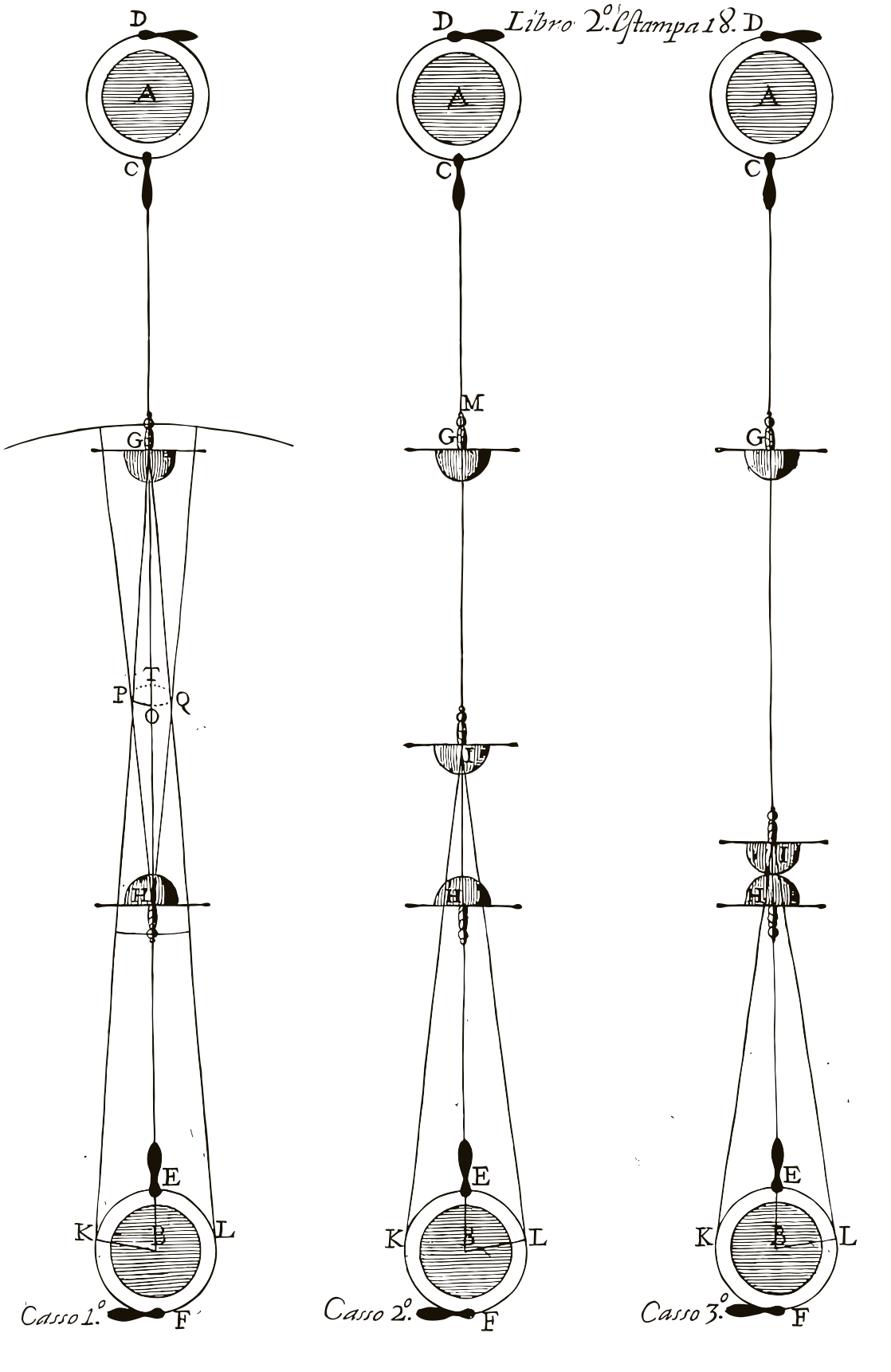
Given that both combatants are affirmed in A.B. on the right angle D.C. and F.E. in the middle of proportion, with their Swords in the primary vertical plane passing through their right vertical planes, we want to examine the amount of movement or portion of the Pyramid the Diestro must make to the right and left to place or contain the opponent's Sword outside the two imaginary defense planes, ensuring that the tip doesn't have a direction toward their body and the cylinder in which we consider them.
Draw the line A.B. of nine feet, in which we imagine the primary vertical plane. Take the lines A.C. and B.E., each one of half a foot, and the remaining C.E. will be eight feet, the distance we have demonstrated must be the middle of proportion, and centers A. and B. The interval A.C. and B.E. describe the circles C.D. and E.F., which will be the bases of the cylinders in which we consider the two opponents. Take the C.G. from the center C. of the opponent's arm to G. the center of the guard of their Sword, measuring two feet and a quarter, and the same measurement from the center of the Diestro's arm E. to H. the center of the guard of their Sword. Draw from the center G. of the opponent's guard the two tangents G.K.G.L., through which we imagine pass the two vertical defense planes that touch the cylinder containing the Diestro in the posture they are affirmed in.
Divide H.G. in the middle at point T. Take T.O. of four fingers and draw O.P. perpendicular to G.K. O.P. will be the smallest movement the Diestro must make to place the opponent's Sword on their left side in the defense plane G.K. and on their right side in G.L. from this intersection O. of the Swords in the primary vertical plane A.B., and it's examined in this manner.
Draw the line B.K., which, by proposition 18 of the third book of Euclid's Elements, will be perpendicular to G.K. And as O.P. is also perpendicular to the same by construction, they will be parallel to each other. Consequently, by proposition two of the sixth book of Euclid's Elements, the sides of the triangle G.B.K. will be divided in the same proportion, and the triangles G.B.K. and G.O.P. will be similar. So, as G.B. is six feet and a quarter, or 100 fingers, to B.K. of half a foot, or eight fingers, so will G.O. of two feet, or 32 fingers, to another fourth proportional, which comes out as 256/100, which is two fingers and a little more than half. This is the amount of O.P. and the movement the Diestro must make to place their Sword, from the primary vertical plane A.B., into the two defense planes G.K. and G.L., on either side, as demonstrated in the first figure.
Given the same conditions as in the previous case, except that in this one, we assume that both opponents are at the distance of the proportionate medium for thrusts that are on the circumference of the sixth orb of the Diestro, having moved two feet from the proportionate medium, from point C to point M. Consequently, the center of his sword guard has moved to point I to strike with a thrust.
Draw the two tangents I.K.I.L. to the cylinder, draw B.L. to the point of contact, and it will be perpendicular to I.L. Draw H.N. perpendicular to I.B., and two similar triangles will be formed, placed subcontrarily, because both are right-angled and have the common angle at I. Thus, the corresponding sides will be proportional, and it will be as I.L. to L.B. is to I.H. to H.N. But since there is so little difference between I.L. and I.B., instead of I.L., we take I.B., saying as I.B. to B.L. is to I.H. to H.N. But of these four proportionals, three are known: I.B. is four feet and a quarter, which is 68 fingers, B.L. is half a foot, which is eight fingers, and I.H. is one and a half feet, which is 24 fingers; and performing the rule of three, the result for H.N. is slightly less than three fingers. Thus, it becomes evident that with the semi-diameter of the Diestro's guard being four fingers on each side, with the aforementioned three fingers, without the Diestro making a move, he achieves defense with his guard, as verified by the second figure.
Given the same conditions as in the previous two cases, except that in this one the opponent took a three-foot step from the medium of proportion to step on the fifth orb, which is the medium for cuts, intending to execute them. Consequently, the center of his sword guard comes to be three feet less a quarter away from the Diestro.
Draw the two tangents I.K.I.L. to the Diestro's cylinder, and B.L. to the point of contact, and at the Diestro's sword guard, draw N.H. perpendicular to I.B. This will form the similar triangles I.L.B. and I.N.H. By the same reasoning given in the previous case, it will be as I.B. is to B.L. is to I.H. to H.N. However, I.B. is three feet and a quarter, which is fifty-two fingers, B.L. is half a foot, which is eight fingers, I.H. is another eight fingers, and H.N. will be a quarter; and forming the rule of three, the result is one finger and three quarters of another finger. Since the semi-diameter of the Diestro's guard is four fingers, this exceeds the necessary amount for his defense in the guard on both sides by two fingers and a quarter, as demonstrated in the third figure.
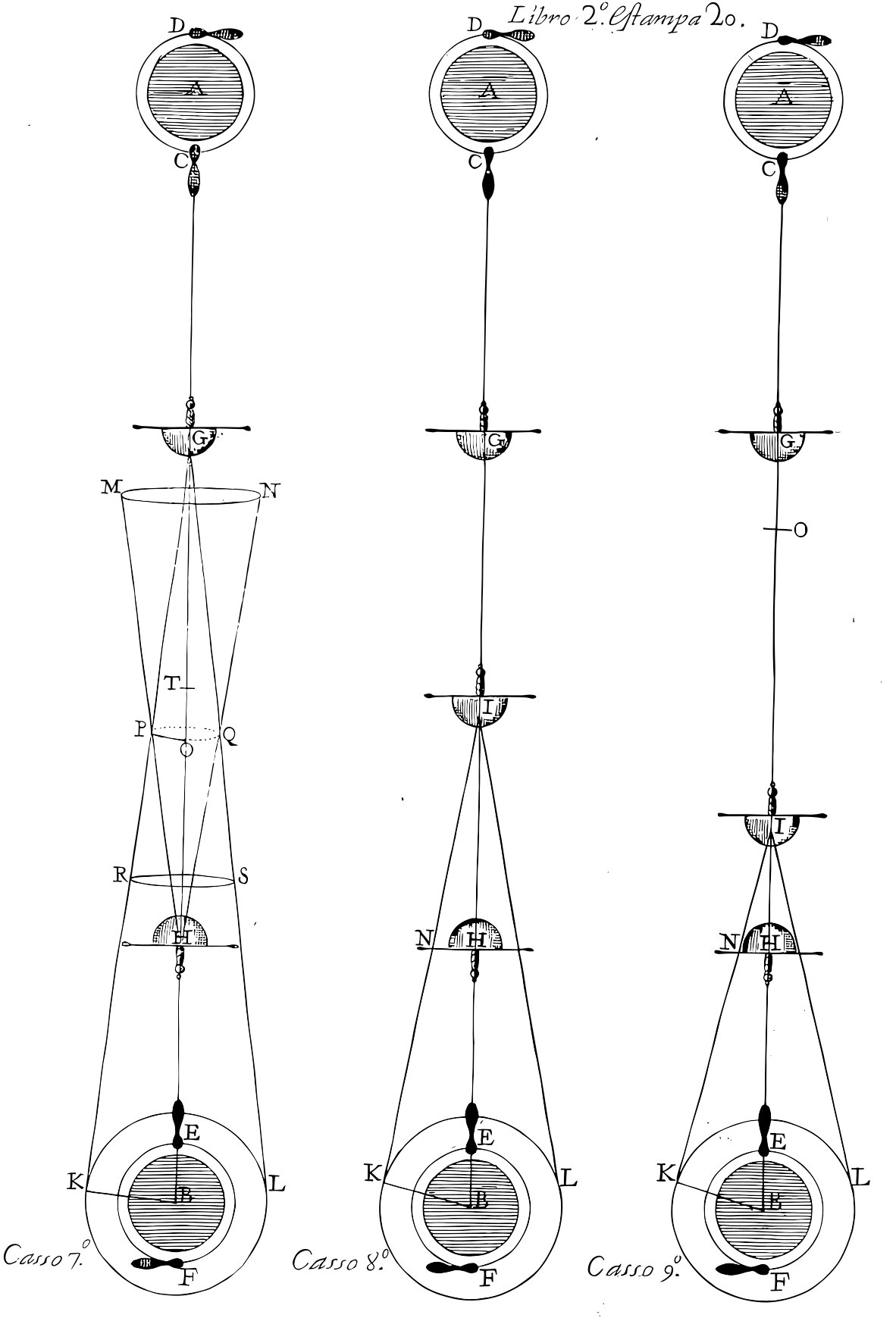
Given that both opponents are affirmed in the medium of proportion C.E. as in the previous cases, the opponent is in his right vertical plane at a right angle and above the right angle on the base of his cylinder, which has a diameter of one foot at D.C., and the Diestro in his right collateral plane, also at a right angle and above the right angle at F.E. Since more width is exposed in this plane, the base of his cylinder K.L. is given a diameter of one and a quarter feet. We want to examine how much movement or portion of a pyramid the Diestro must make with his sword to the left or right to place it or contain it outside the two vertical planes of his defense.
Draw the tangents G.K. and G.L. Draw the B.K. to the point of contact. Divide the G.H. which is between the two centers of the quillons in half at T. Take a quarter of a foot from T. to O. Draw O.P. parallel to B.K., which will be perpendicular to G.K., forming two similar triangles G.B.K. and G.O.P, and their corresponding sides will be proportional. It will be as G.B. is to B.K. as G.O. is to O.P. However, of these four proportional values, three are known: G.B. is six feet, which is thirty-two fingers; forming the rule of three in this order, it is found that O.P. is three fingers and one ninth, which is the amount of movement that the Diestro must make at this intersection of the swords with his defensive Pyramid P.H.Q. to place with a portion of it the opponent's sword, from the primary vertical plane, on both sides, outside the planes of his defense G.K. and G.L., as seen in the figure.
Given the same conditions as in the previous case, except that in this instance, the opponent steps forward two feet from point C to point G to strike a thrust at the Diestro, moving the center of his quillon guard from point G to point I. This results in point I being four feet less a quarter away from Diestro's cylinder F.E. The query is to determine how much movement, or what portion of a pyramid, the Diestro must perform from the primary vertical plane A.B. to his left side to place or contain his opponent's sword on the surface of his cylinder.
Draw the two tangents I.K.I.L. and B.K. to the point of contact, and H.N. perpendicular to I.B. This results in the formation of two similar triangles I.B.K. and I.H.N., placed subcontrarily, with their corresponding sides proportional; but for the reason given in the second case, of these four proportionals, three are known, as I.B. is four feet and a quarter, which is 68 fingers, B.K. is 10, and I.H. is one foot and three quarters, which is 28 fingers. Forming the rule of three, it is found that H.N. is four fingers; thus, the Diestro must move the center of his guard, and his quillons, four fingers to the left and right to place the opponent's sword outside the two vertical planes of his defense I.K.I.L. to remain defended.
Given the same conditions as in the previous case, except that it is assumed the opponent steps forward three feet from point C to point O to step on the Orb of cuts, vertical and diagonal reverses, and half cuts, and half reverses of the same species, and reaches with this step the center of his guard to point I. This point is three feet less a quarter away from the Diestro and allows striking with one foot of the sword; the query is to examine how much the Diestro must move the center of his guard and quillons from the primary vertical plane A.B. to both sides to remain defended.
Draw the two tangents I.K.I.L. to Diestro's cylinder F.E. and B.K. to the point of contact, and H.N. parallel to it, or perpendicular to I.K. This forms two similar triangles I.B.K. and I.H.N., with their corresponding sides proportional, as I.B. is to B.K. so is I.H. to H.N. However, of these four proportionals, three are known, as I.B. is three feet and a quarter, which is 52 fingers, B.K. is 12, and I.H. is 20 fingers. Forming the rule of three, it is found that the fourth proportional H.N. is four fingers and three-fifths, which is the amount of movement the Diestro must make from the primary vertical plane A.B. to both sides, with the center of the guard and quillons of his sword, to place and contain his opponent's sword outside the two vertical defense planes I.K. and I.L. to remain defended from any of the circular and semicircular tricks and species of them with which he may be attacked in the jurisdiction from the superior plane upwards, as verified by figure nine.
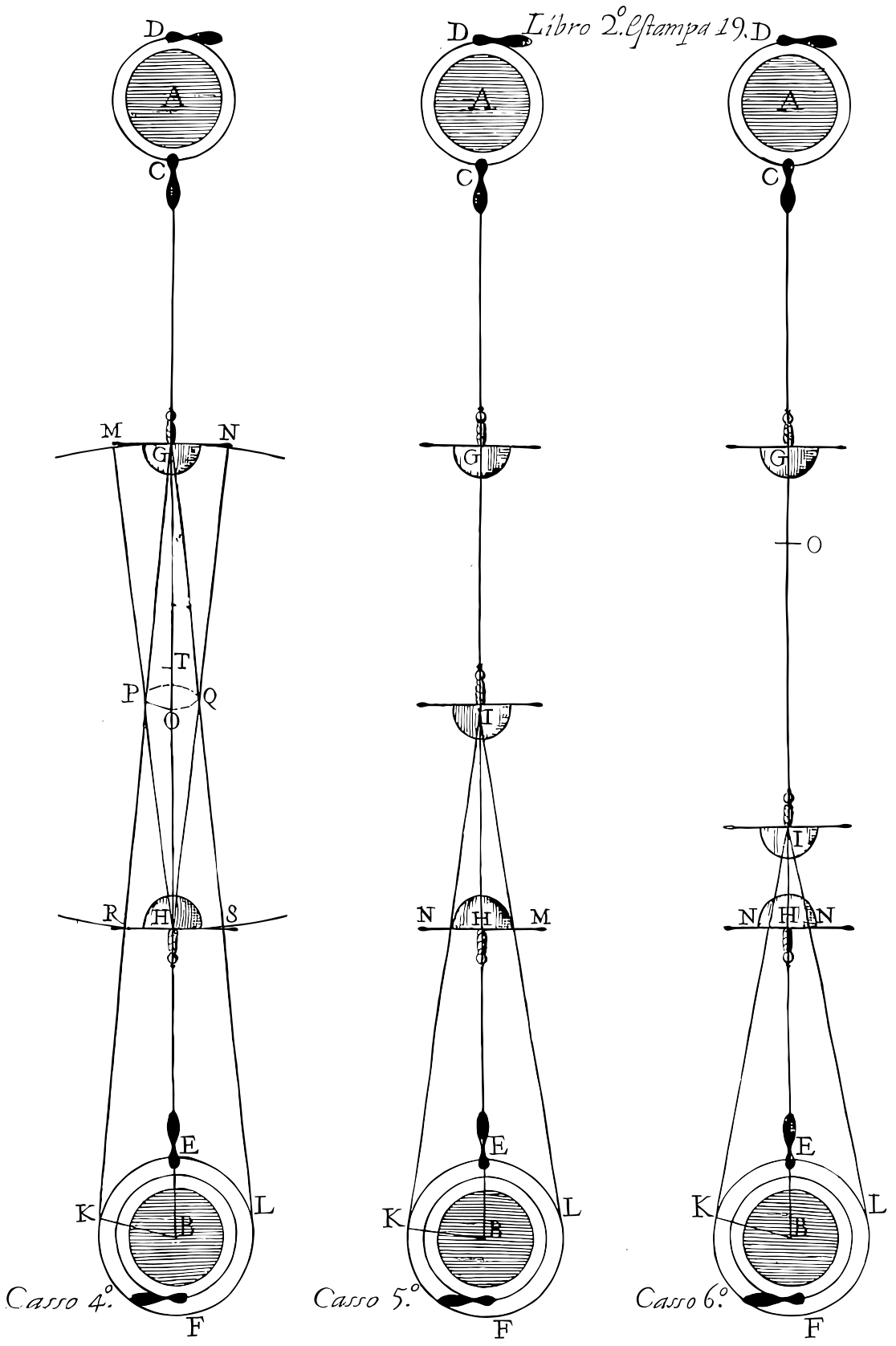
Given the same conditions as in the first and fourth cases, except that in this case, the Diestro stands with his arm and sword in his vertical plane of the chest. In this position, he loses half a foot of reach and exposes all his width, which is half a foot more than what was given to the diameter of the cylinder in the first case, where he is supposed to stand in his right vertical plane. To remain defended in this square posture, including the shoulders, the diameter of his cylinder F.E. is given as one and a half feet. The query is to determine how much movement or what portion of a pyramid the Diestro must perform with the center of his guard, from the primary vertical plane to his left and right, to place or contain his opponent's sword in the two vertical defense planes.
Draw the tangents G.K. and G.L. to Diestro's cylinder F.E. Draw B.K. to the point of contact, divide G.K. in the middle at T. Take T.O. as four fingers, draw O.P. parallel to B.K. or perpendicular to G.K. This results in the formation of two similar triangles G.B.K. and G.O.P., with their corresponding sides proportional, as G.B. to B.K. so is G.O. to O.P. However, of these four proportionals, three are known, as G.B. is six feet and a quarter, which is 100 fingers, B.K. is 12, and G.O. is two feet and a quarter, which is 36 fingers. Forming the rule of three, it is found that the fourth proportional O.P. is four fingers and a third. This is the amount of movement the Diestro must make from the primary vertical plane A.B. at this intersection, to both sides, with the defense pyramid H.P.Q. to place and contain his opponent's sword outside the two vertical defense planes G.K. and G.L. tangent to his cylinder F.E. with the center of his guard, to remain defended.
Given the same conditions as in the previous case, except that it is assumed the opponent takes a step of two feet from point C to point G to reach the first Orb of thrusts, and in this position, the center of the guard and quillons of his sword reach point I to strike a thrust at the Diestro, whose point is four feet less a quarter away. The query is to examine how much movement the Diestro must perform with the center of his guard and quillons to place and contain his opponent's sword outside the two vertical defense planes I.K.I.L. tangent to his cylinder F.E.
Draw the two tangents I.K.I.L. to Diestro's cylinder F.E. and B.K. to the point of contact, and H.N. parallel to B.K. or perpendicular to I.K. This results in the formation of two similar triangles I.B.K. and I.H.N., and their corresponding sides are proportional, as I.B. to B.K. so is I.H. to H.N. Of these four proportionals, three are known, as I.B. is four feet and a quarter, which is 68 fingers, B.K. is 12, and I.H. is two feet, which is 32 fingers. Forming the rule of three, it is found that H.N. is five fingers and two-thirds. This is the amount of movement the Diestro must make from the primary vertical plane A.B. with the center of his guard and quillons to both sides to place and contain his opponent's sword in the two vertical defense planes I.K. and I.L. tangent to his cylinder F.E. to remain defended, as shown in the figure.
Given the same conditions as in the two previous cases, except that it is assumed the opponent takes a step of three feet from point C to point O to step on the second Orb of proportionate means for circular and semicircular wounds; and in this position, the center of his guard reaches point I, which is three feet less a quarter away from the Diestro, to execute with one foot of his sword his tricks on the Diestro. The query is to examine how much movement the Diestro must make to his left and right sides, from the primary vertical plane A.B. to place and contain his opponent's sword outside the two vertical defense planes.
Draw the two tangents I.K.I.L. to Diestro's cylinder F.E. Draw B.K. to the point of contact, and H.N. parallel to it, or perpendicular to I.K. This results in the formation of two similar triangles I.B.K. and I.H.N., with their corresponding sides proportional, as I.B. to B.K. so is I.H. to H.N. However, of these four proportionals, three are known, as I.B. is three feet and a quarter, which is 52 fingers, B.K. is 12, and I.H. is 20 fingers. Forming the rule of three, it is found that the fourth proportional H.N. is four fingers and three-fifths. This is the amount of movement the Diestro must make from the primary vertical plane A.B. to both sides, with the center of the guard and quillons of his sword, to place and contain his opponent's sword outside the two vertical defense planes I.K. and I.L. to remain defended from any circular and semicircular tricks and their species aimed at him in the jurisdiction, as verified by figure nine.