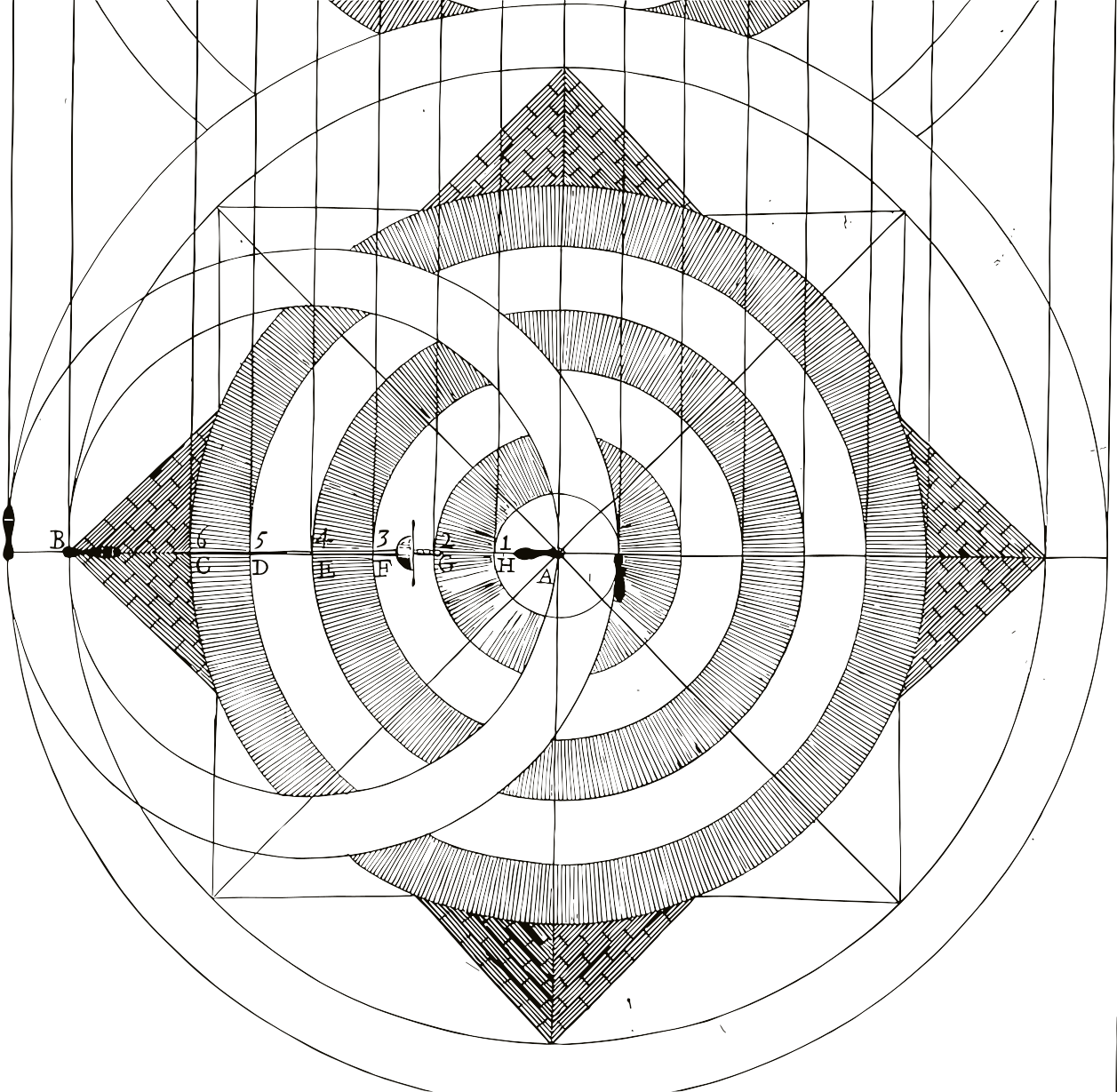
The first thing we assume for a better understanding of what is intended to be explained is that the most universal discovery for the practical use of Skill are four movements; two that belong to the body and the other two to the arm and Sword; to which correspond another four terms, which are to impede the plane, to apply the plane, to oppose the plane, and to strike through the plane.
The first of these terms concerns the arm and Sword of the Diestro, to impede the plane through which their opponent must move to attack, ensuring safety to move to the second term, which pertains to the body, making a movement from one place to another through some of the compasses that must precede the proposition intended to be executed. Thus, in the newly acquired position, they can apply the primary or common plane to their opponent's particular plane corresponding to it, simultaneously opposing it with their own particular plane on which they have an advantage, which pertains to the third term; and with this, they can proceed to the fourth, which will be to strike their opponent through the same primary plane in which it was applied.
The Diestro will achieve the aforementioned safely due to the inequality they have with their adversary and the advantage of their particular plane over their opponent's plane in which they have applied the primary one. By adhering to these precepts, the Diestro will execute all tricks with complete perfection and safety, as none are excluded from this universality.
The Diestro must always create the primary plane in their particular plane, which is more advantageous than their opponent's particular plane, to which they will have to give opposition through the same primary plane when applied. This means if it is weak, for example, if the Diestro has applied the primary or diametrical plane, which is strong, on the right vertical of the opponent, which although having greater reach is weak, the Diestro will overcome it with the opposition of their diametrical plane, which is stronger. And if the opponent has their diametrical plane of the chest forward, although it is stronger there, it also has less reach. Thus, in this case, the Diestro will oppose their right vertical plane of greater reach, trying to act from the farthest end so that the opponent cannot counter with their greater strength. In any proposition, the Diestro must govern themselves in a way that they always have a known advantage over the opponent, benefiting from the aforementioned precepts.
The aforementioned explanation boils down to how to apply the primary or common plane to the particular planes of the opponent and which ones the Diestro will put of their own, or the same primary plane, so that they can achieve, through scientific knowledge and use of these planes, the necessary inequality with their opponent.
Now it's necessary to know the principal and most universal ways in which the Diestro, assuming they are affirmed on the right angle and in the right angle, can communicate their Sword with their opponent's for more clarity, so that they can achieve the inequality and use of these planes discussed in the previous chapters. The first methods are reduced to four.
The third is that having the Diestro's Pyramid of the arm and guard in its place as the principal wall of their defense, they will lower their Sword to the acute angle, making contact with the opposing one from the inside and carrying it to their left side as necessary, observing the teachings given in its place.
These four methods are the most universal for the Diestro to safely communicate their Sword with the opponent's and apply the primary vertical plane to one of the opponent's particular planes. Simultaneously, with the same safety, they can oppose one of their particular planes through the same primary plane, which has an advantage over the opponent's.
It should be noted that when the Diestro finds contact on the opponent's Sword at the time they communicate with theirs, they will act according to the disposition it provides, and through the assaults they can make from the side they find themselves on to strike, using diversions or through the same Sword if it's not in its place.
But when the opponent only makes contact with their Sword on theirs, in this case, the Diestro can form the four general tricks on the side of the body or through the posture of the Sword because they will be capable of including it in one of their Pyramids or carrying it with pressure from them into one of the two vertical planes of their defense, according to the quality of the trick they intend to perform.
Through the blocks and other dispositions that will be mentioned in their place, the Diestro can proceed to make a concluding movement, and having done so, the opponent's Sword will be in the vertical plane of their defense on their left side, more securely than in any other part. In all this, the Diestro will act according to the dispositions they have, following the precepts of the Art.
The Diestro can step with the left foot to the same side and with the right foot to the right side without communicating with the opponent's Sword, impeding it with theirs from the plane through which it could immediately reduce to strike. This will be done through the posture of the acute angle. While they can impede it from the upper part, it won't be as secure. Having caused this inequality, they can strike if the opponent doesn't move, or make their assaults to achieve it through them. If the opponent does move, which will be necessary, they can also maintain their advantage to strike without risk by observing the individual precepts given for each case.
The other method is that when the opponent does not proceed as a Diestro in either jurisdiction, moving their arm and Sword away from the place where they have the defense, the Diestro will find themselves in a position to act with them as if they had completed the first three universal terms, only leaving the fourth term to be executed, which is the execution. The knowledge of this generality is considered sufficient for the Diestro to form their concepts from it. Thus, the individual explanation of it is left for the Treatise on Tricks to which we refer.