CHAPTER TWENTY-THREE
Explanation of the Other Planes Parallel and Oblique to the Horizon, of Which the Fencer Must Be Aware, to Direct Straight, Circular, and Semicircular Techniques to Their Proper Targets on the Opponent's Body; This Also Includes Knowledge of the Three Lower, Upper, and Middle Planes, All Very Necessary for the Practice of Skill in Arms.
Given a right-handed fencer positioned in a perfect right angle and with his arm and sword also in a right angle in his right vertical plane, we imagine his body, which represents the cylinder (as we have previously explained), divided into eight parts through four parallelograms and their two diagonal lines each.
The third oblique plane, represented by the line H.L. in the chest, is imagined to pass from the left arm's center H. to the right side of the waist L. It shows the movement of the sword in the formation of the diagonal thrust and also corresponds to this plane the formation of cuts to the arm from the inside.
The fourth oblique plane, represented by the line G.M., corresponds to the obliquity with which the sword moves when attacking from the inside, executing cuts to the outside part of the arm, known as elbow cuts; it should be noted that the safest and strongest cuts will be those executed perpendicularly to the elbow and wrist.
The sixth oblique plane, represented by the line L.O., also doesn't serve for striking but is as important as the previous one because it prevents the opponent from delivering immediate strikes from the upper or lower part, with the right-handed fencer placing his sword on the inside corresponding to this plane.
In the common section of these two planes, all types of movement begin, and in it are made the remissive movements and reductions on both sides, and the straightness forward with the arm and sword, which also serves as the axis of the main pyramid. In it, the vertical, oblique, and horizontal planes intersect, from whose common sections result the perpendicular, horizontal, and oblique lines. These same lines are used for considering the straightness imagined for the use of Skill, both from this upper plane upward, as in the part below it, and in the same plane.
The middle plane R.L.M.S., passing through the waist, is where the guard and the sword must be placed to have a Atajo in place on both the inside and outside from the far end: so that they do not pass from this plane, unlike when these Atajos are made from the near end because then it is necessary that the guard and the sword be placed below this middle plane, and also for the Atajo that is put on the inside to execute the thrust of the fourth circle, as will be explained in its place. And through these Atajos, which are assumed from the far end on both sides, one enters to strike if the opponent gives an opening, and if not, approaches are made to be able to offend with the types of maneuvers that the same approaches dispose of.
The Atajos made from the near end on both jurisdictions are usually for making finishing movements. And with these Atajos from the far and near end, on both sides, not only is what has been said achieved, but the opponent's ability to immediately offend is removed, and he is forced to make more movements than the Diestro to attempt to offend if he does not change posture after being blocked.
The plane T.P.Q.V. represents the horizontal lower plane (which is the ground), and thus, this plane is not imagined like the others but is real. However, it is of great importance for the use of Skill, as it is considered for this purpose. Just like cosmographers, hydrographers, and navigators use the imagination of rhumbs and other lines representing the circles of latitude or parallels to the equatorial circle to guide ships at sea and determine the location and place they are in, we too imagine straight lines representing the rhumbs by which the Diestro is to guide himself to execute his maneuvers and circles. Similar to latitude circles, these determine the place and site where the Diestro is to choose his proportionate means and measures, through the use of straight, transverse, curved, trepidation, and mixed trepidation and extraneous compasses. To regulate these compasses, we use the eight lines caused by the common section of this lower plane with the four vertical planes, which we call Rhumbs, a common circle imagined between the two combatants, a Maximal Orb for each one, considered the means of proportion, and another particular circle also for each one, with its tangents and two isosceles triangles, the other on the body's profile, whose vertices are in the inner orb of one of the two Maximal Orbs, and their bases on the tangent of the common circle. The perpendiculars and the two of these two triangles serve for the most refined aspects that have been discovered in terms of compasses, to pass with very natural disposition and great security to the places that are mathematically determined for the proportionate means of maneuvers in both jurisdictions within the common circle and Maximal Orb of the means of proportion. Also, the place and means of the block made by the sword's posture and the distance to pass to the middle of this block without risk and with ease are determined.
Also described is the Diestro standing on a right angle and in a right angle with his arm and sword on his right collateral plane and upper plane, occupying with the center of his right foot the center of his Maximal Orb in it, six other concentric Orbs, each one having one geometric foot of thickness, which correspond to the six divisions considered on the arm and sword, which are also one geometric foot apart from one another.
Of these six Orbs, one foot each in thickness, we imagine their projections on this horizontal lower plane, which are determined in it by perpendicular lines coming from the upper plane and the same divisions considered on the arm and sword. The first two Orbs from the arm's center to the wrist and pommel of the sword determine the means of proportion when the Diestro stands on it with his opponent, as it's an inviolable precept that the tips of their swords should not pass the pommels and recta lines of their wrists.
The fourth Orb is the place occupied by the left foot for the movement of conclusion, and the fifth Orb is the place for the block from the near end, and the vertical and diagonal cuts, and half cuts, and half reverses; and the sixth and last Orb is the place for first intention wounds and fourth circle, and the four general maneuvers in both jurisdictions.
In this lower plane, we describe the idea of our Fort, with its Arms Plaza, foundations, with its bastions, and circumvallation, whose construction is founded on these Orbs, and the divisions we've considered on the arm and sword in the upper plane, and its projection, as mentioned on this lower plane. We give necessary rules and precepts on how to storm and defend this Fort, as will be explained in its place.
This Fort, and all other considerations and things we've imagined in the Diestro, we also consider in the opponent, with no difference whatsoever, assuming they are affirmed in the means of proportion, as will be seen in our universal figure and its explanation, and the remarkable harmony it has among itself for the operational use of Skill, and all else that we explain through figures in their proper places, with much distinction and clarity.
Lamina dieze y ſiete del Libro ſegundo.
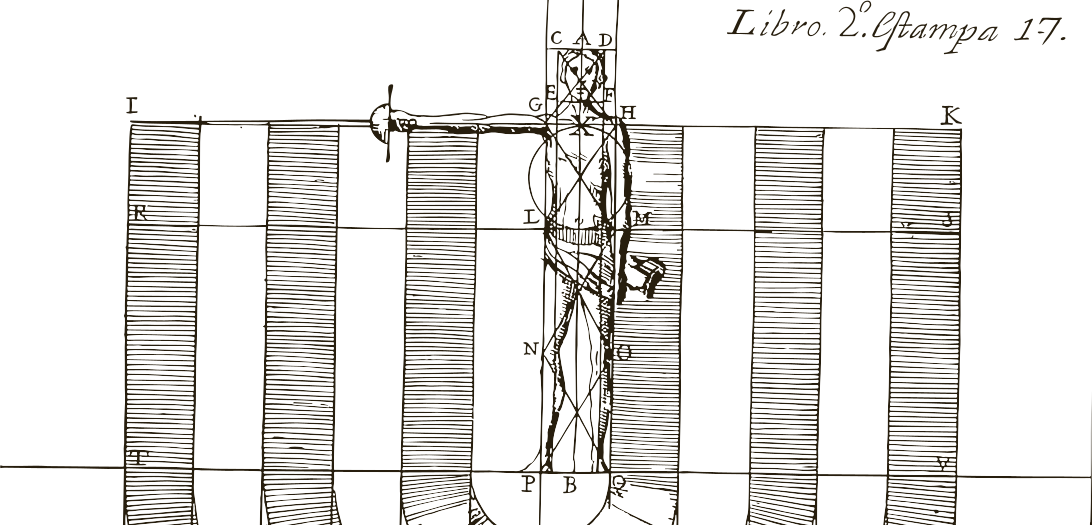
Plate seventeen of the second book.
I've split this from Plate 17 in the proceeding chapter for clarity
