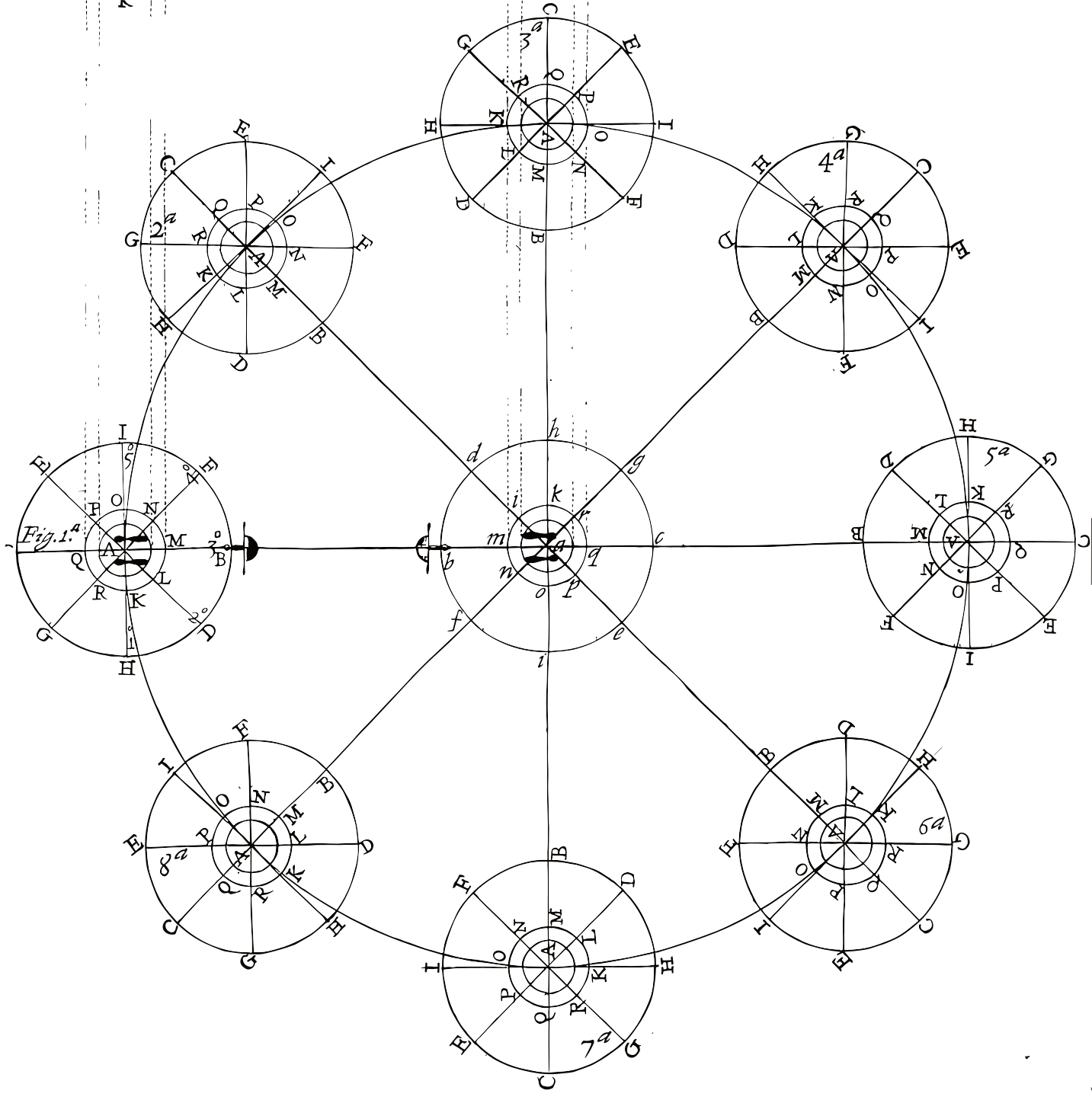
Let the maximum Orb AAAA be given, described with an interval at A of eight feet, which is the distance between the two centers or axes of the two cylinders when the two combatants are affirmed in the middle of proportion, facing each other squarely. Let the circle M.K.Q.O. be described with an interval of three-quarters of a foot (which is the base of the cylinder) in which the opponent is considered, and the outer circle B.H.C.I. be described with an interval of two feet, which is the distance from point A, center of the figure, and line of direction, to the extremity of the arm or straight line, placed at a right angle.
Making centers at the extremities of these Diameters AAAA. &c., eight figures equal in every way to the central one will be described on the circumference of the maximum Orb: the inner circle of each of them Q.O.M.K. represents the base of the Right-hander's cylinder, in which we imagine he has, as said, a diameter of a foot and a half, and the outer circle C.I.B.H with a diameter of four feet, whose Semidiameter A.B. of two feet represents the distance from the line of direction, and center of the cylinder where the centers of the feet are in lines, to the straight line or extremity of the arm.
Divide these eight circles into eight equal parts, each with another four Diameters C.B.I.K.E.D.G.F. intersecting at the center A. of each figure, where they will be divided into eight Semidiameters, representing the eight vertical planes we have imagined in the Right-hander, explained in the following way.
The other seven figures, which are also on the circumference of the maximum orb, were described with the same intervals, divisions, and letters as the first one, which we have explained and is on the circumference of the same orb. This is to understand that as the Right-hander gives his compasses to his right or left side, he will carry with him this first figure, with its particular planes and the considerations that have been made of them.
Imagine then, with the opponent affirmed squarely, his line of direction corresponding to the center of the maximum orb and of his cylinder a., and the Right-hander is also affirmed in the same way squarely in his particular first figure on the circumference of the same maximum orb, his line of direction corresponding to the center of it, and of his cylinder A. In such a way, that the Right-hander's vertical chest plane A.B., and the opponent's vertical chest plane a.b., both passing through their diametrals, are opposed, and through them passes the primary or common vertical plane A.a. that we imagine between the two, as is shown both by the figure in plan and by the bodies that have been placed in elevation.
Being thus affirmed, we consider that this primary vertical plane A.a. passes, as has been said, through both of their particular chest planes, applied by the Right-hander in the particular vertical of his opponent, also caused in his own particular chest, which being of the same nature both particular planes will have equal potency; and to see the universality, and manner, as the Right-hander will apply this primary plane around the circumference of the same maximum orb, it is necessary for its understanding, we suppose for example, that the opponent waits in the same square position, and that the Right-hander passes giving compass to his left side, from the first figure, in which we affirmed him, to the second, preserving the same position of his particular planes with respect to the primary one he had in the first, to preserve in it his particular vertical chest plane A.B., with which he will have changed its place with respect to his opponent, to whom he will have it opposed in this second figure by the same primary A.a. and it is found that he has applied it to his right collateral plane, which represents the line a.d., and as this plane of the opponent is of a weaker nature than the vertical chest A.B. of the Right-hander, he will have dominion over the Sword of his opponent to divert or include it, in order to offend and remain defended.
What we have noted in this second figure, as to the position of the Right-hander's planes with respect to his opponent, the same must be observed as he passes to the other six figures, which are on the circumference of the same maximum orb, through his compasses, with which in each one he will oppose his particular vertical chest plane A.B. to the particular planes of his opponent, which being stronger, he will have an advantage in them by the same primary A.a.
From this second figure, the Right-hander will pass to the third, keeping the same position as in the previous two, will have applied the primary plane A.a. to the right vertical plane of his opponent, corresponding to the line a.h., and simultaneously will have opposed it, by the same primary, his vertical chest plane A.B.
If from this third figure the Right-hander passes to the fourth, maintaining the same position as in the others, he will have applied the primary plane A.a. to the right collateral plane of the opponent's back, which represents the line a.g., and opposed it, by the same primary, his vertical chest plane A.B.
With the light of this doctrine, the Right-hander, in this revolution, can make the same consideration of this primary plane A.a. and of his vertical chest plane A.B. in which he causes to apply it to the intermediate planes that are between the eight particular planes of the same opponent, noting that the more he approaches these planes with this revolution, the more inequality the Right-hander will acquire with him, except when he is further away from each one of these planes.
In the preceding sections, we have explained how the Right-hander can apply the primary plane to his particular planes and also how, through his compasses, he will apply the primary plane to any of the particular planes of his opponent. The universality of the application of this primary plane is understood not only as the Right-hander can apply it through his vertical chest plane, as exemplified, but also through all his other particular planes that are more used in Fencing, and through his intermediate vertical planes, as we will explain later.
It is now important to note that although there are eight particular planes, the five most used in Fencing are the right vertical plane A.H. (which we call the first), the right collateral plane A.D. (second), the vertical chest plane passing through the diametral A.B. (third), the left collateral plane of the side A.F. (fourth), and the left vertical plane A.I. (fifth). The other three planes A.E.-A.C. and A.G. correspond to the back and are the least used, as mentioned.
These five planes, and any of their intermediates, can be opposed by the Right-hander to his opponent's particular planes, through the primary plane, and by the two aforementioned methods. To always maintain the necessary inequality when starting his propositions from the posture of the Sword, the Right-hander should oppose his stronger planes to counter his opponent's greater reach advantageously; and by the profile of the body, he will oppose the planes of his greater reach to overcome, according to the teachings given later, his opponent's planes of greater strength. By keeping these precepts, the Right-hander will begin and end his tricks with advantages and will be in immediate disposition to choose the proportionate means of the wounds, and to exit to the maximum orb of the means of proportion, where the precepts given in the explanations of the exercises that the Right-hander must perform are also to be kept, to which we refer.
These foundations and precepts are essential for the practical aspect of Fencing, as they guide how to offend without being offended, as will also be seen in the Chapter on proportionate means and in the Treatise on Tricks, where it is evident that the means of each one is reduced to the consideration of the inequality of these particular planes and the primary or common plane, which is the guide by which they are governed, and the shortest distance between the two combatants, as is explained and seen in the main figure and the others in it. The understanding and teaching of all this will always be common to both opponents; and whoever makes use of these precepts more perfectly and quickly will be the victor.
Because in different parts, we have not only called this primary plane the guide by which the other particular planes are governed, but we have also called it common, which implies equality between the two combatants. To satisfy this objection that may be raised, we say that this name common refers to the fact that either of the opponents can cause it in any of their particular planes, and apply it to the particular planes of the opponent, as has been explained. However, whoever anticipates doing so with more perfection and speed, as mentioned, will overcome his opponent. And in this rule lies the whole operative aspect of Fencing, as far as the choice of tricks and the ability to execute them securely are concerned.
By keeping these scientific and necessary precepts, one will always come to strike through the shortest distance, which is the line of Diameter, which until now has only been considered in the common circle between the two combatants, with the universality mentioned. Paying attention to the primary plane and the opposition of inequality that must exist between the particular planes of the two adversaries, the Right-hander will find himself in the battle with the required knowledge and great ease and promptitude to regulate his operations, without attending to the lower plane, as it is very difficult in the rigor of the battle, due to either of the two opponents, or both together, moving from place to place, erasing those first species that were imagined in the lower plane and common circle, and much more with the speed at which the two combatants move from one part to another, resulting in greater confusion, and the inability to keep the precepts produced by this science. This has led us to speculate on how to avoid this and to ensure that the Right-hander has a universal guide and easy foundation in his exercises with his opponent, and in real situations, so that neither acceleration nor anger have jurisdiction to remove him from the scientific knowledge to govern his actions; in such a way, that in them he has defense and offense against his opponent, if appropriate.
In terms of this defense and offense, the Right-hander must always seek to cause this primary vertical plane in one of his particular planes, with motion over the center of his particular circle, or through one of his compasses, and for the same purpose, apply this primary plane to one of his opponent's particular planes, which is inferior to his particular plane in which he caused the primary, through which he will strike, because in this lies the achievement of both defense and offense without risk.
Having affirmed the opponent on the right angle to explain the universality of this primary plane and the other particular planes has been so that they can be more easily understood, imitating those who have written about fortification, who first explain regular places so that irregular ones can be better understood. In Fencing, there is regularity in how one combatant affirms himself with another, and the Right-hander, according to our precepts, must observe to affirm himself perpendicular to the Horizon. Many nations do the opposite, affirming themselves by disproportionately spreading their feet, creating extremes, placing the Sword out of term. To be able to judge these irregularities, it was convenient to affirm the Right-hander perpendicular to the Horizon at a right angle, as it is the most perfect and regular posture, so that with the knowledge of the considerations and precepts we have given, no matter how much the opponent disproportionates his body in them, he can never fail to give his planes to the Right-hander, so that he can regulate his propositions; especially since the most perfect wounds are executed from the waist up, and this part of the body can never be hidden by the opponent from the Right-hander, nor prevent him from considering him constituted in a cylinder. Moreover, no matter how disproportionated the opponent is affirmed, to attempt to wound the Right-hander, it is necessary that he reduce himself, even if he does not understand it, to causing his primary plane in one of his particular planes, and that he apply it to a particular plane of the Right-hander, or in the intermediate of them; and as this cannot be hidden from the Right-hander, he can easily make a judgment, according to the posture in which his adversary is affirmed, on which plane he can try to wound him, and have prepared the plane that he must oppose, which is superior to his. And while the case of offense does not arise, he can, with only our posture of the acute angle, prevent any inferior or superior plane in which he is affirmed, whatever it may be; so that his Sword does not have direction to his body, and that it is in one of the vertical planes of his defense, or that it passes the parallel plane to the Horizon, which we imagine passing through the vertex of the head; and no matter how much the opponent brings his Sword restless, the Right-hander's movements to achieve these effects of his defense, with respect to his own, will be so brief that he can easily continue to prevent the plane in any part from which he wants to attack. And since it is not of this place to explain how these planes are to be opposed to the postures that the opponent makes, so that through the practice of Tricks, where individual knowledge of everything necessary will be given.