In Astronomy, to regulate the movements of the Stars, Mathematicians have imagined various circles, among them a principal one, called the Primary, whose nature is through the Zenith, the Pole of the Horizon, and by the true East, and as long as this point or Zenith does not change, this circle does not move; but as it moves away from the equinox, or approaches it, this circle also changes its place in the heavens: so much so, that if it were possible, that the Zenith reached the Poles of the World, there would be no point in the entire globe through which this primary vertical circle had not passed.
In the Art of Arms, we imagine a circle, which being vertical, bears much resemblance to this primary, because we consider it to pass through the Zenith of the two combatants; and more precisely through the two axes of the two cylinders, in which we consider the two combatants perpendicular to the Horizon, and if neither of them moves, this circle remains fixed; but moving circularly over its own center, or by the circumference of the circle of its opponent, there will be no point on the entire surface of the combatants through which this circle or primary vertical plane has not passed, according to the movement it has made, relative to itself or its opponent: that is, if the Fencer moves over his own center, this primary vertical plane will pass through all his planes and body surface; and if he makes a movement from place to place, by the circumference of the circle of his opponent, then he will make this primary vertical plane pass through all the particular planes of the same opponent; and for this reason, and resemblance, we rightly name it the primary vertical.
Thus, to consider the universality of this primary vertical plane, it is necessary to imagine that the two combatants are each contained in a cylinder, which is constituted in the form mentioned in Chapter XIV, where the eight particular planes that are imagined in man for the use of Fencing are explained.
This primary vertical plane, or common, as we have already defined it, is the one that is considered to pass through the two axes of the two cylinders in which the two combatants are considered to be affirmed, perpendicular to the Horizon, from whatever distance they are found, and whatever their aspects may be.
The property found in this primary plane is to be the shortest distance between the two opponents, and it is of such importance to pay attention to this plane, to execute or defend tricks, that not having it as a guide, it could be said that Fencing had no true foundation of science, because it is a universal principle, to regulate with knowledge and accuracy the particular planes of the Fencer, and those of his opponent; and for this reason, we imagine in this plane the Angles of the bastions in the idea of our Fort.
Through the compasses, or motions, over the center of his particular circle, and the Pyramid of the arm and guard, in which the main defense lies, one strikes through this primary vertical plane, or common, and it is achieved with security, with the inequality that is caused; and with this Pyramid of defense, the placing at the time of execution the Sword of the opponent in the two vertical planes of the defense, which are the sides of the Angle of these bastions.
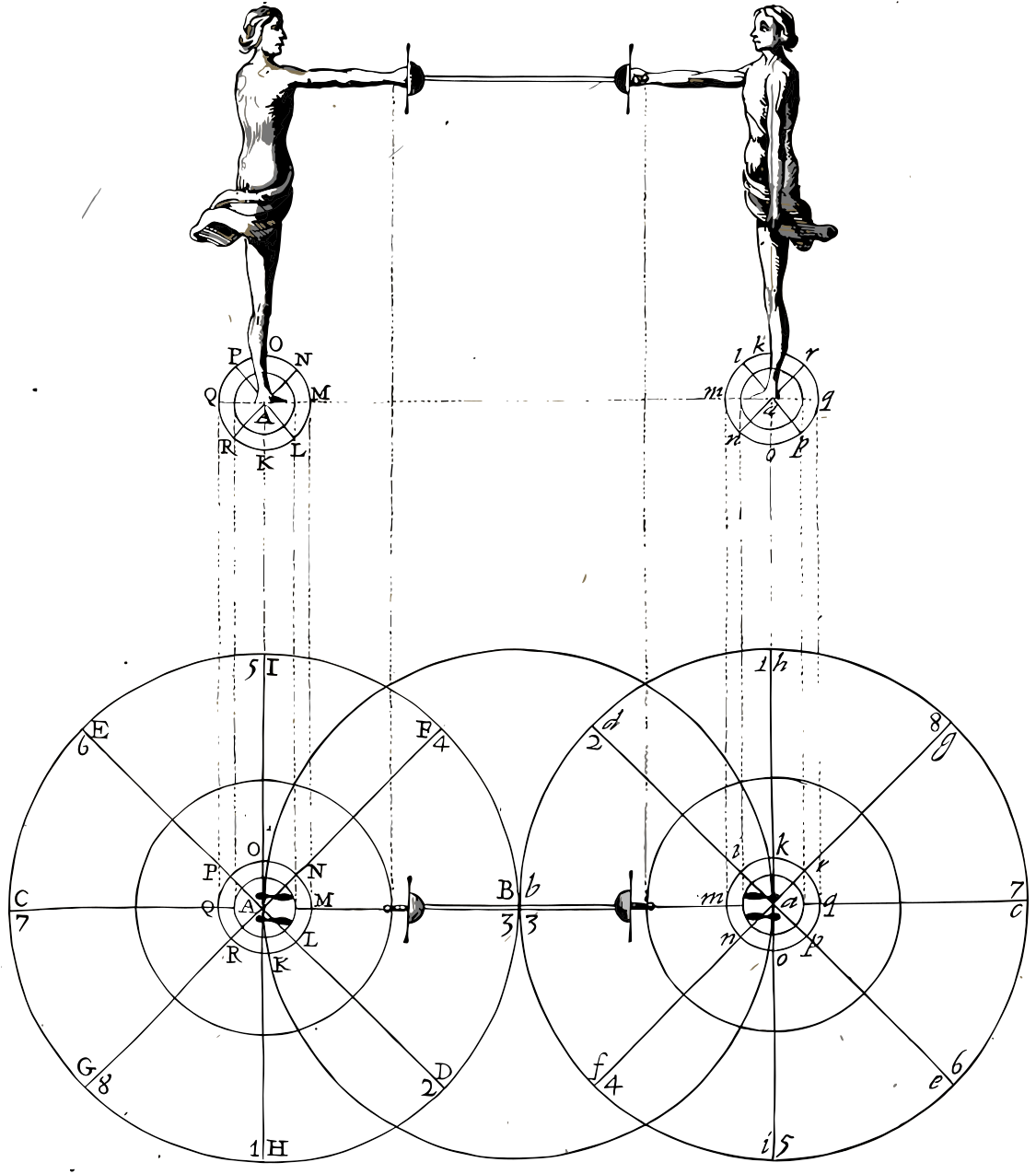
Given are two figures, or plans of the two cylinders at any distance, provided it is not less than a foot and a half, which is the width we have found to be of a man's body from shoulder to shoulder, and we mark them with the letters M.K.Q.O. as the base of the cylinders in which we consider the Fencers; although for the use of Fencing, and for clearer understanding, we consider that between the two cylinders from point A to point A there are eight feet of distance, which is the half of proportion, where the combatants are affirmed, facing each other squarely, as shown both by the cylinders that are in the plan, and by the figures that are in elevation.
From the center A draw the line A, which represents the common section of the primary vertical plane, and common in the lower plane, whose primary plane must always be considered between the two opponents with the universality that will be said later, and now according to our construction, corresponds to their vertical chest planes, particular to each one of the two, the Fencer marked with A.B. and that of the opponent with the letters a. and b. small, in whose position, being both planes of one nature, and property, will be in equal potency.
Given, then, that the opponent does not move, and that the Fencer gives a revolution around the center A. and direction line of his cylinder, in which we consider him, he will be applying his particular planes: in the primary A.a. as for example can be seen thus: If the Fencer moves to his left hand, he will apply his right collateral plane, represented by the line A.D. in the primary plane A.a.
Although we have said that the three planes, which correspond to the backs are of little use, as here we deal with the universality of them, we include them all; and also with the attention that there is a trick in the common Fencing, called the Turnaround, with which the application of all these planes is made in the primary vertical.
Note that in the same revolution that the Fencer gives, moving on the center, putting his particular planes in the primary, the immediate one to the one he applies in this primary, occupies the place of the plane he left; and successively, in this same order, the planes are occupying the places of their predecessors; and applying one in the primary, all of them change at the same time, as it is clearly recognized by reflecting on this figure.