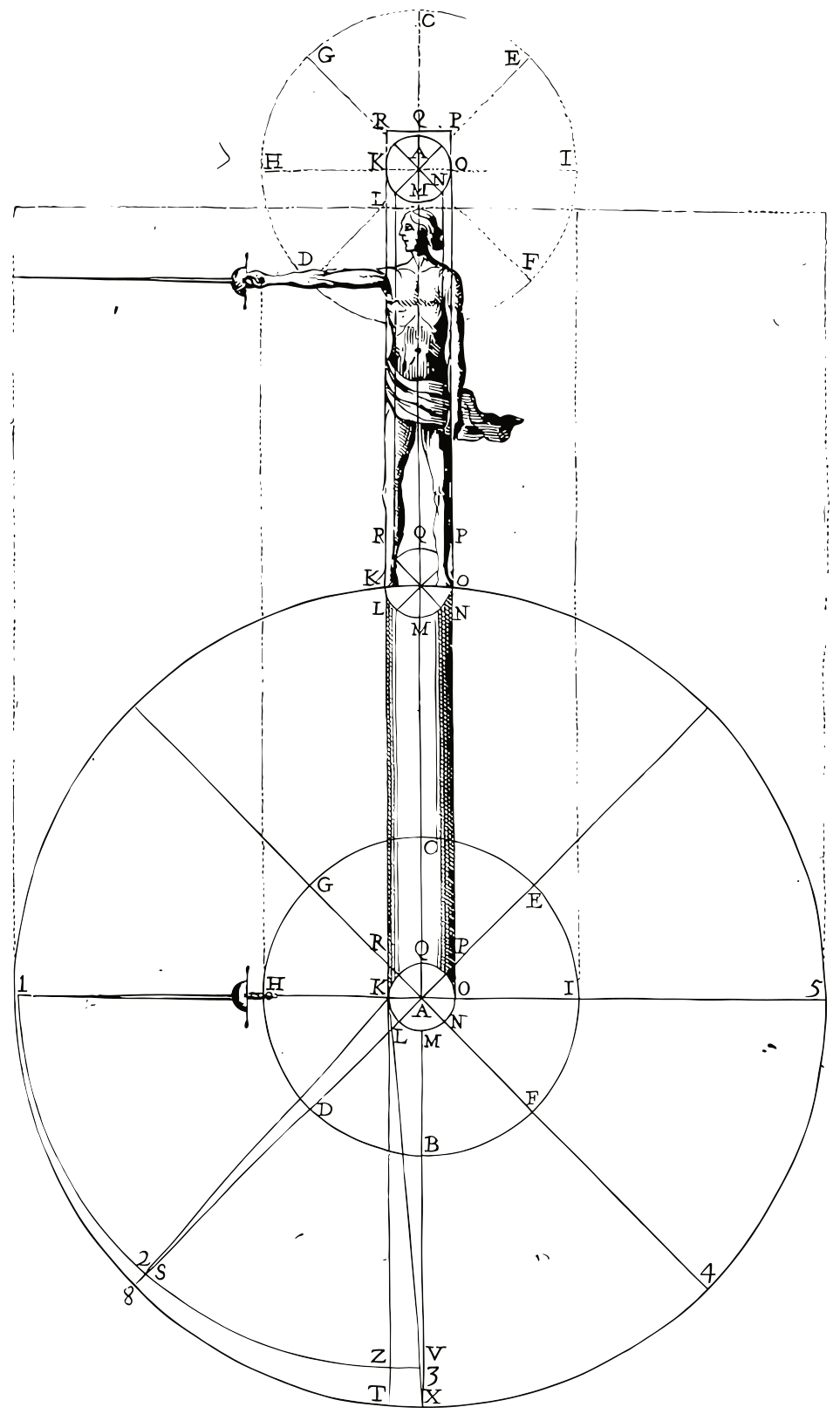
Consider that the Right-hander is inside the smaller circle so that his direction line corresponds to the center A, and the diametral of the chest corresponds to A.B. and that being in this position, the smaller and larger circle, with all their diameters, rise parallel to the Horizon up to the vertex of the head.
In these considerations, we will first find that the inner circle with this movement will have caused a cylinder, in which we imagine the Right-hander is contained, and the eight points K.L.M.N.O.P.Q.R. will have caused with this movement 8 lines on the surface of this cylinder: and the one described by point M, because by supposition corresponds to the chest, will be called Vertical, or Diametral of the chest. And the one described by point Q will be called Vertical of the back. And the one described by point L will be called Right Collateral. And the one described by point P, opposite, will be Left Collateral of the back. And the one described by point N will be Collateral of the left side. And the one caused by point R, opposite, will be Right Collateral of the back. And the one described by point K will be the Right Vertical. And the one described by point O, opposite, will be the Left Vertical.
With the same consideration, not only is the cylinder formed, with its eight surface lines that have been explained; but also outside of it, four vertical planes are formed, with the same movement, that divide the cylinder into eight equal parts; and all are divided in the middle in the axis of this cylinder, which corresponds to the direction line, whose imagination in Fencing is of great use and utility; and although in rigor there are no more than four planes, for more intelligence we divide them into eight, and give each one the denomination of the line by which it passes, in this way.
The one caused by the line A.B., for passing through the vertical of the chest, we call it Vertical Plane of the chest. And the one caused by the line A.C., opposite, because it passes through the vertical line of the back, we call it Vertical of the back. And the one caused by the line A.D., for passing through the right collateral line, we call it Right Collateral Plane. And the one caused by the line A.E., opposite, for passing through the left collateral line of the back, we call it Left Collateral Plane of the Back. And the one that causes the line A.F., for passing through the left collateral, we call it Left Collateral Plane. And the one that causes the line A.G., opposite, for passing through the right collateral of the back, we call it Right Collateral Plane of the Back, we call it Right Vertical Plane. And the one that causes the line A.I., for passing through the left vertical, we call it Left Vertical Plane.
These circles with their lines of Diameter, divisions of the planes, and letters, we could have imagined them in the plane that passes through the vertex of the head of the Right-hander, parallel to the lower plane, and that from this plane it was going down parallel to the Horizon, until the same lower plane, causing with its movement the same cylinders, lines, and planes that we have explained, whose common section in the lower plane will cause the same semidiameters corresponding to the upper ones, for the consideration of the planes; but as this would be difficult, for those who are not used to these imaginations, to consider first these circles, and their divisions in the Air, it has seemed to us, to facilitate their intelligence, to imagine them first in the lower plane, where they can be described, to satisfy more the understanding; although it is necessary, that for the intelligence of this harmony, and of what is preached about it, and of the organization of man, that these imaginations be considered in the plane that passes through the vertex of the head, and that the two circles, and lines go down, as has been said, parallel to the Horizon, until the lower plane, so that the common section of the four Vertical planes, with it, cause the eight semidiameters in the same lower plane, which serve as compasses in navigation, so that the Right-hander gives by them his straight, transversal, strange of trepidation, and mixed of trepidation and strange compasses; whose knowledge is very important, and its use, for the practical of Fencing, as will be seen in the figures in which the Right-hander will have to exercise, and in particular in the one we call Universal, which includes all the exercises that can be done, and the propositions that must be worked in Fencing, to which we refer ourselves for not being of this place.
The imagination of these planes has been in order so that the operations of the arm and Sword of the Right-hander in the Air, and of the body in the lower plane, can be regulated, in imitation of the Mathematicians, who to regulate the movements of the Stars in the Heavens, and of the rays of the Sun, and of the sight in the Air, and of the Ships in the Waters, make use of the imagination of straight and circular lines, planes, and bodies of different species, from which they have drawn, and draw admirable utilities, as is notorious to the World; and so that the Right-hander can achieve them in Fencing with accuracy, it is convenient to explain the fruit that will be drawn from each one of the imaginations that we have made.
If it were possible to put his arm, and Sword in the left vertical plane, which corresponds to A.I. he would find himself in his greatest strength, because he would have the arm united to his whole; but he would have two feet less reach, which is the length he has from his arm from its center to the wrist, or straight line; because in this consideration he will be embedded in the width of the body, as anyone can experience by putting the arm to the chest, and putting his Sword in the least reach, so that the tip is in this plane.
Because the diametral plane, which represents the line A.B. for being equally distant from the two vertical right and left planes, it will be found that in it participates in the properties of both, that is, of the strength of the vertical plane A.I. and of the reach of the vertical plane A.H. and for this reason, it will have less reach, than in the first plane A.H., the excess that there is from V. to X. orb of the Sword, and less strength, than in the fifth plane A.I.
The other three planes, corresponding to the back, which are the right and left collaterals A.G. and A.E., and the diametral A.C., are not used for the arm because it cannot reach them with the required perfection. Thus, they serve only in the lower plane as a guide for the three compasses: the one given by the line A.C. is called Compass of Trepidation; the one given by the lines A.G. is Transversal to the right side; and the one given by A.E. is a mix of Trepidation and Strange, along with their intermediates. More detailed reasoning on these and other compasses will be provided in their respective sections.
The explanations of the first five planes are understood without difference with the opponent opposite the Right-hander, as they are predicated on the organization and composure of man, which is common to all. For the same reason, the other three planes at the back, which serve in the lower plane for the aforementioned effects, are also understood in the opponent.
It is noted that wherever either of the two combatants moves, they will carry with them the consideration of their planes, as they all intersect at the axis of their cylinder, passing each one through its determined line on the surface of it. Thus, it is evident that with any movement the cylinder makes, all will move, each maintaining the position in which it was considered in its origin. For example, in the vertical plane passing through the Diametral of the chest, which was caused by the line A.B., there are two parts: the one caused by A.M. remains inside the body of the same cylinder, in a determined and fixed place, and the M.B. outside of it; but these two parts can never be separated. Therefore, as the part A.M. moves, it is necessary that M.B. also moves, and this with any type of movement that is made. This same consideration applies to all other planes, as the same reason converges in each one of them; thus, moving any of these planes, at the same time, all will move.
In what we have said, knowledge of the nature of each of these planes, considered in each of the two combatants, and their properties, has been given, recognizing there is inequality among them in terms of greater and lesser strength, and greater and lesser reach, and how they accompany the body in each of its movements. Because all Fencing, in its practice, consists in the Right-hander having inequality with his opponent, to perform his proportions, remaining defended at the time he offends, we want to show how through the use of these planes he can achieve this inequality. To do this more accurately and clearly, we rely on the imagination of a plane, called primary and common among the two combatants, which must serve as a guide for all operations of Fencing; and as such an important foundation, it is appropriate that before entering to treat its use, we give knowledge of it.