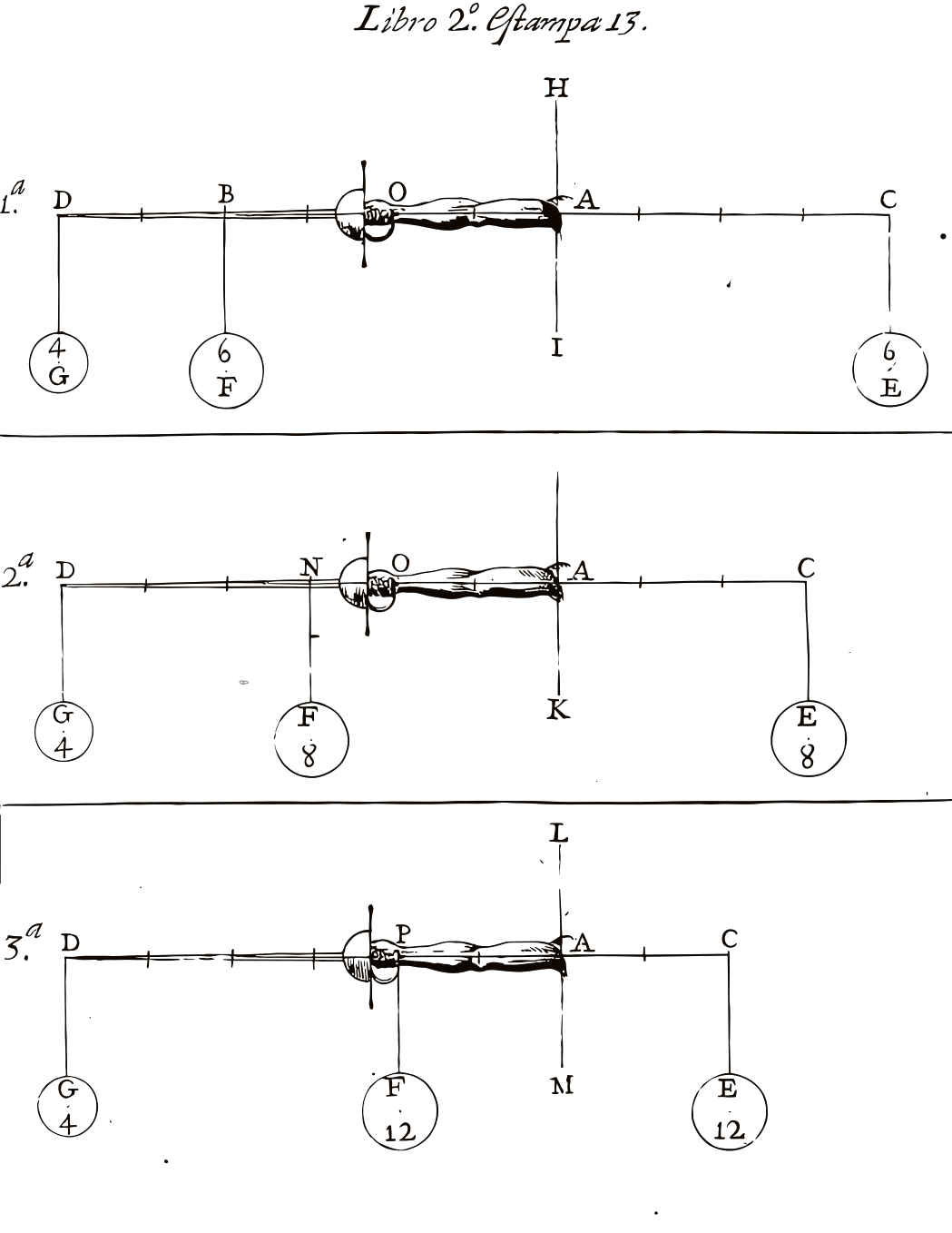
It is a well-established concept among Mathematicians that the property of the scales (one of the five powers of statics) is to proportion weights to the distances at which they are placed in relation to the fulcrum (commonly called the Balance), as seen in the first figure of Plate F.G. In this figure, we suppose that the line A.D. represents the arm and sword extended straight, as it comes from the shoulder parallel to the Horizon, whose length is six Geometric feet, two from the center of the arm A. to the wrist line, or wrist O., and the other four from the wrist O. to the tip of the sword D., which is the length from the pommel to the tip, divided into six equal parts, two pertaining to the arm and the other four to the sword.
For this demonstration, it is supposed that at point B., four feet away from the center of the arm A., a weight of six pounds is hanging at F., and that the line A.B. is extended to C., so that A.C. is equal to A.B., and from point C., another weight of six pounds is hanging at E. It is evident that they will be in equilibrium, as they are equally distanced from the fulcrum A., where the center of gravity of these two weights is, through which passes the line of direction H.I., as demonstrated by Guido Baldo, proposition one of the Lever.
To regulate this power with another weight hanging from the tip of the sword D., a rule of three is formed, taking as the first term six, which is the length of the arm and sword D.A., as the second term A.C., which is four feet, and as the third term the weight hanging from point C. of six pounds; and performing the operation, the result is the weight G. of four pounds, hanging from the tip of the sword. These two weights will also be in equilibrium, by the aforementioned first proposition of Guido Baldo, where he shows that the proportion that the length D.A. has to A.C., which here is sesquialtera, is reciprocally the same that the weight E., hanging from C. of six pounds, has to the weight G., hanging from D. of four pounds.
From this, it follows that since A.B. is equal to A.C. and weight F. is equal to weight E., the same proportion that D.A. has with A.C., D.A. has with A.B., according to Euclid's ninth proposition of the fifth book: then as D.A. is to A.B., so is weight E. to weight G. But since weight E. is equal to weight F., according to proposition seven, also of the fifth book, the line D.A. to the line A.B. will have the same proportion, reciprocally sesquialtera, as weight F. to weight G., which is what was required to be demonstrated, and is demonstrated by the first figure of Plate F.G.
In this second figure, the same length as in the previous one is given to the arm and sword A.D. of six feet, and A.C. of three feet, and weight G. of four pounds hanging from the tip of the sword D., and it is desired to examine, in respect to this power, the weight that can be sustained at point N., three feet away from the center of the arm A.
By rule of three, the proportion that the length A.N. of three feet has to the length A.D. of six feet is the same as the weight G. of four pounds, hanging from point D., to another; and performing the operation, the result is, in double proportion, the weight F. of eight pounds, hanging from point N., which is what can be sustained according to this power, represented by the weight E. of eight pounds, hanging from point C., which is what was required to be demonstrated in the second figure.
In this third figure, the same length as in the previous ones of six feet is given to the arm and sword A.D., and A.C. of two feet, and weight G. of four pounds, hanging from the point of the sword D., and, in respect to this power, it is desired to examine the weight that can be sustained at point P. on the wrist, two feet away from the center of the arm A.
By rule of three, the proportion that the length P.A. of two feet has to the length A.D. of six feet is the same as the weight of four pounds G. hanging from point D. to another; and performing the operation, the result is weight F. of twelve pounds, hanging from the wrist point F., and it will be in triple proportion to the weight G. hanging from the tip of the sword D., which is what was required to be demonstrated.
From these three demonstrations, it follows that in the divisions and degrees of the sword that are closer to the guard and arm, there will be greater strength than in the divisions and degrees that are more remote; and to examine the power that will be had in each one, proportioning the greater and lesser lengths in the order that has been maintained in these demonstrations, anyone can examine the strength and weakness that will be had, according to their power, in any degree of their sword.