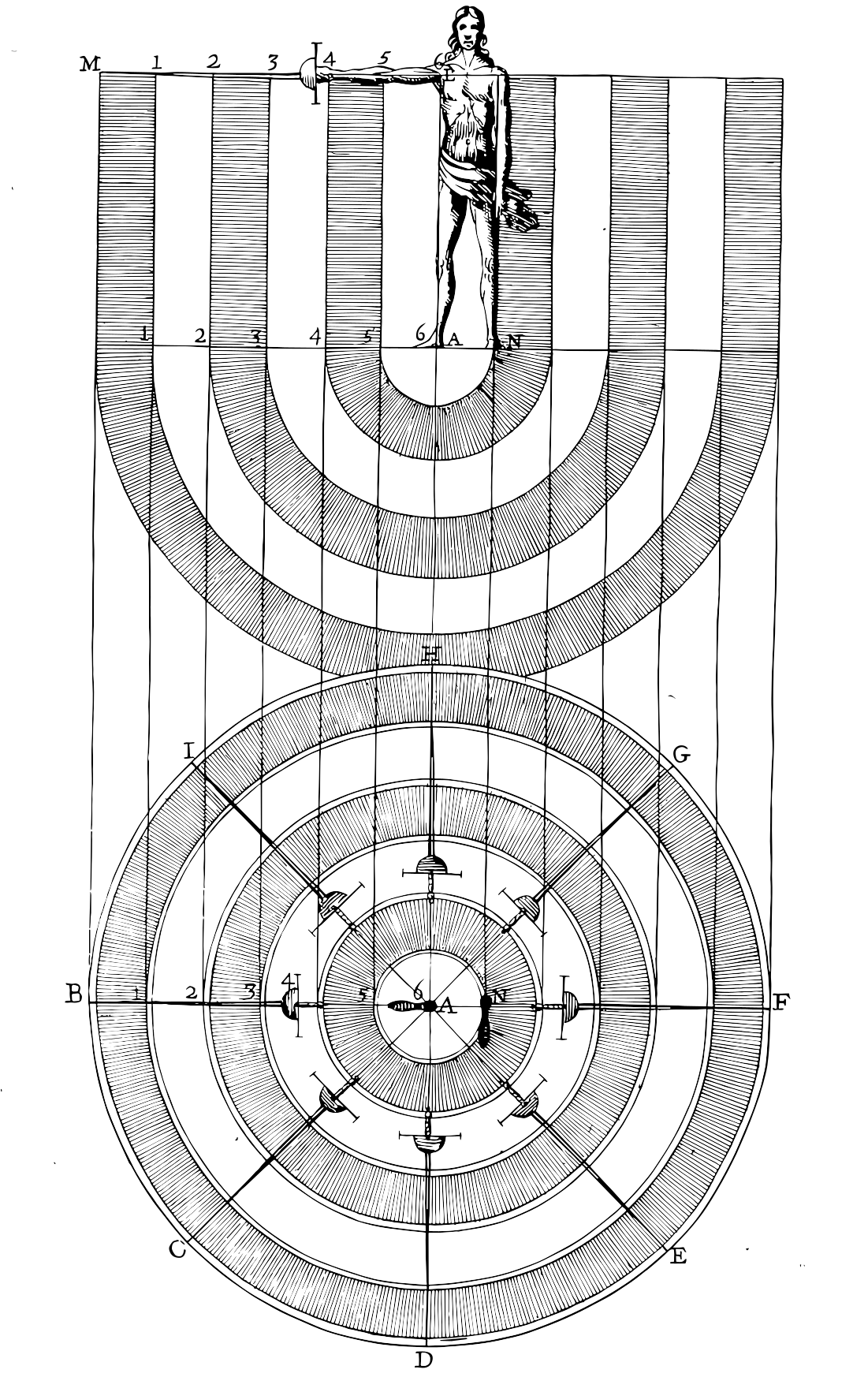
Both in the Book of Science and in this one on the Art of Managing and Governing the Armed Instrument, the Sword, we have shown that the Skill of Arms is a science subordinated to Mathematics, particularly to Geometry, as it is founded on the consideration of all four types of quantity, etc. And that, following the example of ancient Philosophers and Cosmographers, who, in order to find the movements of the Stars in the Sky and to regulate the movement of Ships on Water, necessarily relied on Mathematical sciences, as it was impossible by other means; and that we too have been forced to rely on them to regulate the movement of the Sword in the Air, and of the body on the Earth. Moreover, those dealing with Military Art, to know not only the movement or path of the bullet through the Air, the movement to be made by the Artillery and Squadrons through the Approaches to get closer to the Fortress, but also the movement to be made to direct mines beneath the earth to the part convenient for the intended effect, give rules based on Mathematics: all of which I mention so that we can begin the construction of a figure, through which the foundation of this science becomes clearer and more understandable, assuming what all those who have dealt with Mathematics have assumed: namely, that every point moves in a straight or curved line; every line moves in a line or forms a surface; every surface moves in a surface or causes a body, according to Euclid Book 11, Definitions 12 and 18. Every body, when it moves, if its movement is local, causes a body of another kind; but if it moves about its axis, some describe different bodies, and others do not. With this in mind, I move on to the construction or explanation of the figure.
This explanation can be made in two ways, the first taking on the lower plane the quantity A.B. of six Geometric feet, divided into six parts, as indicated by the numbers from B to A.1.2.3.4.5.6., and with the center A, if a revolution is given from each of these divisions, the circle B.D.F.H. will be formed, representing the orb of the Sword, and each point will have described one of the other five orbs, as seen in the figure.
The second method is to suppose the Fencer affirmed on a right angle at A.N. and at a right angle with his arm and Sword M.L.A., with the same divisions in the arm and Sword, on the upper plane 1.2.3.4.5.6., and from the extremity of the tip of the Sword and from each one of the divisions, draw a perpendicular to the lower plane B.D.F.H. that ends on the line B.A. at the same numbers 1.2.3.4.5.6. corresponding to those of the lower plane, as seen in the figure that is in elevation.
Imagine that the Fencer makes a revolution around the center of his right foot, maintaining the same posture of body, arm, and Sword, with each of the extremities of the six perpendiculars causing its circle on the lower plane, and six concentric circles will be formed, whose intermediate spaces we call Orbs of one Geometric foot each, indicated by the same numbers 1.2.3.4.5.6. In these Orbs, we have placed the projection of the Sword in the divisions of the eight directions that we imagine as traces left by the revolution in the Air when it passes through the eight main planes, which we also imagine to be of so much use and foundation in Skill that we have deemed it appropriate to mark them with the Swords, leaving their explanation for later in their place; and these eight planes have their common section in the center A. of the figure, and are the most essential paths through which the Fencer must regulate his operations: and because the figures in elevation are not intelligible to all, we have put the one that follows it, with the same projections in plan, which is the first one explained, as it is easier to perceive. And in both, we have avoided multiplying letters, because for their understanding it is enough with those that have been placed, to avoid confusion.
Having explained the idea of our Fortress and the size or dimensions that the shield must have for its defense, the most immediate thing is to provide knowledge, according to the order that has been established, so that the Fencer can achieve both ends, defense and offense if appropriate; and so to make evident what they consist of, and how the inner and outer bulwarks of our Fortress can be formed, we will use statics, to demonstrate through it how easy its possibility is.