CHAPTER SEVENTEEN
Proposition I. Theorem I.
It is demonstrated that whenever the Fencer is positioned at a right angle, and at a right angle in his vertical right plane, and his opponent attacks him to strike with a thrust through the same plane, he can defend the depth of his body with a guard of two fingers in semi-diameter; however, it is necessary that the centers of the guards are in the common section of this vertical plane and the superior plane.
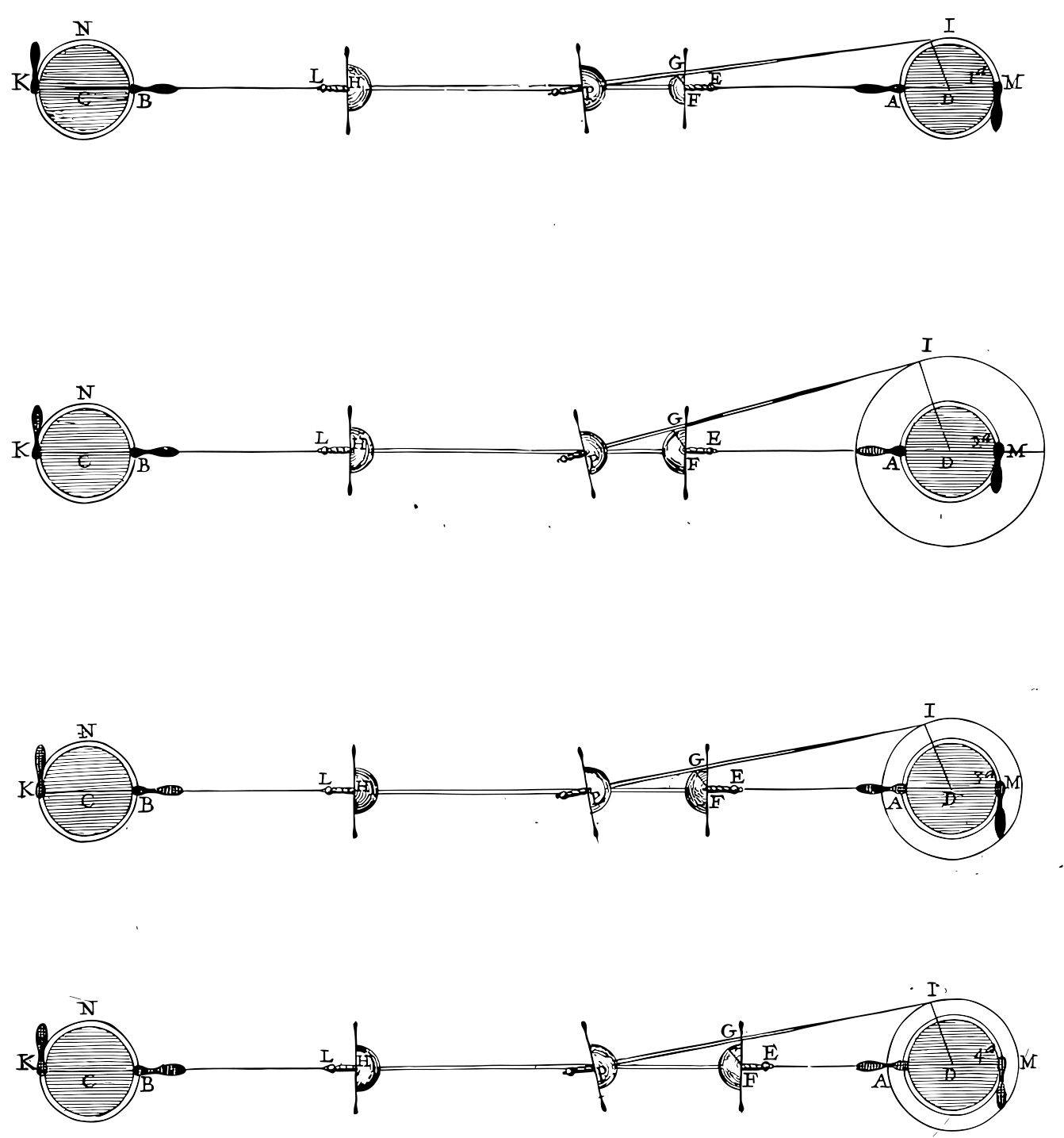
Let the circle A.M.T. be the common section of the Fencer's cylinder and the superior plane, and the circle B.N.K. be that of the opponent's cylinder with the same plane, and the line A.B. be the common section of the Fencer's vertical right plane and the same superior plane, and let this distance A.B. be that of the middle of proportion of eight Geometric feet.
A.E. of two feet is the length of the Fencer's arm from its center to the wrist, and A.F. of two feet and a quarter is the length from the center of the arm to the center of the guard, and the same is considered in B.L. and B.H. for the opponent: thus, the center of his guard will be six feet less a quarter distant from the surface of the Fencer's cylinder, and the tip E. will reach two feet distance from the body of the Fencer; and from this position to be able to offend, it is imagined that the opponent takes a step of two and a half feet: thus, if the guard of the Fencer did not prevent it, the opponent would reach with the tip to strike him with a thrust through the same line at point D. which represents the axis of the cylinder, and the center of the guard of his Sword will be at point P.
I say that in this position, having the Fencer the center of his guard at point F, whose Semi-diameter F.G. is of two fingers and two fifteenths, he will defend the depth of his body, even though it has a diameter of one foot, which is more than what a well-proportioned man should have.
Determination that settles the question.
Draw from point P, the center of the guard, the line P.I. that touches the circle of the Fencer at point I, and the line D.I. from the center D to the contact point I. Draw the line F.G. from the center F of the Fencer's guard parallel to D.I by the 31st of the first book of Euclid's Elements.
Construction
Since in the triangle B.P.D.I. the line F.G. is drawn parallel to the base D.I., it will divide the sides P.D. and P.I. in the same proportion by the second proposition of the sixth book of Euclid's Elements, and will form the two similar triangles I.P.D. and G.P.F. for having the angles P.G.F. and P.F.G. equal to the angles P.I.D. and P.D.I., external to internal by the 29th of the first book, and the angle at P common, thus the three angles of one are equal to the angles of the other, each to each.
Demonstration
Therefore, by the fourth proposition of the sixth book, the homologous sides will be proportional, and as P.D. to D.I. so P.F. to F.G. and of these four proportional quantities, three are known, the P.D. of 60 fingers, the D.I. of 8, and the P.F. of 16. And forming with these numbers the rule of three, the result will be a quotient of two fingers and two fifteenths of another finger, which is the proportion. Therefore, &c. which is what was to be demonstrated in figure 1.
Because it is difficult for the centers of the guards of the two opponents to be on the line A.B. or common section of the two vertical and superior planes, not only has the semi-diameter of the guards been doubled in Spain, as it is very close to four fingers, but it is also necessary to make use of our Pyramids, as we demonstrate in the idea of our Fortress; and to know the defense that is provided by the guards in Spain, we will show what they cover of the body in the three most principal planes, which are the vertical right, right collateral, and vertical plane that passes through the chest vertical.
From P, the center of the Fencer's guard, draw the tangent P.G. and extend it as necessary; from point F, the center of the opponent's guard, draw F.G. to the contact point, and from point D, draw D.I. parallel to F.G. meeting P.G. at point I. I claim that D.I. will be fifteen fingers, which is demonstrated in this way.
In the triangle P.D.I., since the line D.I. is parallel to F.G., the sides P.D. and P.I. of the triangle P.D.I. will be divided in the same proportion, and since the angles in F.G. are equal to the angles D.I., and the angle at P is common, the triangles P.I.D. and P.G.F. will be similar by the first definition of the sixth book; and by the fourth proposition of the same book, the homologous sides will be proportional, and as P.F. to F.G. so P.D. to D.I. But P.F. is 16 fingers, F.G. is four, and P.D. is sixty; forming the rule of three, the D.I. of fifteen fingers will be found, which is about one foot: therefore, the guard of the Sword, which has a semi-diameter of four fingers, can cover thirty fingers of breadth and length of the body, which are two feet less two fingers, which is what was to be demonstrated in figure two.
With the Fencer in the same distance from his opponent with the center of his guard at point P, as in the past two propositions, and both centers of the guards P.F. occupying the common section of the opponent's right collateral plane with the superior plane, in which position his guard is three fingers closer to his body than in the previous ones, will cover a space in circumference of 25 fingers and one-third in diameter of the breadth and length of his body.
Let A.B. be the common section of the opponent's right collateral plane with the superior plane, with the same distances as in the previous ones between the two fighters, except that the center F of the opponent's guard, in this position, is three fingers closer to his body. I say that it will only cover a space in circumference of 25 fingers and one-third in diameter of the breadth and length of his body, whose semi-diameter D.I. will be twelve fingers and two-thirds.
In the triangle P.D.I., since the line D.I. is parallel to F.G., the sides P.D. and P.I. of the triangle P.D.I. will be divided in the same proportion; and since the angles in F.G. are equal to the angles D.I., and the angle at P is common, the triangles P.I.D. and P.G.F. will be similar by the first definition of the sixth book; and by the fourth proposition of the same book, the homologous sides will be proportional, and as P.F. to F.G. so P.D. to D.I. But P.F. is 19 fingers, F.G. is four, and P.D. is 60. Forming the rule of three, the D.I. of 12 fingers and two-thirds will be found: therefore, the guard of the Sword, with a semi-diameter of four fingers, placed in the right collateral plane as described, will cover 25 fingers and one-third in diameter of the breadth and length of the body, which is what was to be demonstrated, as shown in figure three.
With the Fencer at the same distance from his opponent with the center of his guard at point P, as in the previous three propositions, and both centers of the guards P. and F. occupying the common section of the opponent's vertical chest plane with the superior plane, in which position his guard is eight fingers closer to his body than in the first two figures, will cover a space in circumference of twenty fingers in diameter of his breadth and length.
Let the line B.A. be the common section of the opponent's vertical chest plane with the superior plane, with the same distances as in the previous figures between the two fighters, except that the center F of the opponent's guard is closer to his body than in the first two figures by eight fingers: I claim that it will only cover a space in circumference of twenty fingers in diameter of his breadth and length, whose semi-diameter D.I. in this position will be ten fingers.
In the triangle P.D.I., since the line D.I. is parallel to F.G., the sides P.D. and P.I. of the triangle P.D.I. will be divided in the same proportion; and since the angles in F.G. are equal to the angles D.I., and the angle at P is common, the triangles P.I.D. and P.G.F. will be similar by the first definition of the sixth book; and by the fourth proposition of the same book, the homologous sides will be proportional, and as P.F. to F.G. so P.D. to D.I. But P.F. is 24 fingers, F.G. is four, and P.D. is 60. Forming the rule of three, the D.I. of 10 fingers will be found: therefore, the guard of the Sword, with a semi-diameter of four fingers, placed as described, will cover a space of 20 fingers in diameter of the breadth and length of the body, which is what was to be demonstrated, as shown in figure four.