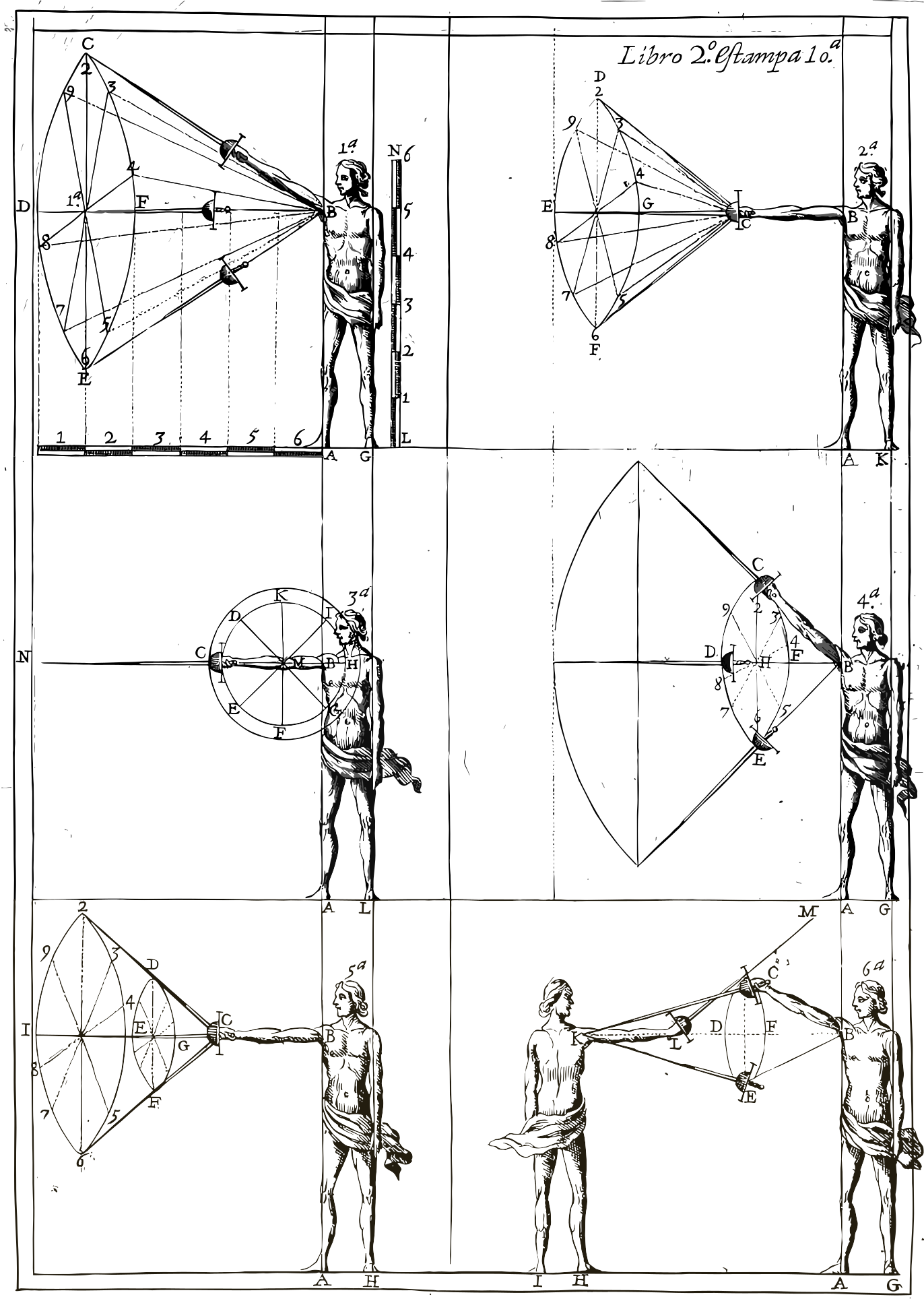
It is formed with the interval of the arm and Sword, with its length, which is 6 geometric feet, giving a revolution, and causing it, with the tip of it describes the base C.D.E.F., and all of it B.E.D.C.F. graduated each quarter of Pyramid in 90 degrees, both in its elevation or inclination of the Sword; and by the pitipie N.L. the measurements of the body, arm, and Sword, and the lower plane six feet in length of the body, and six feet of the arm and Sword will be adjusted.
pitipie from the french petit pied or small foot, the scale of a map or plan
Having explained the largest Pyramid, necessary for the practice of Skill in Arms, imagining it formed, with its axis on the upper plane of the right angle, so that with this knowledge it can be considered in any other part where it is necessary to form it, or portions of it: it is now important that for its use we explain in how many parts one is divided, and for this we put an example in this one which is the largest, whose vertex is in the center of the arm, and is formed with it and the Sword, holding it from the Fencer in the hand affirmed at an angle, and upon a right angle.
Let us suppose again the Swordsman affirmed on the right angle A.G. and at a right angle D.B.A. The first thing we consider in the common section of the primary vertical plane, and of this Pyramid, which is made by the axis B.D. causes the triangle 2. B. 6. by the axis, whose sides B.2, and B.6. are the first two lines that we imagine on the surface of this Pyramid; to the upper B.2. we give the name of the second, and to the lower B.6. of the sixth.
Then we consider another common section of the upper horizontal plane and this Pyramid, which results in the triangle by the axis 4.B.8. whose base is the line 4.8. and since this whole triangle is parallel to the Horizon; the one on the right hand B.4. we will call the fourth line; and the one on the left hand B.8. the eighth line: and as the primary vertical plane and the plane of the base of the Pyramid are perpendicular to the horizontal plane, it follows that their common sections at the base 2.6.4.8. will also be cut at right angles by the 19th of the eleventh of Euclid, and will divide the circle of the base into four equal parts, or quadrants.
Imagining each of these quadrants divided into two equal parts by two oblique planes, the first starting from the right side, no. 3. to number 7. and from the left side from number 9. to number 5. which also cut at the axis, will cause on the surface of this Pyramid four more lines, caused by the common section of the oblique plane of the upper right side, no. 3. and ends on the lower left, no. 7. and so we call the upper line B.3 the third line, and the lower line B.7 the seventh line.
So, the common sections of these four planes, the primary vertical and the upper horizontal, and the other two oblique planes, cause on the surface of this Pyramid eight lines, and their intersection with each other causes another line, which is as has been said in the axis of this Pyramid, and the first line.
Also, through it, one comes to understand what has been said and demonstrated in the explanation of the movements, by finding in it encrypted the majority of the things that pertain to the Sword, because by dividing its base into the lines it shows, it will be recognized with evidence that if from its axis the Sword is moved to any part of the circumference, or from the circumference to the axis and center of the Pyramid, it will form not only the simple and mixed movements but also the right, obtuse, and acute angles, and the six straightnesses or general postures of up and down, to one and the other side, forward and backward, and the intermediate or mixed ones considered among the simple.
The usefulness of this Pyramid will be seen in the formation of the three general rules: closing in, weakness, below and above the strength, as in all these the arm should not move from the right angle; rather, all the movements that these rules consist of (except the line in cross) until executed, will be done by the hand, which nature has disposed to enjoy the four straightnesses: C.D. is the straightness above, C.F. the straightness below, C.4. the straightness to the right side, and C.8. the straightness to the left side.
In these two Pyramids that have been explained, the greater and the lesser, whose vertices are in the center of the arm and wrist, as they can be formed in front of the body of the adversary, the tactics are disposed and executed, sometimes by the same axis occupied by the arm and sword for the thrust wounds, and other times to strike through any of the vertical, horizontal, or oblique planes, because the circular movements that converge in them are only dispositional to reach to strike these planes.
It is also noted that these two greater and lesser Pyramids can be formed in all the simple and mixed straightnesses, although not always will it be necessary to form the greater one, as will be seen in the explanation of the combined and more universal Pyramids, and in the jurisdiction of each one, according to the demands of the battle circumstances; and wherever they are made, the same divisions will always have to be considered in each one, and everything else that has been explained and preached about the greater Pyramid; and it will be at the will of the Fencer to form the larger or smaller ones, or the portion of them that is necessary, according to what the nature of the tactics requires, or the movements of the adversary oblige. Through these two Pyramids, the Fencer achieves not only offense when it suits, but also defense, because through them he places the sword of his adversary in the three vertical planes of his defense, sides of the angles of each one of them, according to the intentions he has in the battle: with which it is recognized how necessary and universal these two greater and lesser Pyramids are, and their use, because the one that has its vertex in the wrist always forms in front of the chest of the Fencer, and is only dispositional for the execution of it, which follows as such.
In this Pyramid, which is formed with the forearm from the elbow forward, only two straightnesses belong to it, which are the one above, and the one to the left side, in this way: if the line M. is the joint of the elbow and N. the tip of the Sword: to make the straightness of the left hand, carry the arm and Sword from where the tip N. is, bending the joint of the arm until it is brought close to the chest, and the tangent line, which is imagined from one shoulder to the other until it occupies the line M.H.
Note that this Pyramid, whose vertex is in the elbow, can never have its axis at a right angle, because for its formation, it is necessary that, making the center and angle at the same elbow, it deviates from it; and although it can be formed around its axis, like the other two, there is a difference, the base of it will not include the opponent, because the Right-hander forms it obliquely in front of his chest, and on his left side. Therefore, the guard that causes the defense describes its base on a plane parallel to the left collateral plane, oblique to the Horizon, and the axis will be the line that is considered from its vertex to the center of the base of this Pyramid, and will be parallel to the left collateral plane. This leads to the conclusion that this Pyramid, as its axis is not directly facing the opponent, is dispositional and only serves to carry the Sword to the left side until placing it in the primary vertical plane, for the moves of vertical cuts, horizontal cuts, thrusts, and diagonal cuts, and for the cuts to the arm, known as elbow strikes; although for the precise formation of these moves, the movement of the wrist and shoulder helps, though not as much as it does. And for the rigorous precision of the moves, the jurisdiction of this Pyramid does not extend to the formation of reverse vertical or diagonal cuts, because on the right side where they are formed, no portion of it can be made according to the organization of the arm, as anyone can experience for themselves. And if the Diagonal reverses, and the half cuts, and half reverses, are formed perfectly, this Pyramid also has no jurisdiction over them, because the half cuts and half reverses are formed by oblique or horizontal planes, and the Diagonal reverses by these same planes: in the end, this Pyramid is a means that serves as a link between the two extremes of the shoulder and the wrist, and for all the moves of the Skill it is necessary the movement, or motion of some of the three Pyramids explained, except for the thrust, which will consist only of the accidental movement.
The third and last one, whose vertex is at the center of the elbow joint, whose axis is the line considered to emerge from the center of its base; and this axis is occupied by the part of the arm from the same center of the elbow joint to the line of the hilt, and the guard of the sword of the Fencer, describes the base in front of his chest: so that the vertices of these last two are in the arm and wrist of the Fencer, and are parts of the length occupied by the axis of the larger Pyramid, and all three have been universally explained, and their admirable use.
Now it is appropriate to give reason for three other Pyramids, which are also considered in the same length of the arm and sword, as the previous three referred to, with a difference, that two are imagined to be formed independently of the opponent, and the other is necessary that the vertex be considered at the tip of the sword of the Fencer, while striking with it the same opponent.
Since this Pyramid has its vertex at the main center of the arm, and its axis in a straight line, which we imagine to emerge from the same vertex to the exterior part of the guard of the Fencer's sword that occupies the arm, and the same guard, which is two and a half feet long, forming this rectangular Pyramid, its base will be two feet minus a quarter distance from his body, and will have a diameter of three and a half feet, as verified by the figure, and becomes evident by demonstrating it as such.
Being affirmed the Fencer in right angle A.B.D., imagine that he raises the arm to the obtuse angle B.C. in such a way that it causes a semi-right angle with the line B.D. and drawing the perpendicular line C.H.E. over B.D., the triangle C.H.B. will be right-angled isosceles, and the line C.H. will be equal to the line H.B. as the two angles in C.B. are semi-right and equal to each other by the sixth proposition of the first of Euclid's Elements.
Now, it is necessary to examine what will be the diameter of its base C.E. and its axis B.H., which is easy to know and explain: because the triangle C.H.B. has its right angle at H., and it will be by the 47th of the first of Euclid's Elements: the square of B.C. equal to the squares of B.H. and H.C. and being isosceles, each one of the squares C.H. and H.B. will be half of the square of the hypotenuse B.C. Thus, with B.C. being known as the length of the arm and guard of two and a half geometric feet, which makes 40 fingers, each of the other two sides C.H. and H.B. will also be known to be 28 fingers, which are two feet minus a quarter, and the whole C.E., which is the diameter of this Pyramid, will be 56 fingers, which are three and a half feet. This operation is done in this way.
Square the number 40, which corresponds to B.C., the length of the arm and guard, and the product, or square, will be 1600. Dividing it by half, each will be 800, which will be the square of C.H. and H.B., whose nearest square root is 28 fingers, corresponding to the line C.H. and likewise to the line H.B. for being equal. And since the triangle B.H.E. is equal to the triangle B.H.C., H.E. will be equal to H.C. Thus, the diameter of the base of this Pyramid is 56 fingers, which are, as said, three and a half feet, which is the largest circle that can be described as the base of this Pyramid, and will be separated from the body of the Fencer by two feet minus a quarter, represented by the line B.H.
Since this base is described with the guard, it serves as if it were a shield with a steel handle, having the same thickness as it, because as the opponent cannot place his Sword at one time, except in one part; and the movement or movements that he makes with it will always be much larger than those that the Fencer has to make to oppose this Pyramid and guard of his, which describes it, it is very conform to reason the comparison, that it will serve the Fencer, following its precepts, as if it were a steel shield.
However, it should be noted that the base of this Pyramid should never be as large, nor its portions as in the past, because it will be enough that they are of the necessary size for the Fencer to place with his guard the Sword of the opponent in the plane parallel to the Horizon, passing through the vertex of his head; and with his Sword the opposite in the two vertical planes of his defense, sides of the angles of the bastions of our Fort: and the smaller the base that is made, it will be further away from the body of the Fencer; thus, the use of it is at his discretion, to regulate this Pyramid and its portions that he has to make, according to the intentions he carries or the movements that the opponent makes with his Sword.
It is very important to note that, even though the Fencer has his arm and guard at a right angle, with a small amount of movement made through the primary vertical plane towards the upper part of the obtuse angle, and to his right and left side, he cannot be offended by his opponent with the use of this Pyramid.
The lower part of the acute angle will be defended, on both sides, by the Pyramid made with the Sword, whose vertex is in the center of the wrist: and because these cases are particularly demonstrated in the idea of our Fort, and it is explained how the use of this Pyramid of the arm and guard is the main wall of it, we refer to what is explained about all of it: and having extended ourselves in mathematically demonstrating this Pyramid has been because it is so essential, and also so that by the method used in the demonstration of this, anyone can demonstrate the other five if they wish; and not having done so is to avoid prolixity, and having said enough about them for their understanding and use: and so now we will explain the second Pyramid, which turns out to be the second wall of our Fort, more external and further away from the Fencer than the one caused by the arm and guard, and we consider it in this way.
We imagine this second Pyramid at the midpoint of the Sword's length from the hilt to the tip, in the amount of Sword from this division to the exterior of the guard of the same Sword of the Fencer, and this is where the axis is, and it is the strongest part of the Sword; and it is evident in the reason that whenever the entire Sword is used to form any larger or smaller Pyramid, at any degrees and point of it, we can imagine that it forms with each a base, and that the entire line for the same reason we have given for the guard, describing the Pyramid of the arm, will cause the same effect; and compared to the opponent's power with that of the Fencer, the latter will be as if forming an entire Pyramid of steel; thus, using it as a Fencer, it will serve for his defense as if it were one: and with this understanding well established, we can very well consider this second Pyramid that the Fencer can form, or portions of it, whenever he moves his Sword to any part; and because this smaller Pyramid is formed with the greatest degrees of force of the Fencer's Sword, whenever the opponent's enters its jurisdiction with lesser degrees of force, the Fencer will have greater power to place it with the portions that are necessary to make of it on both sides in the two vertical planes of his defense: and most commonly, this second Pyramid is used when it is formed from the entire Sword, whose vertex is in the wrist, and the Fencer's movements are very brief in respect to this second Pyramid, and he has a great advantage over those of the opponent, who makes them with the entire arm and Sword, or at least with the entire Sword, as we will demonstrate and explain in our Fort, and in its cases, to which we also refer.
We consider the third and last of these three Pyramids when the Fencer strikes a thrust from the remote end at his opponent in the center of the right arm or slightly away from it, and because he does not immediately move to the middle of proportion, the opponent also attempts to strike him. In this case, the Fencer must imagine that the tip of his Sword with which he strikes is the vertex of this Pyramid, and its axis is the straight line from it to the center of the base, which can be described with the guard of his Sword. With it, he can defend himself in any part where the opponent attempts to strike him, from the right angle to the upper part of the obtuse angle, and in the lower part of the acute angle, up to the middle plane, moving his Sword in the two vertical planes of his defense, up to the horizontal plane, which we imagine passes through the vertex of the opponent's head. This base is common to this Pyramid and the one of the arm, whose vertex is considered at the main center of it; thus, they come to be two opposing Pyramids, and although they are opposing, the Sword's Pyramid cannot cause defense without the arm's Pyramid coinciding with it, accompanying it to any part where it is formed, or portions of it. However, the arm's Pyramid, which is responsible for the main defenses (as already noted), can do so without depending on it; and if in the referred case the opponent lowers his Sword from the middle plane to strike, then the Fencer will have to rely on the smaller Pyramid, whose vertex is imagined at the center of the wrist and is formed with the length of the Sword to be defended. To give the Fencer more individual knowledge of what is explained in this third Pyramid, I will demonstrate it in the following manner.
In this Pyramid, we also imagine the Fencer standing firm on a right angle A.G. and at a right angle with his arm and Sword K.B.A., assuming he moved from the middle of proportion to the proportioned, striking the opponent with a thrust, who also waited, standing firm on a right angle I.H. and in order to attack the Fencer, remained at a right angle only with the arm L.K.H. because at the time the Fencer struck him directly in the right collateral, represented by point K., he raised the Sword to the obtuse angle L.M. to strike him with a cut on the head; and the Fencer causes his defense with the portion he makes of his Pyramid of the arm and guard, also raising it to the obtuse angle from D. to C. And although with much less portion of this Pyramid he could have been defended, as seen in the figure, by the distance from the opponent's tip M. to the Fencer's head; still, for clarity, it has been arranged in the form shown in the figure.
Also for the sake of clarity, we assume that the opponent lowered his Sword to the acute angle, and the Fencer followed with his own to the same angle, making another portion of his Pyramid from point C. to point E. to keep the opponent's Sword on the surface of his own so that it had no direction to his body: and in this position, the opponent's Sword has not been placed in the figure, to avoid causing confusion, and the Fencer in any other position that the opponent attempts to strike him, can use this Pyramid to cause the same defense.
This Pyramid differs from the previous two because they focus solely on defense; however, this third one pertains to both defense and offense, and the Fencer achieves both effects because it is opposed to the Pyramid of the arm and shares the same base, which is described with the guard. Because the arm's Pyramid (which, as we have already said) accompanies it, is primarily responsible for defense, and for this reason, it can safely use the Sword's Pyramid to attack the opponent.
One who knows how to use these two Pyramids with the perfection required will have mastered one of the greatest skills in the practical aspect of Fencing, and it could not truly be said that there is science in this art without the use of these Pyramids. Through them, one can unite defense with offense, as will be clearly recognized in the course of this work, and particularly in the Treatise on Techniques.