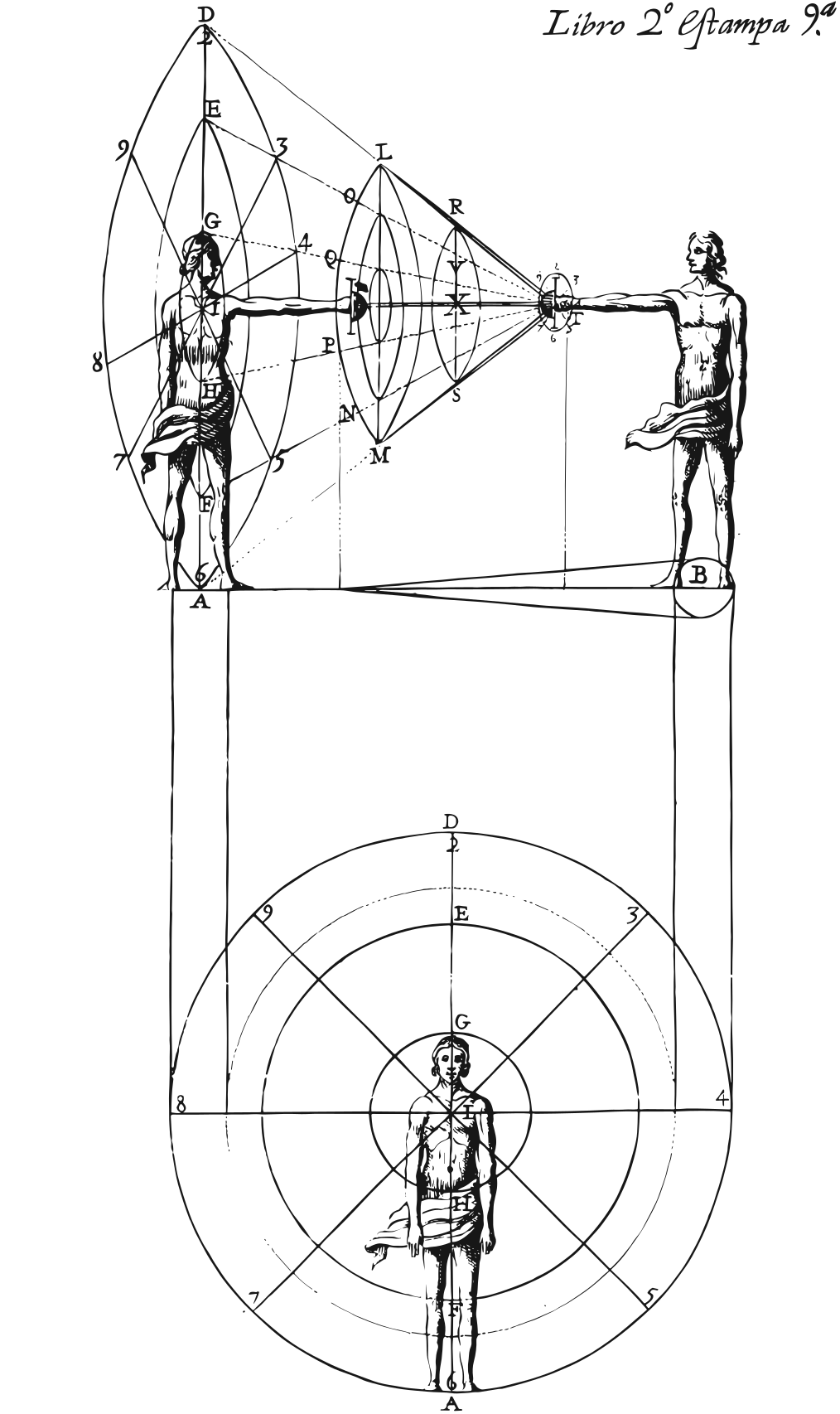
Now that we have explained the movements that are made through planes, we will now deal with the circular movements that the Sword can make. The first is the one it makes around its own center, in imitation of the one made by the body around its own, forming a circle with both quillons of the Sword, which we will also divide into eight equal parts, in conformity with how we have divided the others.
Another circular movement can be described with the guard of the Sword, when the opponent with the left hand grasps the tip of the Fencer's Sword, or when the latter strikes a thrust from the remote end at the center of the opponent's right arm, and in order not to come out to the middle of proportion, the opponent attempts to strike him, and the Fencer defends himself by applying his guard, considering for this two vertices, one at the tip of the Sword, whose axis is the straight line to the guard; the other, the center of the arm, and the axis, its length up to the same center of the guard, which is with which the base of this circular movement is described.
Another circular movement, and the largest that the Sword can make, is through the circumference of this large circle, which we consider between the two combatants, causing the Sword with the arm to form a conical pyramid, according to the definition of Apollonius of Perga, with its base being this circle, and the vertex the center of the arm, noting that at the time it is revolving, the Sword will pass through each of the divisions of the circle, and dividing the surface of the Pyramid into eight equal parts, causing with these divisions lines that take the name of the divisions, such as 2, 3, 4, etc., up to 8, 9.
This same circle can be imagined as placed on some plane of those considered in the opponent perpendicular to the first vertical plane, as shown in the second figure of this ninth plate; and in this case, with the arm at a right angle, the Sword can incline through the lower part until, if it were longer, it could touch the lower circumference, which is at point A. And being in this inclination, it will form its movement, or Pyramid, with the center of the wrist being the vertex: but as the tip of the Sword only reaches up to the wrist of its opponent, it will form there a smaller circle, as seen in the figure, and indicated by the letters L.K.M, and the middle division of the Sword will form another, as seen by the letters R.S. This second Pyramid, which is made with the defensive strength of the Castle, which we have to consider defending the Fencer, can be seen by the same demonstration of these Pyramids, that if there were a shield placed between the two combatants, of the size that is the circle R.S., with both combatants standing at a right angle, it is recognized that it would cover the whole body, if the Sword were of the length of T.A. And when this Pyramid is not sufficient to defend ourselves, as the vertex of this Pyramid can move to various parts, and not always have to maintain the posture of a right angle, I show that the Fencer with a portion of this Pyramid, can force the opponent to have his Sword out of two or three planes of defense, which are the ones that constitute the bastion that always guards this Fortress, if the Fencer is not careless in the opposition of the part of the Pyramid that is appropriate.
Within this Pyramid, two others can be considered: so, the inner, and smaller one we will call the first, and it has about two and a half feet in diameter its base, considered in the body of the opponent; but at the tip of the Sword a little more than one foot, and in the defense, which is made with the middle division of the Sword about half a foot, and will pass through the head, and the waist of the opponent: the second passes through the knees, and the third corresponds to the feet, as everything is demonstrated by the figures, both by the upper one, which is in perspective, and the lower one, which is in plain view.
The three planes of defense, which we have mentioned, that serve as a bastion to the Fencer, are two of them vertical, or perpendicular to the Horizon, touching the cylinder of the Fencer, converging at the guard of the opponent, and the third is an oblique plane that passes through the guard, and touches the head of the Fencer: these three planes are of great use in the Skill, because the defense of the Fencer consists of nothing else but in keeping the Sword of the opponent out of these three planes, as I have already noted elsewhere, and will demonstrate when I manifest the way the Fencer will have in forming the Angles of the bastions of the idea of the Fortress.