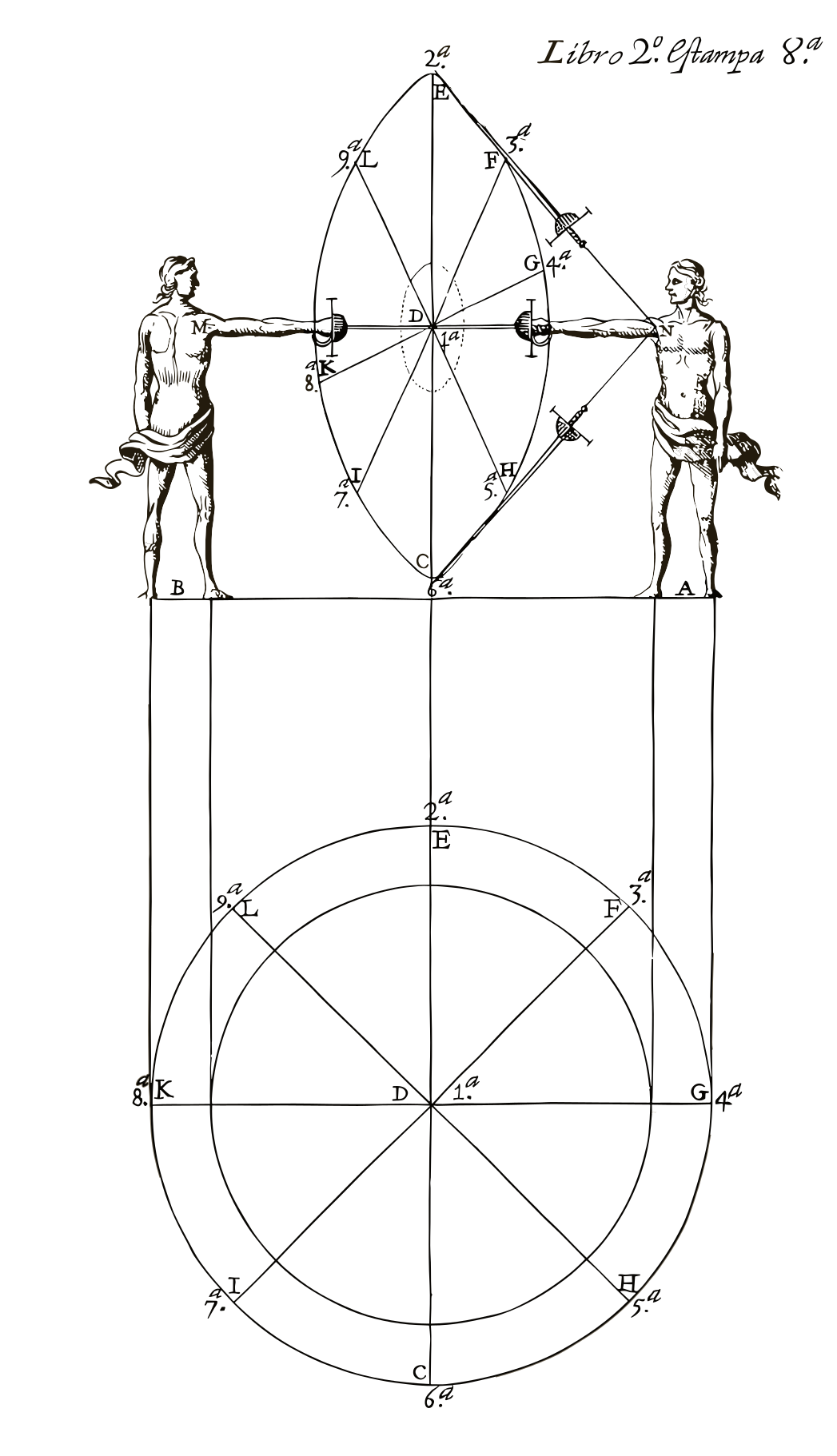
Although what has been said so far about these planes seemed sufficient to regulate the movements of both the arm and the Sword; nonetheless, I have deemed it appropriate to add another speculation, which will not seem of lesser utility than the aforementioned, rather one with the other will greatly facilitate this work.
Sailors, for the governance and good direction of their Ships on the Seas, not only rely on the courses set parallel to the Horizon, but they also use an instrument which they incline between their sight and the Pole, to observe the movement of the Stars near the Poles, to know through this observation the height and position in which they find themselves: they do the same for the movement of the Moon, considering it parallel to the equinoctial circle, to know in the middle of the Sea the directions the waters flow in the crescents and wanes of each day; and all this has been done by Geographers to avoid the multiplication of instruments, so as not to burden them with different uses, imaginations, or rules.
We must do the same, using to observe the movement, place, or position of the Sword of the Fencer or his adversary, imagining in the middle of the two combatants, a circle perpendicular to the Horizon; and in the way that the particular circle, which is considered in the lower plane, is divided into eight courses or paths, to govern the movements or compasses of the Fencer on the ground; this circle will also be divided into eight equal parts, to regulate the movement of the Sword in the Air.
The parts into which this circle is divided are as many places where everything necessary for the understanding of the operations that pertain to the arm and Sword can be found, such as the types of Angles, the types of movements, and the six simple straightnesses, as well as the four types of mixed straightnesses, which are imagined in the Air, in imitation of the places we have considered on the ground or lower plane, to regulate the movements of the body. Following in these imaginings, as already mentioned, the Sailors, who not only rely on the courses to govern the movements of the Ships over the surface of the waters; but also use the same considerations and terms in the Air, to regulate the movements of the Stars: all in order for the perfection of their voyage, and to reach the port they have destined; and since in a vast sea men have been able with these imaginings to find a way to conduct themselves to any part of the World, avoiding the risks of shallows, and reefs, and other dangers; greater ease must be granted to us in the understanding and application of these same considerations in the movements of the body, which a man can make with his arm and Sword, to avoid the risks and dangers that he has with an adversary, also opposed with a Sword in hand, because with the movements of the body, which we call compasses, and motions on its center, and those of the arm and Sword, with admirable artifice, one passes to the formation and execution of all the tricks, harmonizing the upper movements with the lower ones, according to what the nature of each one demands for its greater perfection, causing the two precise effects of defense and offense: this being supposed, let us come to demonstrate the circle, explaining in it what we have offered, and it will be in the following form.
Let the Circle E.F.G.H. &c. be placed perpendicularly on the lower plane A.C.B. and let it have its semidiameter of five feet. which is the height we suppose a man of perfect stature has from the center of the right foot to the center of the right arm; so that, being affirmed on a Right Angle, and at a Right Angle with his arm, and Sword parallel to the Horizon, it passes through the center of this circle, and divides it in half; and for better clarity, we will accompany this demonstration, which is in plan view, with another that is in perspective, and the two combatants affirmed in their means of proportion in Angle, and on Right Angle, the Fencer in A.N. and the adversary in B.M. having between the two centers of the arms, and of the right feet eight feet of distance, which distance is divided in the middle at C. a straight line C.D.E. is considered perpendicular (which will coincide with the line M.N. which is considered passing through the centers of the arms of the two combatants) and will pass through the middle of the Sword of the Fencer, so that it is perfectly affirmed at Right Angle in its first Vertical plane, if it is considered on the line C.D. as a measure, described a circle so that it is perpendicular to the Horizon, in the middle of the two combatants, as represented by the figure, and perpendicular to the first vertical plane, it will be of great use to regulate the movement of the Swords of both combatants; because if the Sword of the Fencer moves from the center D. to any of the eight marked courses, it will form not only the three Right, Obtuse, and Acute Angles, but also those called movements of the Sword, both simple and mixed, and the simple and mixed straightnesses, all in this way.
Through the lines, or parts in which the circle was divided, and from the angles that have been mentioned, one comes to understand the types of simple and mixed movements that can be made. Because if from the axis D. the arm and sword rise through the primary vertical plane, which is represented with D.E., the movement that is made is called violent; and if it descends from the axis and center D. through the same primary vertical plane along the line D.C., the movement will be natural.
Thus, when the Fencer moves his arm and sword from the axis N.D., where the right angle is considered, to line F., this movement will be called a mixed movement of remiss and violent to his right side; and if through the same plane he moves the sword from the circumference and point F. to the axis D. and right angle, this movement will be a mixed movement of natural and reduction.
With this, the types of mixed movements are also explained, and with the same doctrine, the Fencer can regulate the many movements he can make of the same types from the axis to the surface of each of the four quadrants we have considered, and from the same surfaces of them to the axis; all of this is very important for the Fencer to have knowledge of the tricks he performs, and those of his opponent, which are formed by these oblique planes: noting that those formed from the upper plane, and obtuse angle, should not pass the sword from the axis of the Fencer, and from that of his opponent, to the lower plane, and acute angle, for greater perfection and safety.
Firstly, it is noted that although we have considered movements from the right angle, as has been done so far, for the universality of this science and its true understanding, it should be imagined that these movements take their beginning through the first vertical plane, which passes through the right angle and axis of this pyramid, and not only from the axis of it, because there are situations in which one can strike without depending on the right angle, as will be said in its place; thus, whenever the tip of the Fencer's sword moves away from this plane to one side or another, and moves through any plane parallel to the horizon, it will make a remiss movement; and if it is reduced by the same plane to the primary vertical, it will be a reduction movement.
By placing his sword on the line N.E, the Fencer will be in the high straightness, and by placing it on the line N.C, he will be in the low straightness, and by placing it on the line G, he will be in the straightness of the right side, and being on the line K, he will be in the straightness of the left side, and being on the line D, he will be in the straightness of the front, and by retracting the arm and sword, he will be in the straightness of the back.