Just as we have considered in the body three types of movements, which are made either on planes, or circles, or lines, or mixed surfaces; similarly, in the Sword, we consider three other types of movements: some on planes, some on circles, and others on lines or mixed surfaces. And just as the body makes some circular movements on its own center and others on different circles; likewise, in the Sword, we consider movement on its own center to regulate the position of the guard in the formation of techniques, and we consider it moving on other circumferences, some larger and others smaller. Just as we don't emphasize mixed movements for the body, we also won't dwell on the infinite curved movements the Sword can make, always following learned scholars who wrote about celestial movements. Although most planetary movements are mixed, they represent all of them through circles to make the complex and challenging easily understandable.
To explain the movements of the Sword, we need to use some terms accepted by mathematicians, rather than inventing new ones. We mimic authors who have written about weapons, who have introduced many such terms, like calling cuts vertical, horizontal, diagonal, etc. Every time the tip of the Sword moves, it will do so on a plane, or a circle, or a mixed line. To explain this more easily, we'll discuss the different possible planes. Opticians have noted these to represent all the differences in planes and lines found in the universe, and even those imagined in the heavens. They depict the movements of the Sun, the Moon, and the Firmament through lines painted on planispheres, astrolabes, or walls. And since there are no planes or lines on earth that aren't parallel to those considered in the sky, we will explain all the differences in planes or circles they've considered in the celestial sphere. This way, we can know what type of plane we're making and which it's parallel to, consequently understanding its type.
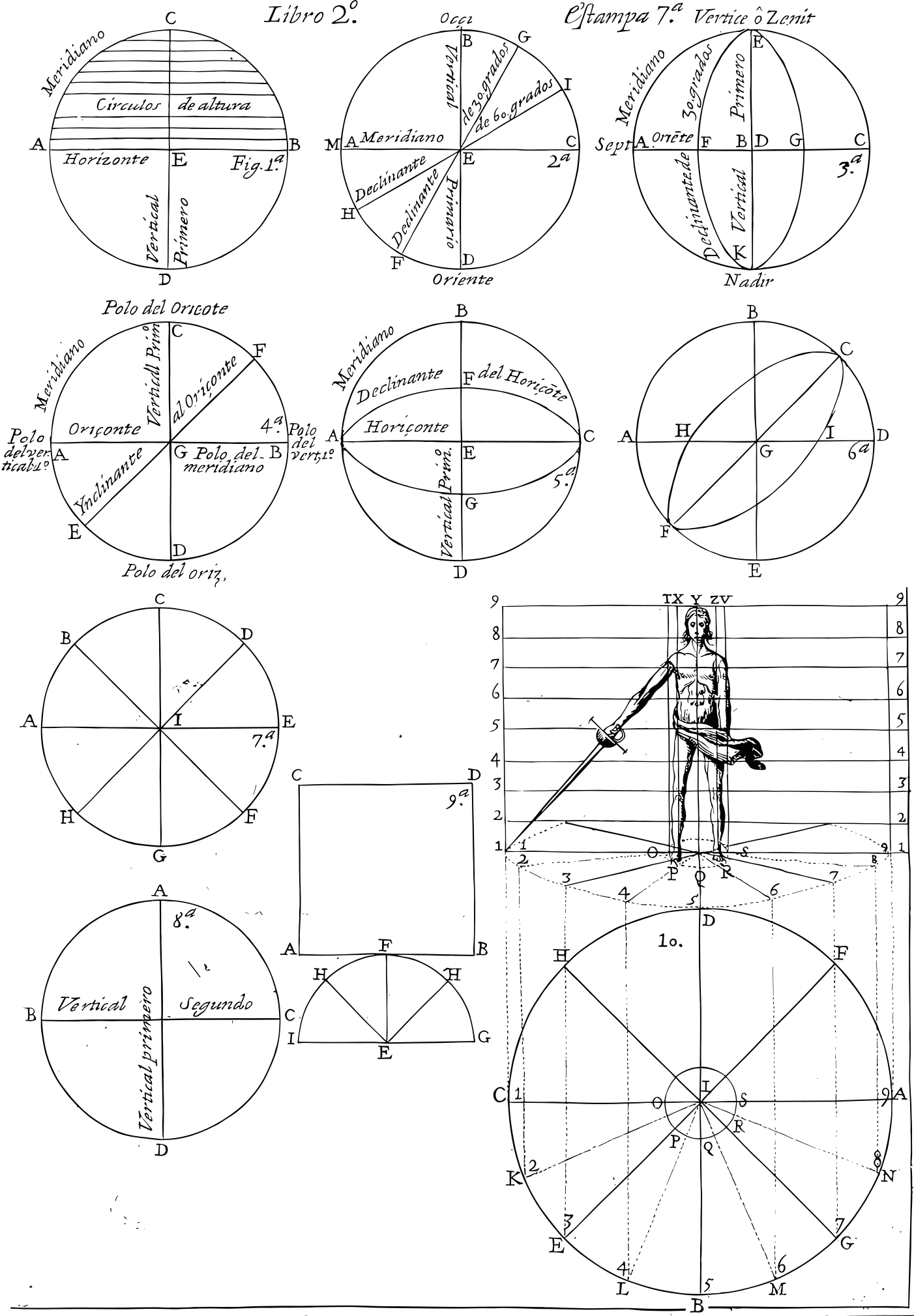
Besides the ten main circles considered in the sphere, the six major ones are: Horizon, Meridian, Equatorial, Zodiac, and the two Colures, Arctic and Antarctic. Beyond other circles called Hourly and Position, etc., there are circles called Verticals or Azimuths, and others of Altitude, etc. To satisfy understanding, I will present the following demonstrations, the layout of which the Swordsman will find in the seventh plate.
In the Art of Fencing, as already mentioned, a horizontal plane or one parallel to the Horizon is considered, which is the ground. To determine the position of the sword's tip or its guard, or more specifically, how far it is from the lower plane or the upper plane (a plane that passes through the centers of the arms of both combatants), some planes parallel to the Horizon are taken into account, as will be explained in due course.
Any other vertical circle between these two is called the Declining circle, and this declination is understood from the first vertical: thus, if this circle deviates by 30 degrees from the first vertical, we will say it declines by 30 degrees, or it has 30 degrees of declination from Noon, or from the North, to the East, or to the West. For example, in the second figure, A.B.C.D. is the Horizon, where A. is the noon point, B. is the West, C. is the North, and D. is the Horizon.
The circle represented by the straight line F.G., which also passes through the vertex E., and deviates by the arc D.F. of 30 degrees, will be called Declining by 30 degrees. The same will be true for any other circle, like the one of H.I. that declines by 60 degrees. The part facing the East, because it is seen from the North point, will be said to decline from the North-East. The other part facing the West, because it also looks at the noon point, is said to decline from Noon to the West, depending on the arc considered between it and the first vertical.
The same demonstration is presented in the third Figure, imagining the Meridian circle as a circle, the Horizon as a line, and the First Vertical as a line as well; however, the Declining circle is represented as an Ellipse. For clearer visualization, I've used the same letters in both figures. However, to explain the Nadir, I've added the letter K in the third figure.
The same is represented in the third figure, where A.C. is the Horizon, its Pole will be point E., Vertex, and the Nadir at K. The Poles of the Meridian are D.B. corresponding to its center; the Poles of the first vertical are the same A.C. The Poles of the declining circles will be on the Horizon and will deviate from the Meridian by the same amount of their declination.
In this figure, let's assume that the circle A.C.B.D is the Meridian, A.B. the Horizon, and C.D. the First Vertical. If the First Vertical, moving over the Poles of the Meridian that corresponds to point G, and if the line C.D. were to incline with point C. moving from C. through C.B. to F. and point D. moving along the circumference D.A. to E., this circle would be called Inclining to the Horizon, by as many degrees as the arc B.F. represents.
If the Meridian were to move over the Poles A.C. of the First Vertical and were to incline towards the Horizon, or if the Horizon were to move over the same points A. and C., it would come to represent some circle, such as A.F.C.G. Even though it is inclined towards the Horizon, to differentiate it from the previous one, it is called Declining to the Horizon.
We have already stated that the movement of the tip of the Sword can be considered as moving across the surface of a Sphere. For this reason, it can be called Spherical. If the circle A.B.C.D. &c., formed with the Sword, when the Fencer stands firmly in position I at right angles, were to revolve around its center, or were considered to move around its Diameter A.D. or C.G, it would create a globe, as already defined in the Definition of the globe. This globe would precisely be called the globe of the Sword, and its jurisdiction because it is formed from the particular circle of the Sword. In this globe, we can consider the same seven distinctions of planes, through which the Sword can move for the formation of any technique.
The second will be the circle represented by the straight line C.G. Since it passes through the vertex I, the Pole of the Horizon and Zenith, and is considered to pass through the center of the opponent's right arm, it will be called the First Vertical. This plane with the Sword will be caused upwards or downwards, creating in that plane the three Angles, called Right Angle, Obtuse, and Acute, or the three postures or alignments, named Forward or Front, High, and Low.
The circle represented by the line A.E., which in the celestial globe would be the Meridian, here we will call it the Second Vertical. This plane can always be caused when the Fencer raises his arm perpendicular and moves his Sword to one side and then the other. This movement will rarely happen, but another movement with the Sword alone, placing it perpendicular and the arm straight can be formed. Although this circle, passing through the center of the arm, is seldom used, another circle, passing through the wrist and parallel to it, can be understood as the Second Vertical. If not this, another circle, passing through the middle of the Sword and dividing the common circle in half, will serve as this and will be very useful to regulate the movements or position of the Sword in any of its alignments or postures, as an example.
If the circle A.B.C.D. were the common circle, considered between the two combatants, with the Fencer at D. and his opponent at A., the circle or plane that passes through A.D. would be the First Vertical plane; and the one passing through B.C. would be what we call the Second Vertical, which will be infinitely useful for the formation of Pyramids and to consider the position of the sword, both of the Diestro and his opponent.
The circles or planes that, passing through the Vertex I., deviate from the First Vertical, such as D.H. and B.F. in the previous figure, will be called Right Declining or Left Declining, depending on the direction of the decline. They will form every time the Diestro, having moved his sword away from the First Vertical plane, such as from I.C. to I.D., raises it upwards or lowers it downwards, creating in this plane the three angles: Right, Obtuse, or Acute, or the three positions they call high and to one side, low and to one side. The movements made by these planes are called violent to go up and natural to go down. The same understanding applies to the planes that can be formed on the left hand.
The plane called Inclining to the Horizon will form every time the Diestro is positioned at a right angle in his First Vertical plane and moves his sword to the Acute or Obtuse angle of one of the declining planes. For example, being on I.C. at a right angle, if one moves to the plane I.D., not with a horizontal movement but oblique to the high posture of the line or Plane I.D., the created plane will be inclined to the Horizon. If from there one returns and moves to the low posture of the plane I.B., it will also be through the same plane inclining to the Horizon. However, this movement is made to form the cuts called Diagonals. So, I do not intend to change the accepted terms, but only to make clear that there isn't a movement that cannot be regulated and adjusted with the sword if we pay attention to it. Because any movement made with the sword must necessarily be through one of these seven planes. If we understand them well, we will be able to recognize the nature of any movement that composes any tactical move.
The Declining Planes from the Horizon will be formed every time that, with the Diestro positioned at an acute angle in his First Vertical plane, he moves his sword to the acute angle or low posture of some declining plane, to the other side. This movement is sometimes used to strike at the shins or to form other variations of tactics, as we will see in due course.
This is what I have deemed appropriate to say for now about the different planes that can be created with the sword. Although at present this may seem somewhat confusing and unclear, the Diestro will later see the clarity and distinction that the use of these concepts will provide in both the theoretical and practical aspects of the art of fencing.
The optical artists have also identified seven different planes and lines to represent on a canvas, through perspective, all visible things, especially architectural structures. Even though there's some variation compared to those considered in the Celestial Sphere, these lines and planes can be compared with the canvas they are to be represented on. Let's explain with an example:
If the declining line E.H. were to rise as mentioned, it would be called both Declining and Inclining simultaneously. All these three different lines are oblique to the horizon. And the line perpendicular to the horizon is called Erect. Thus, we have these seven different lines. When applied to the sword, they are considered in the following manner:
Whenever holding the sword at an acute or obtuse angle, if he moves it away from the initial vertical plane and takes it to one or another declining plane, it will be called "Declining and Inclining simultaneously". And every time, if he inclines it while it's adverse, it will be called "Declining from the Horizon." And if he raises it so high that it's perpendicular to the horizon, it will be called "Upright".
Everything that has been said about the lines will be understood about the planes because as the planes are considered contained by lines, according to the nature of the lines by which they are understood, they will take their name: so, if a plane is contained by direct lines, it will be called "Direct"; if by declining lines, it will be called "Declining"; if by inclining ones, it will be "Inclining"; and the same for the others.
What has been said so far about the lines that can be considered in the sword must be attended to in the lines that are considered in the arm's line, and each of its parts, because to specify the position, both of the entire arm and of the part that is between its center and the blood groove, as well as the remaining part between the blood groove and the wrist, we must consider the same differences in lines.
But as it is difficult to regulate the declination and the very different inclination that these parts can have, I have found it more appropriate to use the same method that astronomers use to mark the place of some star or comet in the sky; that is, by means of some vertical circles and others horizontal, because if once we determine the position of the sword tip, that is, in which declining or vertical plane it is, and then there's a way to determine its height in that plane, and we would do the same for the pommel, we won't lack the knowledge of the true position of the entire sword.
Let the individual sphere of the fencer be A.B.C.D., or the larger one, and let A.C. represent the right and left vertical plane, or the plane that passes through both the right and left verticals, and B.D. the one that represents the plane that passes through the vertical of the chest and back. Divide the fourth C.B. and B.A. into equal parts with the lines E.F.G.H. and these will be the planes corresponding to the collaterals, as already mentioned. Divide each arc into two equal parts at K.L.M.N. and draw lines from the center: these lines will represent the vertical planes that we need to regulate the movement of the sword, in relation to how much it deviates from the first vertical plane; and for easier understanding, we will call the plane corresponding to the right vertical represented by the line I.C. as "First" and the one immediately following it, represented by I.K., as "Second". The plane I.E. between the right collateral and the chest vertical will be called "Fourth". The vertical of the chest will be called "Fifth": and so on for the rest up to the left vertical plane I.A., which is the 9th.
If these lines rise with the entire circle upwards to the level of the head, they will not only mark the vertical planes that we need to consider, but will also display and mark the main vertical lines and their intermediates on the surface of the fencer's body, as seen in the figure, where the line C.A. representing the right and left vertical plane, forms with its movement on the surface of the cylinder, which represents the fencer, the lines O.T. for the right vertical and S.V. for the left vertical.
The collateral planes E.F.G.H. create the two lines P.X. for the right collateral and R.S. for the left collateral. And the chest's diametrical B.D. causes the chest's vertical, or Diametrical Q.Y., as seen in the same figure; and the intermediate dotted lines cause their intermediate lines to the verticals and collaterals.
For the consideration of the planes parallel to the horizon, we've imagined that as the circle of the lower plane A.B.C.D. rises parallel to the horizon, it leaves its traces in certain places, as represented by the lines that are drawn parallel to the line 1.9. of the lower plane; and this is done for clarity, and I've imagined another nine planes, including the lower plane: and this is to consider the height at which the sword's tip will be from the lower plane, and we are grading it in this manner.
The first will be the lower plane, or the ground on which the fencer stands. The second will pass through the midpoint between the lower plane and the knees. The third through the knees. The fourth between the knees and the waist. The fifth at the waist. The sixth between the waist and the centers of the arms. The seventh through the centers of the arms. The eighth through the mouth or nose. The ninth at the top of the head.
Curious readers will note that to determine the fixed position of the sword's tip, it is not enough to just mark the vertical and horizontal plane where it is located. Astronomers do this to determine the position of the fixed stars, all of which are considered in the Firmament. However, these two circles are insufficient to determine the true position of the planets, which are in other lower heavens. To do so, it's necessary to know the distance, which is found by measuring Parallax, or the difference in appearance. To precisely determine the position of the sword's tip, hilt, or elbow, it is necessary to determine the distance of each of these points to the direction line, considered to pass through the middle of the cylinder in which the fencer is considered. This is easy but not necessary because the elbow already has its determined length from its center. If we determine its horizontal plane, it can only be one, and thus it will serve as a common place for that point. If, in addition to this, we determine its vertical plane, it will also be common, and it cannot be in different verticals at the same time. Therefore, at the intersection of these two planes, which will be a straight line, the center of the elbow must be located. The location along this line will be determined by the arm's length from the center to the elbow or the "sangria".
Having determined the elbow's point, the same can be done for the center of the guard, thus precisely knowing its place and position for the same reason. These are the three things required: the intersection of the two horizontal and vertical planes, and the determined place on that line, knowing the distance from the elbow to the wrist. Once this is determined and the elbow's location is known, the wrist's location will be known through a circle formed by the length from the elbow to the wrist.
The same logic follows to determine the position of the sword's tip. However, since the sword can rise much higher than the head, we can imagine another four planes above the mentioned ones, each one foot apart from its lower counterpart, totaling four feet, which is the maximum height the sword's tip can reach in the formation of tactics. Thus, with these planes, there will be no position or straightness, both of the arm and of the sword, that cannot be explained to be able to declare with specificity the perfect formation of tactics, both in their beginning, middle, and end.