Euclid, in book 5, Defin. 6. of his Elements, says that proportion is a similarity of ratios; and in Defin. 3. of the same book, he says that a ratio is the relationship one quantity has with another, as to how it is equal, greater, or lesser than it. Even though, according to this definition, there cannot be a proportion among less than three quantities, the terms ratio and proportion are still often conflated, contrary to Euclid's intent or purpose. Authors call it the means of proportion to the distance chosen by the two combatants because this distance is proportional to the weapons they use for fighting.
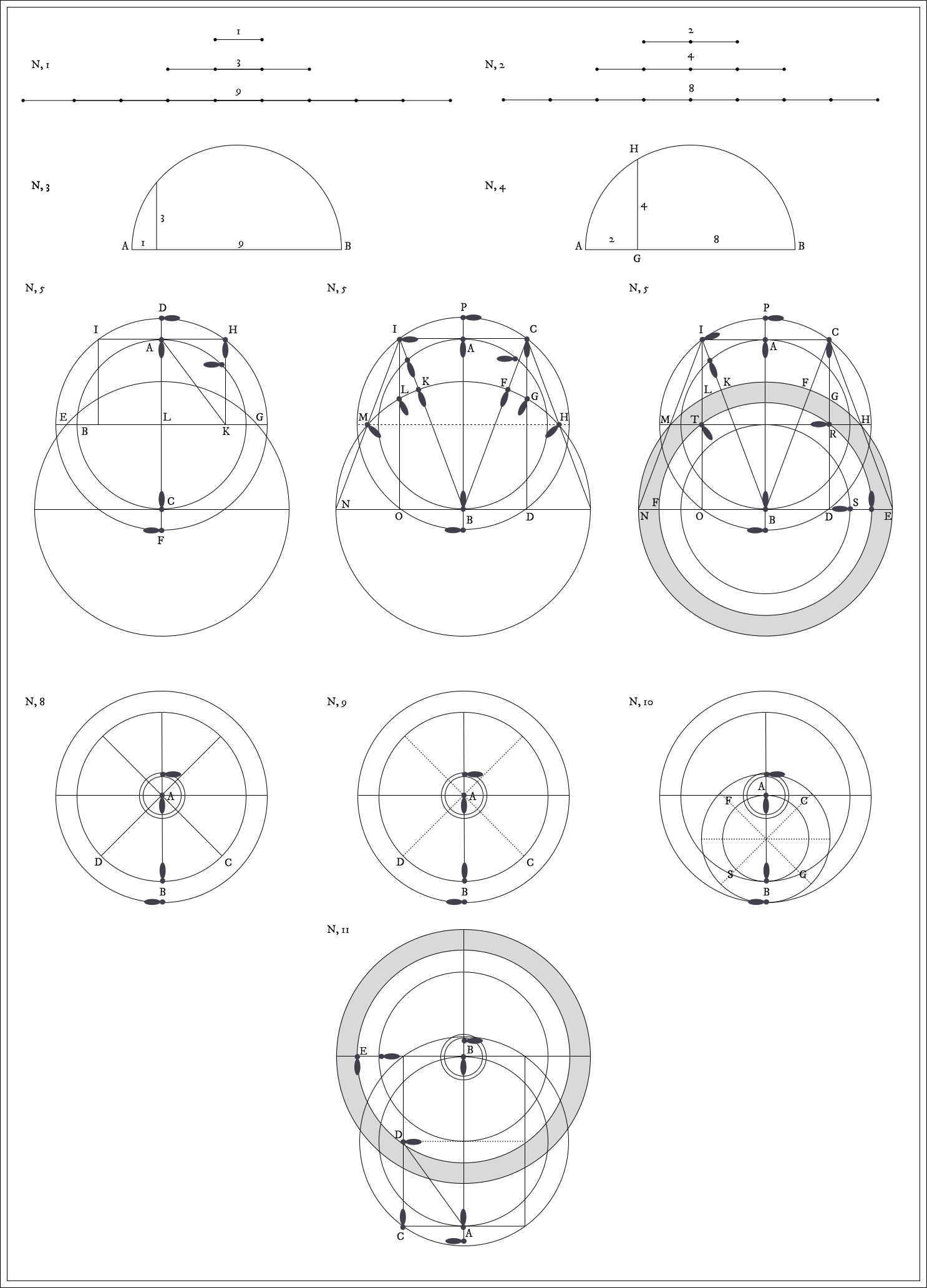
Euclid refers to a mean proportional when among three quantities the same proportion is found from the first to the second, as from the second to the third. The one that lies between the two extremes is called the mean proportional. For example, with the numbers 9, 3, 1 of the first figure, 3 will be the mean proportional between 9 and 1 because there is the same proportion from 9 to 3 as from 3 to 1. The same understanding applies to the numbers 8, 4, 2 from the second figure, where 4 is the mean proportional between 8 and 2.
In the circle, or semicircle, there exists a unique property: whenever a perpendicular is raised from any point on the diameter and terminates on the circumference, it will always be the mean proportional between the segments of the diameter. For example, in the semicircle A.D.B. indicated by the third figure, if the perpendicular C.D. is raised from point C, it will be the mean proportional between A.C. and C.B. This can be inferred from the corollary of proposition 8 in book 6 of Euclid's Elements. One can empirically test this, finding that if A.C. is 1 and C.B. is 9, then C.D. will measure 3.
Let the circle A.B.C. have a diameter of eight feet, which is what we call common, where the two combatants stand with their right feet; and let the other external circle of the left feet be D.E.F. with a diameter of 10 feet. Draw a tangent I.A.H. from point A to the inner circle, which will be perpendicular to the diameter D.F., according to proposition 16 of book 3 by Euclid. Based on the aforementioned reason, it will serve as the mean proportional between the line D.A., which is one foot, and the line A.F., which is nine feet. The same will apply to the line H.K., perpendicular to the other diameter G.E. that is 10 feet. The line K.E. is eight feet, K.G. is two feet, and the mean K.H. will be four feet, being equal to and parallel to the radius of the common circle A.L., as can be verified in figure number 5.
And because at point A is the mean proportional, and at point K is the proportional mean for the atajo, as will be shown in its place, with our proportional mean being at H, it can be seen that all three means are located at the angles of a right triangle, whose base opposite the right angle is A.K., measuring five feet. Due to such a large distance of five feet, especially with the left foot positioned at D, it seems nearly impossible to take such a large step, which is almost six feet, to move from the mean proportional to the proportional mean. This is the reason that has prompted us to search for a mean between these two extremes, arranged in such a way that what cannot be achieved with one step can be easily and safely accomplished with two, as anyone can verify by drawing a figure on the ground in the required manner, to practice the necessary exercises to easily find these means, both in proportion, and in proportionals and proportionates.
Take note that, in addition to the absolute necessity of understanding this mean, it offers a great ease to transition from it and choose all the proportional means for all the maneuvers. Although many may appear evident, we have nevertheless reduced them to a total of nine so as not to deviate from what our predecessors have left us. Our intention is to simplify this subject, not obscure it, as will be explained in these two diagrams, numbers 6 and 7. Thus, the six means presented in diagram number 6 are from the distant end and are located on the circumference of the Sphere of the Sword. They lie along the sides of two isosceles triangles and their perpendiculars, specifically, at the intersections of these straight lines with this circle and are used for thrusts.
Two of them, present in diagram number 7, are used for cuts, reversals, half-cuts, and half-reversals. They are located at the intersections of the perpendiculars of these triangles and the fifth Sphere of the opponent's Sword, and are also useful for the most powerful bind. The ninth, also present in number 7, is for concluding movements and is situated in the opponent's fourth Sphere and on its tangent from the common inner circle. To better illustrate all of this, the diagrams will be explained in the following manner.
Draw the lines C.E. C.D. C.B., and the isosceles triangle C.B.E. will be formed, with its base B.E., its perpendicular C.D., and its vertex C, which is our proportional mean. We also consider another isosceles triangle on the other side of the Diameter I.N.B., with its base N.B. also of 6 feet, its perpendicular I.O of 8 feet, being equal to the Diameter A.B. Each side and perpendicular represent a path from the means of proportion to the proportional means, and these means are determined, that is to say, those of the distant end in F.G.H. by the jurisdiction of the opponent's arm, and in K.L.M. by the jurisdiction of the body.
Also, the mean at point F. is useful for the general constriction by the same jurisdiction. And point G. for cross line. Point K. from the other triangle of the jurisdiction of the body, serves for the general constriction by this jurisdiction. Point L. serves for the cross line. And point M. serves for the two general moves, below and above strength.
Let the fencer note that even though we have identified these proportional means, we do not intend to suggest that merely positioning oneself in these positions is sufficient to attack the opponent without other considerations. If the fencer doesn't apply their defensive pyramids at the same time, they would have achieved nothing. For instance, in the siege of a castle or fortress, little would it matter to have a breach open for assaulting the place if the offenses from inside the fortress are not neutralized. Similarly, it would matter little to a fencer to have chosen these means if they do not hinder their opponent and remove the threat, always covering themselves and forcing the opponent to point their sword away from their body. This will be further clarified when we delve into atajos
From this, it follows that the proportional mean should not be understood merely as the position we indicate for each technique, but rather when, along with the body's movement, both straight and circular, the sword's movement also aligns, preventing any potential threat from the opponent, from the moment one moves away from the proportional mean until one is able to attack the adversary without receiving harm. Otherwise, this distance would be termed common to both. Hence, we will need to explain all the movements that serve to set these impediments, which we will call atajos, even though interception and impediment are the same thing in their common sense. Simultaneously, we will address the potential attacks from each of these positions to offend the adversary.
However, before delving into these, it would be best to first conclude with all the movements that concern the body in the lower plane, due to the significant correlation between the movements of the lower plane and those of the upper or intermediate plane, through which the sword must move. As we have already discussed the straight body movements, which are the straight and transverse steps, etc., that are made along those eight lines we call directions, we now need to address the body's circular movements, performed in three different circles.
The first circular movement is made within its first particular circle, which is the first of those that make up its Orbs, and is performed without moving the center of the heel of the right or left foot, forming with the tip of the same foot a circle, as seen in this figure num 8. This movement is called motion about the center, and this movement serves to oppose the steps or movements that the opponent might make around the circumference of the maximum Orb, as seen in the same figure. When the opponent is at B, and moves around the circumference B.C. to C, the swordsman, to oppose him, will move the tip of the foot in A.C. The same will be for A.D.
The second circular movement that the swordsman can make is around the opponent's maximum Orb, which is the Orb of the means of proportion, and is called curved step because it's taken along the circumference of a circle. This step is used to seek an advantage over the opponent, if they neglect to make the proper opposition with the motion about the center. So, if the swordsman, being on the circumference of the maximum Orb, takes a curved step from B. to point C. by the profile of the body, or to point D. by the posture of the Sword, and their opponent, who we assume is at point A. in this figure num 9, doesn't make a motion corresponding to those lines, the swordsman will have gained an advantage for all the propositions of our Fencing.
The third circular movement is the one the swordsman will make through the common Orb, which is considered between the two combatants, as seen in figure num. 10. Where the swordsman is at A. and his adversary at B. If he takes a curved step around the common circle from B. to S., he can take his from A. to C., ensuring he always remains in the middle of proportion.
Another step is called mixed, and transversal and curved. This is because part of this step or movement is made in a straight line, and part is made along the circumference of a circle, which is the opponent's fifth, as seen in this figure. Here, the swordsman is at A. and his opponent at B. If the swordsman takes a transversal step along line A.D. from the middle of proportion A. to the proportioned middle D. for the atajo, and without setting the left foot next to the right, goes on to position himself on the opponent's tangent; and having set it, he will move the right foot to point E. along the circumference D.E., positioning the heel's center on the tangent, and with the foot's length, he will occupy part of the circumference of Orb 5, as shown in the figure.
The same will occur if the swordsman goes to make this concluding movement from the proportional middle C. because the step he takes from C.D. will be transversal, and the remainder from D.E. will be curved. Therefore, this step, or movement made with the right foot along the straight and circular line, will be called mixed transversal and curved for the concluding movement. This will be done much more easily and safely from the proportional middle C. than from the middle of proportion A., as we will demonstrate in its place.